Whether Early Bull Terriers Looked Like Today’s
Early Bull Terriers did not have the smoothly curved, egg-shaped heads familiar today. The breed developed gradually from earlier bull-and-terrier dogs, and old photographs can make the differences hard to judge. This guide explains what those early dogs looked like, how breeders shaped the modern Bull Terrier, and why the transformation was more gradual than a simple before-and-after comparison suggests.
What early Bull Terriers looked like
They were less uniform than modern Bull Terriers
The first dogs called Bull Terriers came from a working-dog tradition rather than a breed with a settled, consistent appearance. In the early nineteenth century, bull-and-terrier dogs varied in size, color, head shape, and build. The name described a type of dog with a combination of bulldog and terrier ancestry, not a single, tightly defined look.
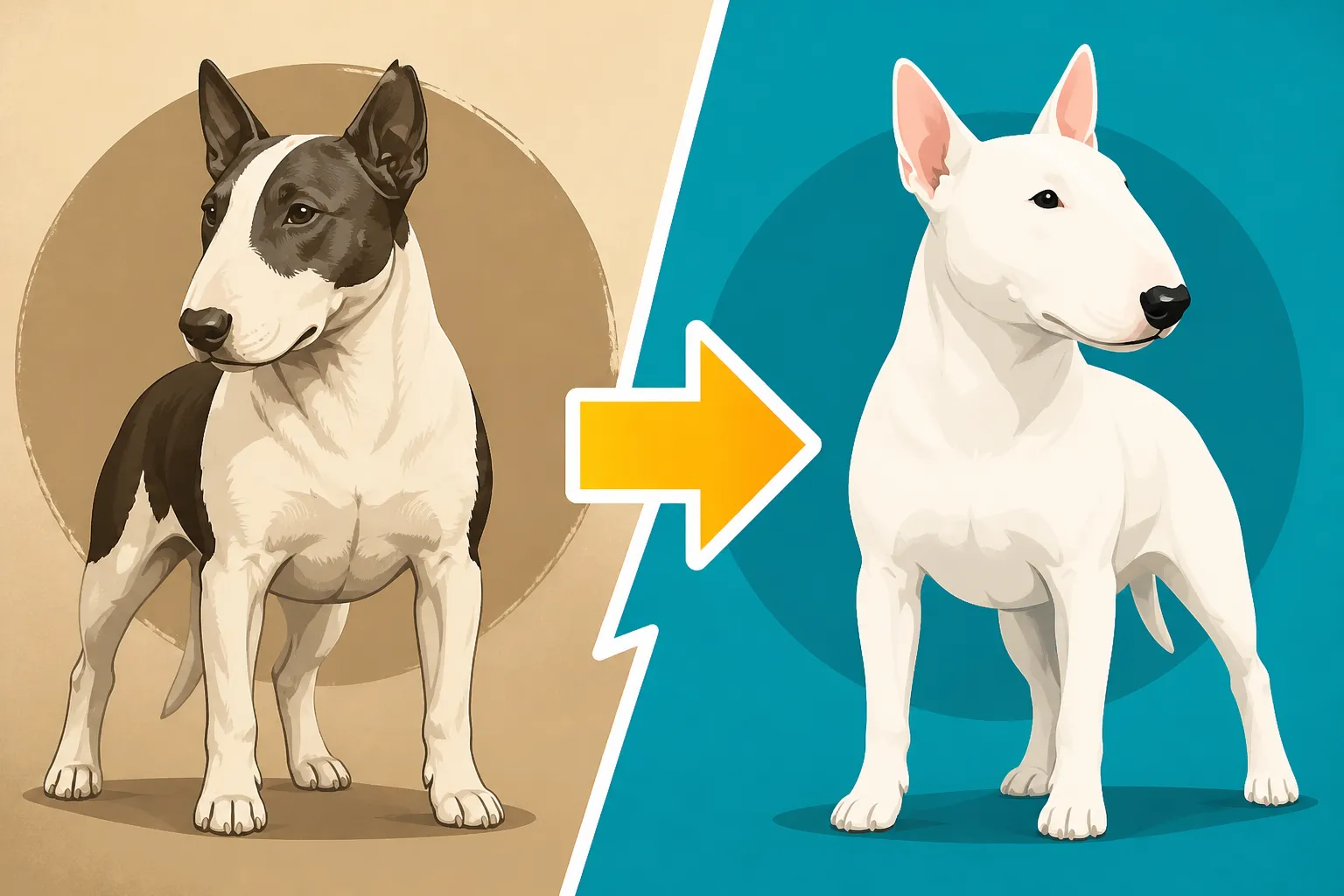
That variation matters when you look for images of the earliest Bull Terriers. A dog in an old painting or photograph might have a narrower head, a more visible stop between the forehead and muzzle, or a shorter, less curved profile than a present-day show dog. Another early dog could look quite different. There was no single early appearance that every breeder was trying to reproduce.
Some early Bull Terriers were more plainly terrier-like than the breed many people recognize now. They could have a lighter build and a less pronounced curve to the face. Their ears and overall proportions also differed from dog to dog. A modern owner used to seeing the breed’s distinctive profile may not immediately identify every historical example as a Bull Terrier.
This earlier variety connects to the breed’s origins. For more background on that foundation, see Which Breeds Went Into the Bull Terrier and What the Bull and Terrier Was. The important point is that early Bull Terriers were part of a changing family of dogs, not a finished version of today’s breed.
Early photographs can be misleading
Comparing an old photograph with a modern portrait sounds straightforward, but the comparison has limits. Early cameras and photographic processes could make details difficult to see. A dog might be photographed from an angle that hides the curve of its profile, or the quality of the image might blur the line between forehead and muzzle.
Pose matters, too. A dog standing with its head turned slightly away can appear to have a different muzzle or skull shape from one shown in a clear side profile. Modern breed portraits are often deliberately composed to show the dog’s outline, while historical images may have been made for a different purpose or under less controlled conditions.
Even the way a dog is presented can affect how its proportions look. A low camera angle may make the head appear larger; a raised head can change the visible line of the muzzle. Clothing, collars, cropping, and old print reproduction can obscure features. So one image rarely proves that an entire generation of Bull Terriers looked a particular way.
When comparing images, look for several examples from different periods rather than relying on one famous dog. Notice the head profile, the length of the muzzle, the body proportions, and the set of the ears—but treat each feature as one clue, not a definitive measurement.
How the Bull Terrier changed into the modern type
Breeders shaped the breed over generations
James Hinks is closely associated with the development of the Bull Terrier as a more recognizable breed type. In the nineteenth century, breeders worked toward dogs with a more consistent appearance, and Hinks became known for the white Bull Terrier. The breed’s development was not a single event in which one person suddenly created the modern dog. It was a gradual process involving breeding choices, changing preferences, and the refinement of a type over time.
As breeders selected dogs for particular traits, the appearance of the breed shifted. The aim was to establish a more unified outline and a distinctive head, rather than preserve every feature found in the earlier bull-and-terrier dogs. Breeding decisions across generations can change a population’s average appearance, but they do not make every dog identical. Individual variation remained, and it remains today.
It can help to think of the change as a gradual narrowing of possibilities. Early dogs could vary widely, while later generations increasingly reflected a recognizable breed ideal. A dog bred toward that ideal might have a longer, more smoothly sloping profile than its ancestors, while another dog from the same broad period could retain a more conventional-looking head.
For a closer look at the people and history behind this shift, read Who James Hinks Was and How Long It Took to Fix the Bull Terrier Type. These topics help put the visual change into context: the modern Bull Terrier was developed over time, not simply copied from one original dog.
The egg-shaped head emerged gradually
The modern Bull Terrier’s egg-shaped head is its most recognizable feature, but it was not fully established in the earliest dogs. Early examples generally show a more noticeable transition from forehead to muzzle. In today’s breed, the profile is typically more continuous, with a downward curve that contributes to the familiar “downface.”
That does not mean every modern Bull Terrier has the same head or that every historic dog had a sharply defined stop. Head shape varies among individual dogs, and the quality of old images makes fine distinctions difficult. The broad comparison is more dependable: the smooth, strongly curved profile became a more defining feature as the breed developed.
The head did not change in isolation. The overall balance of the dog matters too. A modern Bull Terrier’s body, neck, chest, and outline contribute to the impression of a compact, powerful dog with a distinctive profile. Looking only at the head can make the historical transformation seem more dramatic—or simpler—than it really was.
The breed’s unusual skull is often discussed as if it appeared all at once. For more detail, explore When the Bull Terrier's Egg Head Appeared and What a Bull Terrier's Downface Is. They help explain the difference between the gradual history of the feature and the instantly recognizable shape people associate with the breed today.
Comparing early and modern Bull Terriers
What changed and what stayed recognizable
The table below gives a broad comparison. It is a guide to general trends, not a checklist that every dog from every era will match.
| Feature | Many early examples | Modern Bull Terrier type |
|---|---|---|
| Head profile | More variation, often with a clearer transition between forehead and muzzle | More continuous profile with the characteristic downface |
| Overall consistency | Greater variation in shape, size, and appearance | More standardized breed outline |
| Build | Could appear more lightly built or terrier-like | Typically presents as muscular and strongly built |
| Breed identity | Part of a broader bull-and-terrier tradition | A distinct breed with a recognizable standard |
| Appearance across individuals | Wide differences from dog to dog | Still varies, but within a more established type |
Some traits connect the old dogs to the modern breed. The Bull Terrier’s athletic, sturdy impression and terrier character did not vanish as the head changed. Nor did the breed’s identity come from its profile alone. The combination of body, movement, expression, and temperament helped distinguish it.
The breed’s coloring also changed in its own way. Early development is strongly associated with white Bull Terriers, while colored dogs became part of the breed later. That history is separate from the head’s evolution, though it is another reminder that the modern breed was shaped over time. See Why Hinks Wanted an All White Dog and When Colored Bull Terriers Were Accepted for more on that story.
Why old illustrations and modern standards do not always match
An old illustration may show an artist’s interpretation rather than a precise record of a particular dog. Painters could emphasize the features they found striking, and some images were made to tell a story rather than document a breed. Even photographs can be affected by lighting, pose, lens perspective, and the limitations of the print.
A modern breed standard is also not a historical photograph. It describes the desired type for the breed in its own context. It can help explain what breeders and judges value, but it should not be used as proof that every modern dog looks exactly alike—or that every earlier dog was far from the ideal.
There is a further complication: the word “Bull Terrier” was used during a period when dog types and names were still evolving. A historical source might use the term more broadly than a modern breed registry would. When reading a caption or account, check whether it is describing a recognizable breed, a bull-and-terrier type, or simply a dog that the writer called a Bull Terrier.
That distinction helps avoid a common misunderstanding: people sometimes assume that a dog either looked exactly like today’s breed or could not have been a Bull Terrier at all. In reality, breed development is gradual. The label, the population of dogs, and the preferred appearance all changed over time.
How to read the breed’s history with care
Separate well-supported trends from exact claims
It is reasonable to say that early Bull Terriers were more variable and that the modern breed developed a more distinctive head and outline over generations. It is harder to make precise claims about exactly when a particular feature first appeared or which individual dog represents the moment of change. Those details can be debated because the historical record is incomplete and not all sources use breed terms consistently.
Be cautious with statements that identify one dog as the undisputed first modern Bull Terrier or claim that one cross alone produced the breed’s final appearance. Breeds are populations, and their features are shaped across many generations. A dramatic, memorable story may be useful as an introduction, but it is not always a complete account of how breeding history works.
If you encounter conflicting descriptions, ask what kind of evidence each one uses. Is it a dated photograph, a contemporary written account, a later breed history, or an illustration? Does the source clearly identify the dog and its breeder? Does it distinguish a bull-and-terrier from a Bull Terrier as a more established breed? Those questions can explain why accounts differ without forcing a false certainty.
For an example of how stories and records can intersect, see What Puss the Bull Terrier Did at Cremorne. For the breed’s broader public history, When the Bull Terrier Reached America offers another useful point of comparison.
The best comparison uses several kinds of evidence
A careful comparison combines written records, photographs, illustrations, and knowledge of how the breed developed. No single source answers every question. A photograph may show a dog’s outline but not its ancestry; a written account may describe its color or reputation without giving a detailed physical description.
When viewing historical images, compare dogs from different dates and look for recurring traits rather than treating one striking portrait as typical. Then compare those recurring features with modern examples. This approach makes it easier to see the direction of change without claiming that every dog followed the same path.
It is also worth remembering that a modern Bull Terrier is not a museum replica of a nineteenth-century dog. The breed has continued to develop, and current dogs reflect generations of selection after the earliest examples. The resemblance is real, but so is the difference.
So, did early Bull Terriers look like today’s? In broad terms, they shared a place in the same developing breed tradition, but many did not have the consistent, strongly curved head profile that people recognize now. The modern appearance emerged gradually through changing breeding preferences. Once you keep that slow evolution in mind, old images become easier to interpret—and less likely to be mistaken for a simple snapshot of the breed’s entire past.
Disclaimer
This article is for general informational purposes only and does not constitute professional advice. Laws, prices and regulations vary by location and change over time. Consult a qualified professional for guidance on your specific situation.