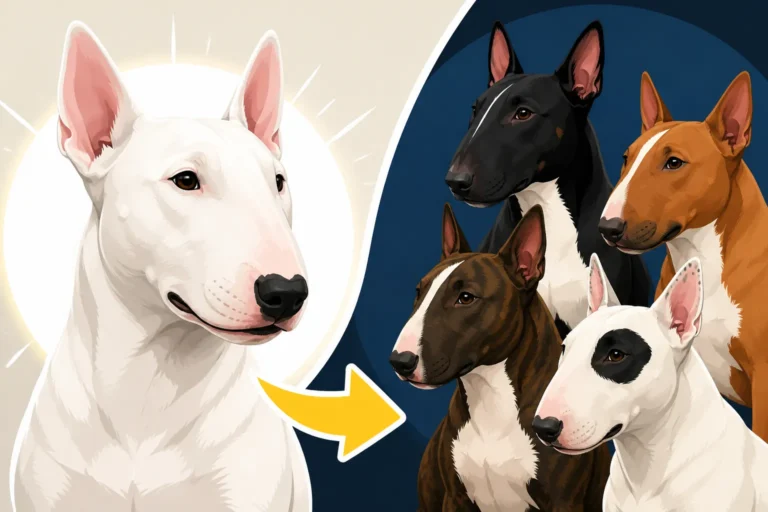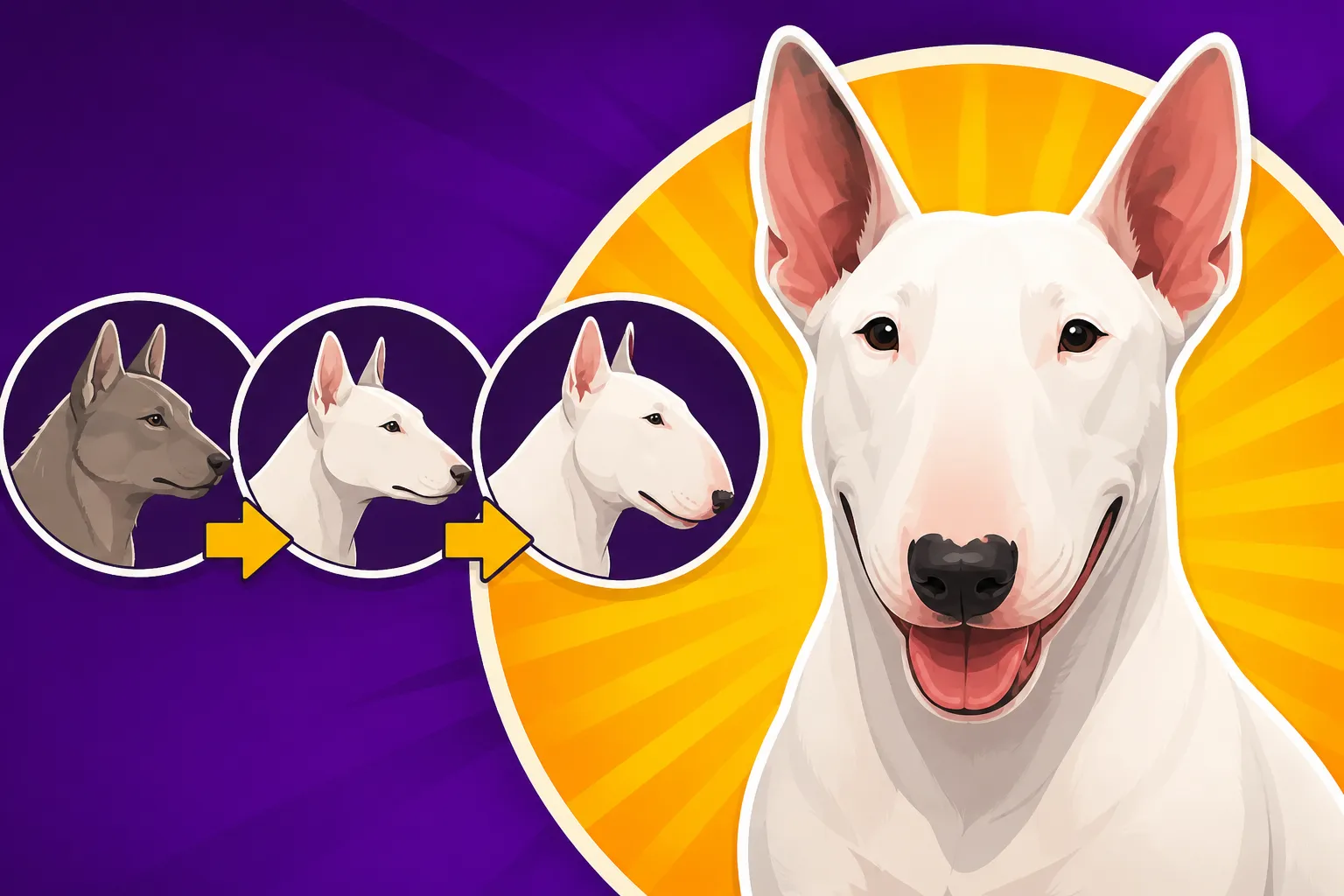
When the Bull Terrier’s Egg Head Appeared
Old photographs can make the Bull Terrier’s famous egg-shaped head seem like a feature that appeared all at once. It didn’t. The breed’s profile developed gradually through selective breeding, and there is no single year or dog that marks its arrival. This guide explains what changed, when the shift became noticeable, and why early Bull Terriers look different from those seen today.
The egg-shaped head was a gradual change
Early Bull Terriers had a different profile
The Bull Terrier’s history is often traced to James Hinks, who developed the breed in Birmingham, England, during the 19th century. The dogs associated with those early breeding efforts were not exact replicas of today’s Bull Terriers. Their heads were generally less smoothly curved, and the pronounced downward sweep of the modern profile was not yet fixed as the breed’s defining look.
That difference can be easy to miss if you have only seen modern show dogs. In old portraits and early photographs, the dogs may have a more noticeable stop—the dip between the forehead and muzzle—and a less continuous curve from skull to nose. They can still look recognizably like Bull Terriers, but the familiar “egg” outline is often less pronounced.
The change was not a sudden redesign. Breeders select dogs with traits they want to preserve, and those choices accumulate across generations. A slightly different forehead here, a longer or more curved muzzle there: over time, the head can take on a shape that looks strikingly different from its earlier form.
For more background on the breed’s beginnings, see Who James Hinks Was and Which Breeds Went Into the Bull Terrier. These histories help explain why the modern Bull Terrier is the result of development and selection, rather than a single dog appearing with the finished look.
Breeders refined the outline over generations
As breeders worked toward a more distinctive type, they selected for a head that looked increasingly continuous from the top of the skull down to the nose. The visible change came through small, repeated decisions—not a single dramatic leap. Different breeders and breeding lines could also emphasize the feature to different degrees, so the transition was not perfectly uniform.
This is why it is difficult to name an exact date when the egg-shaped head “appeared.” A breed trait can become recognizable before it is consistently present. Some dogs may show an early version of a feature while their contemporaries retain older characteristics. Only as the trait becomes more common does it start to seem like a defining part of the breed.
The shift also took place within the broader story of the Bull Terrier’s development. The breed’s appearance changed over time as breeders established a more consistent type. A useful comparison is How the Bull Terrier's Head Changed Over Time, which focuses specifically on that evolving outline, and Whether Early Bull Terriers Looked Like Today's, which puts the contrast into perspective.
Think of it less like a switch being flipped and more like a familiar design gradually coming into focus. If you compare dogs from different periods, you may notice the change in the forehead and muzzle before the full modern profile becomes unmistakable.
When the modern profile became recognizable
The change took place over decades, not in one year
The modern egg-shaped head is best understood as the outcome of a gradual shift during the breed’s development. Early Bull Terriers had a more conventional head shape, while later examples increasingly displayed the smoother, downfaced profile now associated with the breed. Historical images can show intermediate forms rather than a clean dividing line between “old” and “modern.”
That makes a precise answer to “When did the Bull Terrier’s egg head appear?” a little frustrating: there is no universally accepted year that marks its arrival. The broad development happened through generations of breeding, with the head becoming more distinctive as breeders selected for the desired shape. A particular photograph may show an early or pronounced example, but it cannot establish the exact moment a whole breed acquired the trait.
If you are comparing images, keep the date, source, and purpose of each image in mind. A formal portrait, a show photograph, and a casual snapshot may present a dog differently. Photographic quality, angle, and lighting can also make the skull look more or less curved than it would in person.
The historical context matters, too. The older English White Terrier is often mentioned in accounts of the breed’s origins, but it should not be treated as a direct, unchanged version of the modern Bull Terrier. For more context, see When the English White Terrier Died Out and What an 1870s Bull Terrier Looked Like. They can help frame the early period without suggesting that the modern head appeared fully formed at the beginning.
Standards describe a type, but do not explain its exact origin
Breed standards are useful for understanding what breeders and judges consider desirable in a Bull Terrier at a particular point in time. They describe the expected appearance, including the distinctive head shape. But a standard is not a timestamp. It records or formalizes a type; it does not necessarily tell us exactly when the trait first appeared in individual dogs.
This distinction helps explain why a written description and a historical photograph may not seem to match perfectly. The standard may describe a head that breeders were working toward, while dogs from the same broad period still varied. A feature can be part of an ideal before it is consistently visible across the population.
Modern descriptions often use terms such as “downface” to explain the profile. The curve is not simply a rounded skull or a short muzzle: it is the overall line of the head, with the face sloping downward from the top of the skull toward the nose. What a Bull Terrier's Downface Is explains the shape in more detail, while Why a Bull Terrier Has No Stop looks at one of the features that contributes to the distinctive outline.
It is also worth separating the breed’s recognizable appearance from assumptions about function or health. The egg-shaped profile is a feature of the breed’s type, but an unusual-looking head does not automatically mean a dog has a problem. If a particular dog shows discomfort, difficulty eating, or another concerning change, that is a question for a veterinarian—not something to diagnose from appearance alone.
| Historical question | What the evidence can show | What it cannot establish by itself |
|---|---|---|
| Did early Bull Terriers have today’s head shape? | Many early examples show a less pronounced profile | That every early dog looked the same |
| When did the egg-shaped head begin to develop? | The profile became more distinctive through selective breeding over generations | One definitive year or first dog |
| Do standards identify when the trait appeared? | They describe the desired type at a particular stage in breed history | The exact date the trait first occurred |
| Can old photographs be compared directly? | They can show broad changes in appearance | A perfect comparison unaffected by pose, lens, or image quality |
How to read old Bull Terrier photographs
Look at the whole head, not just the curve
When comparing an early dog with a modern Bull Terrier, focus on the whole profile. Notice the line from the top of the skull to the nose, the forehead-to-muzzle transition, the length and direction of the muzzle, and how the jaw fits into the outline. Looking at one feature alone can make the difference seem smaller or larger than it is.
It helps to compare photographs taken from a similar angle. A dog photographed from the side gives a clearer view of the profile than one facing the camera. A low camera angle, a tilted head, or a shadow along the face can change how the curve appears. Even an old image with limited detail may flatten the outline and hide some of the shape.
The dog’s age and condition matter as well. Puppies have not yet developed the same proportions as adults, and changes in weight or muscle can alter how the head and neck appear together. When possible, compare adult dogs in clear side views rather than relying on a single portrait.
Finally, remember that breed history is not a neat sequence in which every dog looks more modern than the one before it. Dogs from the same decade can differ, and a striking example of a trait does not prove that it was already common. When the Bull Terrier Reached America offers another historical milestone to consider when placing photographs and breeding developments in context.
Use dates carefully and avoid the “one inventor” story
A photograph can provide evidence of what one dog looked like, but it cannot tell you how typical that dog was. The same caution applies to captions, kennel histories, and family stories. A breeder may have helped develop or popularize a feature without being the sole person responsible for its entire history.
If you come across a claim that a specific dog or year “created” the egg head, look for the difference between introducing a trait, making it more visible, and establishing it as a consistent breed characteristic. Those are separate steps. The modern profile became recognizable through selective breeding over time, not through a single documented moment that neatly divides the breed’s history into before and after.
A practical way to assess a historical claim is to ask three questions: Is the dog’s date secure? Are there comparable images from other dogs of the same period? Does the claim describe an individual example or a wider shift across the breed? Those questions keep an interesting anecdote from being mistaken for a complete explanation.
The short version is that the Bull Terrier’s egg-shaped head emerged gradually as the breed’s appearance was refined. Early dogs often had a less pronounced curve, later generations increasingly showed the continuous downfaced outline, and no single year captures the whole transition. The old photographs are valuable precisely because they show that process in progress.
Disclaimer
This article is for general informational purposes only and does not constitute professional advice. Laws, prices and regulations vary by location and change over time. Consult a qualified professional for guidance on your specific situation.