How Small a Miniature Bull Terrier Is
A Miniature Bull Terrier is small in height, but not delicate: it has a broad chest, solid muscles, and the same unmistakable egg-shaped head as its larger cousin. That can make online photos and size labels misleading. This guide explains how tall and heavy a Miniature Bull Terrier usually is, how to measure one, and what its compact size means in everyday life.
How small is a Miniature Bull Terrier?
The Miniature Bull Terrier is a compact, sturdy dog—not a tiny toy breed. In the United States, the breed standard sets a maximum height of 14 inches at the withers, the highest point of the shoulders. Weight should be in proportion to height and build, rather than conforming to one fixed number.
In practice, many adult Miniature Bull Terriers stand around 10 to 14 inches tall and weigh roughly 20 to 35 pounds. Those figures are useful as a general picture, not a pass-or-fail test. A dog’s sex, frame, muscle, and overall condition all affect what a healthy individual weighs. Some Minis look particularly solid for their height, which is part of their distinctive appeal.
Height and weight are not the whole story
A Mini can be short enough to fit comfortably beside you on a sofa and still be surprisingly dense when you lift it. Its compact frame, deep chest, and muscular build give it more heft than its height might suggest. That’s why “small dog” doesn’t necessarily mean “easy to carry” or “fragile.”
A healthy weight is best judged alongside body condition. You should generally be able to feel the ribs beneath a light layer of tissue, and the dog should have a visible waist when viewed from above. A thick, muscular body can make an overweight Mini hard to identify by eye alone. If you’re unsure, ask your veterinarian to assess body condition and suggest a suitable target weight.
For another point of comparison, How Much a Bull Terrier Weighs and How Tall a Bull Terrier Stands explain the larger breed’s size. Comparing the two can help put the Miniature’s proportions in perspective, but remember that individuals vary.
Height limits depend on the breed standard
Breed standards are not identical everywhere. The American Kennel Club standard says a Miniature Bull Terrier should not exceed 14 inches at the shoulder, with weight in proportion to height. The UK standard does not set a strict height or weight limit; instead, it emphasizes a compact, powerful dog whose substance suits its size.
That difference matters if you’re comparing a dog with a show standard, reading a breeder’s description, or looking at a Mini from another country. A dog slightly outside one organization’s measurement guidelines isn’t automatically unhealthy. Conformation standards describe the ideal for that organization; they don’t replace a veterinarian’s assessment of an individual dog.
The Miniature is recognized as a distinct breed, not simply a standard Bull Terrier that happens to be unusually small. For more on that distinction, see The Miniature Bull Terrier Is a Different Breed and How a Bull Terrier Differs From a Miniature Bull Terrier.
How to measure a Miniature Bull Terrier accurately
A dog can look taller or shorter depending on posture, camera angle, and how it’s standing. If you need a reliable measurement—for a crate, harness, or general recordkeeping—measure the dog on a level surface while it is standing naturally.
Measure height at the shoulder
Place your Mini on a firm, level floor with its front legs straight and its head in a natural position. Find the withers, the highest point of the shoulders just behind the neck. Measure vertically from the floor to that point using a measuring tape or a rigid ruler. Don’t measure to the top of the head or the tips of the ears; neither is used for the breed’s height.
It can help to have a second person gently keep the dog still while you take the measurement. If your Mini wiggles, offer a treat, take a breath, and try again rather than forcing it into an awkward pose. A couple of measurements on different days can give you a more dependable result than one hurried reading.
Measure for equipment, not just breed size
A height figure won’t tell you which harness, collar, or crate will fit. For a harness, measure around the chest at its broadest point and follow the manufacturer’s sizing instructions. For a collar, measure around the neck with enough room to fit a couple of fingers between the collar and the dog. For a crate, check the dog’s length and standing height so it can stand, turn around, and lie comfortably.
Don’t choose equipment based only on a “small,” “medium,” or breed-based label. Those terms differ between manufacturers, and a muscular Mini may need a different fit from a lighter dog of the same height. When comparing harnesses on Chewy or another retailer, use the product’s own measurement chart and check its return policy before ordering. A close but restrictive fit can rub under the front legs or limit comfortable movement.
Miniature Bull Terrier versus standard Bull Terrier
The names make it easy to assume the Miniature is just a scaled-down standard Bull Terrier. They share a recognizable type and many physical traits, but the Miniature is a separate breed with its own size expectations and breed standard.
| Feature | Miniature Bull Terrier | Standard Bull Terrier |
|---|---|---|
| Typical height | Around 10 to 14 inches in the United States | Usually substantially taller |
| Typical build | Compact, muscular, and solid | Larger-bodied and powerful |
| Weight guidance | In proportion to height and condition | Varies; the standard does not set a fixed weight |
| Breed status | Distinct breed | Separate standard breed |
| Everyday handling | Easier to fit into some smaller spaces, but still strong | Takes up more room and has greater physical reach |
The table gives a broad comparison, not a guarantee about any particular dog. Breed standards and individual builds vary, and “Miniature” describes size relative to the standard Bull Terrier—not a promise that the dog will be lightweight or easy to manage.
A Mini is not necessarily an easier Bull Terrier
Smaller size can make practical things easier. A Mini may need less floor space than a standard Bull Terrier, and lifting one into a car can be more manageable for some owners. But the dog still needs training, regular activity, supervision, and a safe home setup. A compact, energetic dog can pull hard on a leash, jump on visitors, or chew household items just as enthusiastically as a larger one.
It’s also worth thinking about handling rather than height alone. A 25-pound dog that braces, twists, or lunges can be challenging to guide if it hasn’t learned loose-leash walking. Training early and using equipment that fits well can make daily walks calmer for both of you. If apartment living is part of your decision, Whether a Bull Terrier Suits an Apartment offers useful context about the breed’s needs beyond its physical size.
Don’t expect a Mini to stay puppy-small
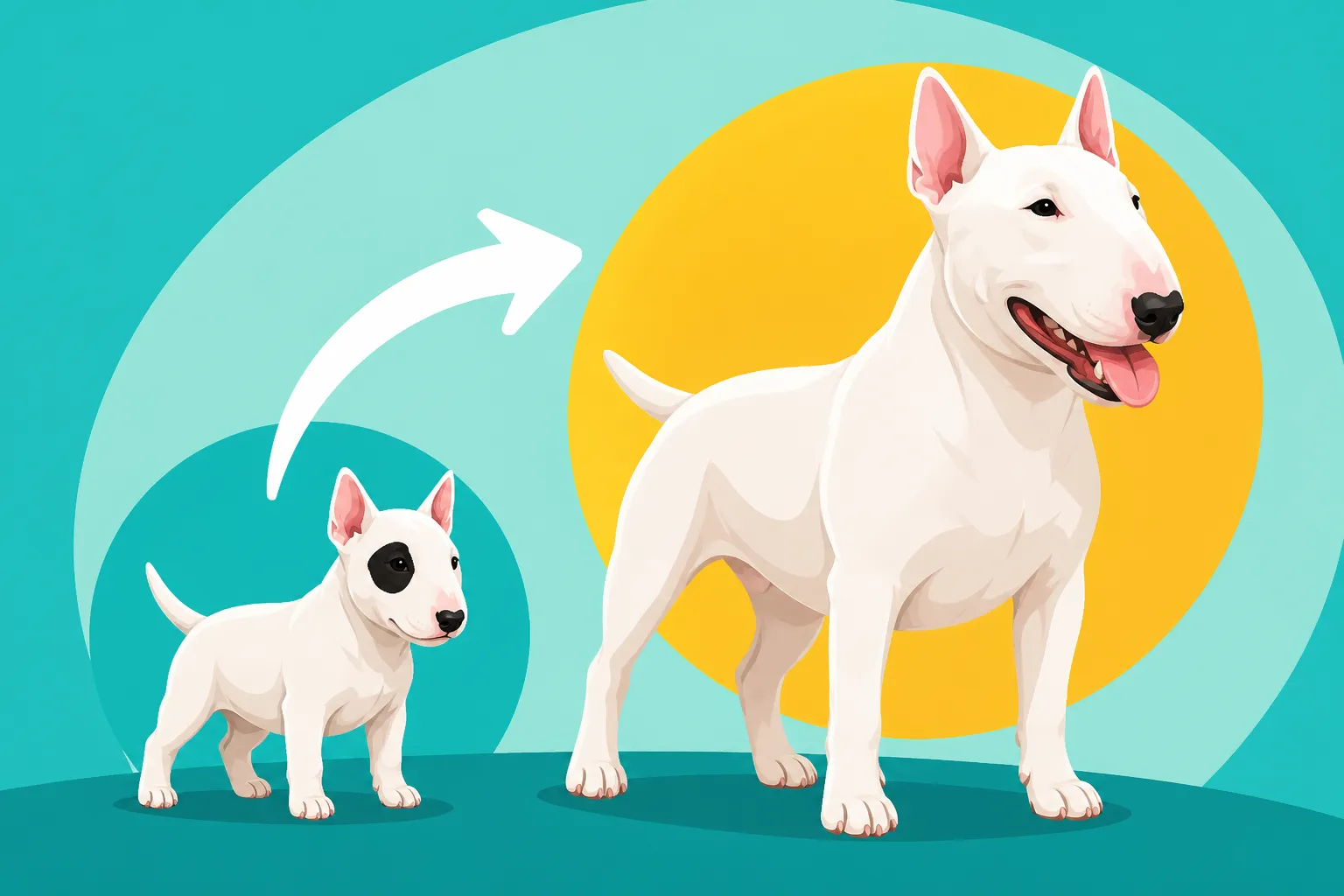
Miniature Bull Terrier puppies start small, but they don’t stay that way. They grow into muscular adults, and their proportions can change noticeably as they mature. A puppy may gain height first and fill out later, so a lanky-looking adolescent can become a much more substantial adult.
Instead of comparing your puppy’s body with a single photo or an online weight chart, keep track of growth over time and bring questions to your veterinarian. Growth rate varies, and a puppy’s monthly weight alone doesn’t tell the whole story. What a Bull Terrier Puppy Should Weigh by Month can provide a broader reference, but your vet can interpret your puppy’s growth in light of its age, health, and frame.
What a Miniature Bull Terrier’s size means at home
A Mini’s compact height can be convenient, but the dog’s actual fit in your home depends on more than its measurements. Think about where it will sleep, how it will travel, how much room it needs to move safely, and whether you can manage its strength and energy.
Choose a crate and bed by measurements
For a crate, measure your dog from nose to the base of the tail and from the floor to the top of the head while standing. The crate should allow the dog to stand without crouching, turn around, and lie down comfortably. If you’re choosing a crate for a puppy who is still growing, consider how you’ll adjust the available space so the crate remains a sensible fit as the puppy gets bigger.
A bed should suit the dog’s sleeping style as well as its length. Some Bull Terriers curl up tightly; others sprawl with their legs stretched out. Watch how your dog actually sleeps before choosing a bed, and leave room for it to settle without hanging over the edge. When browsing crate or bed listings on Chewy, check the listed internal dimensions, not just the product name or the suggested breed size.
Size affects gear, travel, and handling
A Mini may fit into more cars and homes than a standard Bull Terrier, but safe travel still matters. A dog should be secured with a suitable travel restraint or in a properly fitted crate, rather than loose in the vehicle. Measure the space available in your car before buying a travel crate; a crate that fits your dog at home may not fit safely in the cargo area.
For daily walks, adjust a harness so it stays secure without digging into the chest or armpits. Recheck the fit if your dog gains or loses weight, grows, or develops more muscle. Chewy’s size charts can be useful when comparing options, but measurements are more reliable than assuming a Mini automatically takes “small” gear.
Plan for the individual dog, not the label
If you’re deciding between a Miniature and a standard Bull Terrier, consider the dog’s adult size alongside your routine. Think about who will walk it, whether everyone in the household can handle it safely, how it will fit into your car, and where it will rest. A smaller dog can be a better physical match for some households, but size by itself doesn’t predict energy level, manners, or how much training the dog will need.
If you already have a Mini, keep a simple record of its height, weight, and body condition as it matures. Chewy’s food listings may include general feeding guidance, but package directions are only a starting point; the right amount depends on your dog’s activity, age, health, and body condition. For a personalized feeding plan—or a sudden change in weight—ask your veterinarian rather than relying on breed averages.
Disclaimer
This article is for general informational purposes only and does not constitute professional advice. Laws, prices and regulations vary by location and change over time. Consult a qualified professional for guidance on your specific situation.