What a Bull Terrier Puppy Should Weigh by Month
One of the most common worries a new Bull Terrier puppy parent has is whether their little egghead is growing "right." You see all these charts and breed standards, and then you look at your bouncy, often gangly, bundle of energy and wonder if they're hitting their milestones. It's a completely valid concern because proper growth is foundational to a healthy adult life, and knowing what to expect, month by month, can alleviate a lot of that initial anxiety. This guide is here to walk you through the typical weight progression of both Standard and Miniature Bull Terrier puppies, helping you understand the nuances of their development and when to give your vet a call.
Understanding Bull Terrier Puppy Growth Patterns
Bringing home a Bull Terrier puppy is an adventure, and watching them grow is one of the most rewarding parts. But unlike some breeds with very predictable, linear growth, Bull Terriers can sometimes feel like they're growing in fits and starts, or perhaps just filling out in strange places first. It's important to remember that while there are averages, every puppy is an individual, and their growth journey will be unique.
Key Growth Stages: From Birth to Adulthood
A Bull Terrier puppy's life is marked by several distinct growth stages, each with its own characteristics. From the moment they’re born, tiny and helpless, they embark on a journey that sees them transform into powerful, robust adults. The initial weeks are a blur of rapid weight gain, fueled by their mother's milk. They literally double their birth weight in a matter of days. This accelerated growth continues, albeit at a slightly slower pace, through their first few months, as they wean and transition to solid food.
By the time they hit about six months, a Bull Terrier puppy will have achieved a significant portion of their adult height, though they'll still be quite lanky and all legs. The next phase, from six months to about eighteen months, is less about adding height and more about filling out, developing that impressive Bull Terrier muscle, and gaining the width and substance that is characteristic of the breed. It's a journey from a gangly teenager to a solid, albeit still puppy-minded, adult. For more on their expected lifespan, you can read The Ten to Fourteen Years a Bull Terrier Gets.
Factors Influencing Growth: Genetics, Nutrition, and Health
Several critical factors play a huge role in how your Bull Terrier puppy grows and develops, making their weight progression a nuanced subject. First and foremost, genetics are the blueprint. The size and build of your puppy’s parents and even their grandparents offer the best indication of what your puppy's adult size and weight might be. If both parents are on the larger side of the breed standard, you can expect your puppy to likely follow suit, assuming all other factors are optimal.
Beyond genetics, nutrition is absolutely paramount. A high-quality, balanced diet specifically formulated for large breed puppies (for Standard Bull Terriers) or all-breed puppies (for Miniatures) provides the necessary building blocks for healthy bone, muscle, and organ development. Feeding an inappropriate diet, or one that’s too high in calories or calcium, can actually lead to developmental orthopedic problems, especially in rapidly growing larger breeds. Lastly, overall health plays a significant role. Puppies burdened with parasites, chronic illness, or even frequent digestive upsets will struggle to absorb nutrients properly and maintain a healthy growth trajectory. Regular vet check-ups, appropriate vaccinations, and parasite control are non-negotiable for optimal growth.
Average Weight by Month for Standard Bull Terriers
The Standard Bull Terrier is a substantial dog, known for its powerful build and distinctive egg-shaped head. Their growth isn't just about gaining pounds; it's about developing dense bone structure and impressive musculature. Expect a fairly steady increase in weight during the first year, with a significant 'filling out' period stretching into their second year.
0-3 Months: The Initial Rapid Gain
In these early weeks, Bull Terrier puppies are little eating and sleeping machines, and their growth reflects that intensity. At birth, they are surprisingly small, but they grow at an astonishing rate. By one month, they've often quadrupled their birth weight! The focus during this stage is primarily on consuming enough calories to fuel this rapid development.
A one-month-old Bull Terrier puppy might weigh anywhere from 5 to 10 pounds. By two months, this can jump to 15-25 pounds. At three months, you're likely looking at a sturdy puppy in the 25-35 pound range. During this phase, you’ll notice them becoming more coordinated and playful, but their body mass is increasing quickly. This rapid gain is normal, but it's important to ensure they're on a diet that supports steady, not overly fast, growth to protect their developing joints.
4-6 Months: Continued Steady Growth
As your Bull Terrier puppy moves into the 4 to 6-month window, their growth rate might seem to normalize a bit compared to the explosive early weeks, but they are still putting on significant size. You'll observe them getting taller and longer, starting to shed that baby fluff for a harsher adult coat, and their distinct head shape will begin to become more apparent.
A four-month-old puppy might weigh 35-45 pounds. By five months, they could be 45-55 pounds, and a six-month-old often hits the 55-65 pound mark. This is a critical time for socialization and training, as their physical capabilities are growing, matching their boundless energy. They're still very much puppies, but with the strength to match their mischievous nature. Ensuring they have appropriate chew toys is a must; you don't want them experimenting with your furniture!
7-12 Months: Slowing Down But Still Developing
Once your Bull Terrier puppy crosses the six-month threshold, the rate of linear growth (height and length) begins to slow, but their body is still very much in development mode. Now, the emphasis shifts to adding muscle mass and substance. They might not look drastically taller from one month to the next, but they'll certainly look wider, deeper in the chest, and more powerful.
A seven-month-old Bull Terrier might weigh 60-70 pounds, increasing to 65-75 pounds by nine months. By their first birthday, a Bull Terrier can easily be in the 70-80 pound range, or even slightly more for a larger male. At this point, while they're physically nearing their adult size, mentally, they are often still very much a teenager, full of energy and testing boundaries. It's often around this time that owners start wondering When a Bull Terrier Puppy Moves to Adult Food.
12-18 Months: Reaching Near Adult Size, Filling Out
Even after their first birthday, a Standard Bull Terrier is not fully "finished." While most of their height and length will have been achieved, the period between 12 and 18 months (and sometimes even up to 24 months) is crucial for them to fill out. This means adding more muscle, gaining girth, and really developing the substantial presence that the breed is known for.
A Bull Terrier might gain another 5-10 pounds during this time, moving into their full adult weight range, which for males can be 60-70 pounds or more, and for females, typically 50-60 pounds. It’s during these months that their "egg head" becomes even more pronounced and their powerful physique solidifies. While their physical growth slows, their energy levels can still be quite high, requiring consistent exercise and mental stimulation. Owners often mistakenly believe they are fully mature at a year, but patience for full physical maturity is key.
Average Weight by Month for Miniature Bull Terriers
The Miniature Bull Terrier shares the same distinctive appearance and spirited personality as its standard cousin, just in a more compact package. Their growth curve is similar in pattern but on a smaller scale, reaching adult size more quickly than the Standards. It's vital to differentiate between the two, as their needs and expected weights are distinct. As discussed in The Miniature Bull Terrier Is a Different Breed, they are recognized as separate entities.
0-6 Months: Smaller But Still Rapid
Just like their larger counterparts, Miniature Bull Terrier puppies experience rapid growth in their first few months. They start tiny but quickly gain weight, making significant strides each week. By the time they are three months old, they'll have achieved a substantial portion of their adult height.
A one-month-old Miniature Bull Terrier puppy might weigh 3-6 pounds. By two months, they often reach 8-12 pounds. At three months, you can expect them to be in the 12-18 pound range. Their four-month mark typically sees them at 18-24 pounds, followed by 22-28 pounds at five months. By six months, many Miniature Bull Terriers are close to their adult height and will weigh between 25-30 pounds. This fast initial growth requires a quality puppy food that supports their developing bones and muscles without encouraging excessively rapid weight gain.
7-12 Months: Approaching Adult Size
As Miniature Bull Terriers enter the 7-12 month phase, their rapid vertical growth usually tapers off. They will continue to fill out and gain muscle, but the dramatic weekly weight increases become less pronounced. This period is about solidifying their frame and developing the robust, muscular build characteristic of the breed, just scaled down.
A seven-month-old Miniature Bull Terrier might weigh 28-32 pounds, slowly creeping up to 30-35 pounds by nine months. By their first birthday, most Miniature Bull Terriers will be very close to their adult weight, typically ranging from 30-38 pounds. Some may continue to add a couple more pounds of muscle in the following few months, but the bulk of their growth is behind them.
Full Maturity: When They Are Considered Fully Grown
While a Miniature Bull Terrier may reach most of its adult weight by 10-12 months, full physical maturity, including complete muscle development and bone density, often isn't achieved until around 18 months of age. At this point, they will have the solid, compact build that makes them so endearing. Their adult weight can vary, but generally, a healthy adult Miniature Bull Terrier will weigh between 30 and 38 pounds. It's crucial during this final filling-out stage to maintain a balanced diet and appropriate exercise to prevent them from becoming overweight, which can put strain on their smaller joints.
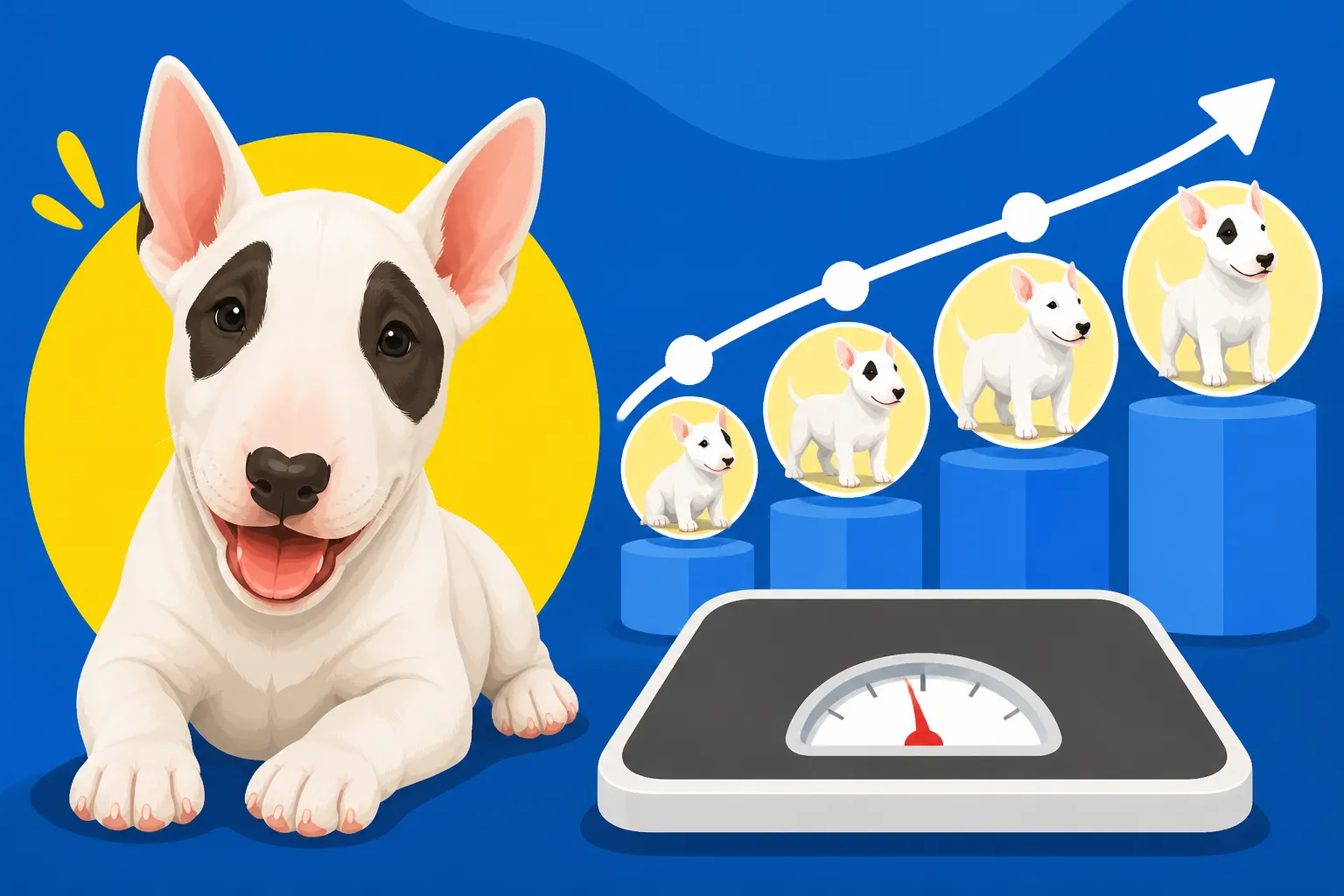
Here’s a general guide to estimated weights for both Standard and Miniature Bull Terrier puppies. Remember, these are averages and individual variation is normal!
| Age (Months) | Standard Bull Terrier (Estimated Weight Range) | Miniature Bull Terrier (Estimated Weight Range) | Key Developmental Note |
|---|---|---|---|
| Birth | 0.5 – 1.5 lbs | 0.2 – 0.7 lbs | Rapid early gains, reliant on mother's milk |
| 1 | 5 – 10 lbs | 3 – 6 lbs | Weaning typically begins, solid food introduction |
| 2 | 15 – 25 lbs | 8 – 12 lbs | More active, exploring, significant growth spurt |
| 3 | 25 – 35 lbs | 12 – 18 lbs | Puppy energy, continued rapid growth |
| 4 | 35 – 45 lbs | 18 – 24 lbs | Taller, lankier appearance, gaining coordination |
| 5 | 45 – 55 lbs | 22 – 28 lbs | Filling out slightly, still growing upwards |
| 6 | 55 – 65 lbs | 25 – 30 lbs | Reaching most of their height, muscle development begins |
| 7 | 60 – 70 lbs | 28 – 32 lbs | Growth slows down, body starts to broaden |
| 8 | 65 – 75 lbs | 29 – 34 lbs | More powerful appearance, becoming more solid |
| 9 | 65 – 75 lbs | 30 – 35 lbs | Approaching adult dimensions, filling out more definitively |
| 10 | 70 – 80 lbs | 30 – 36 lbs | Nearing adult weight for most, final muscle definition |
| 11 | 70 – 80 lbs | 30 – 37 lbs | Continued filling out, mental maturity still developing |
| 12 | 70 – 80+ lbs | 30 – 38 lbs | Physically adult-sized, may add a few more pounds of muscle |
What Influences Your Bull Terrier Puppy's Weight?
It's tempting to look at a chart and expect your puppy to match it exactly, but the reality is that many factors can subtly or significantly shift their weight trajectory. Understanding these influences can help you better assess your puppy's individual growth and ensure you're providing them with the best possible start.
Genetics and Parental Size: The Blueprint
When you picked out your Bull Terrier puppy, hopefully, you saw both parents and got a good idea of their size and build. This isn't just for curiosity's sake; it's your puppy's genetic blueprint. If your puppy comes from lines with consistently larger-than-average Bull Terriers, your pup will likely trend towards the higher end of the weight scale, assuming good health and nutrition. Conversely, if the parents are smaller or more compact, your puppy might mature at a lighter weight. This genetic predisposition is powerful, and while you can influence growth through care, you can't fundamentally change their inherited potential. Knowing the parents' weights can be a great indicator of How Long a Bull Terrier Lives on Average too.
Nutrition and Diet Quality: Fuel for Growth
This is perhaps the most controllable factor in your puppy's weight development. What you feed your Bull Terrier puppy provides the literal building blocks for their growing body. A high-quality puppy food, appropriate for their breed size (large breed formula for Standards, or a general puppy formula for Miniatures), is crucial. Look for foods that list meat as the primary ingredient and have a balanced ratio of protein, fat, and carbohydrates. Avoid overfeeding, which can lead to excessive growth and put undue stress on developing joints. Similarly, underfeeding can stunt growth and lead to nutritional deficiencies. Products available from retailers like Chewy often provide detailed nutritional information and reviews to help you make informed choices. For specific details on puppy diet, you might find What a Bull Terrier Puppy Eats at Four Months helpful.
Exercise and Activity Levels: Muscle vs. Fat
Bull Terriers are naturally muscular dogs, but that muscle needs to be developed through appropriate exercise. Too little exercise, coupled with too much food, can lead to your puppy putting on excessive fat rather than lean muscle. Conversely, too much strenuous exercise at a young age can be detrimental to their developing growth plates and joints, especially in a breed prone to being enthusiastic.
The key is balance. Regular, moderate exercise that encourages natural play and movement is ideal. Short walks, supervised play in a secure yard, and puppy-appropriate games help build muscle and maintain a healthy weight without overstraining their immature bodies. Remember, a fit Bull Terrier puppy feels solid and muscular, not squishy or soft. This balance is also why it's recommended that Why a Bull Terrier Puppy Should Grow Slowly, to allow bones and joints to properly mature before carrying too much weight.
Health and Parasites: Impact on Development
An unhealthy puppy will struggle to thrive and gain weight appropriately. Internal parasites, such as worms, are a common culprit, stealing vital nutrients from their host and leading to a failure to gain weight, a pot-bellied appearance, and dull coat. Regular deworming, as advised by your vet, is essential.
Beyond parasites, any chronic illness or recurring health issue can impact growth. Digestive sensitivities, allergies, or more serious conditions can all interfere with nutrient absorption and overall development. If your puppy consistently seems behind on their weight milestones, or experiences bouts of lethargy, poor appetite, or chronic diarrhea, a thorough veterinary check-up is in order to rule out underlying health concerns. This is also why responsible breeders will have performed Which Health Tests a Bull Terrier Breeder Should Run.
When to Be Concerned About Your Bull Terrier Puppy's Weight
While variation in puppy growth is normal, there are certainly times when a puppy's weight can signal a problem. Being too far off the average, either too thin or too heavy, warrants attention and usually a conversation with your veterinarian. Don't hesitate to seek professional advice if you have any doubts.
Underweight Concerns: Too Skinny, Lack of Energy
If your Bull Terrier puppy seems unusually thin, has ribs that are very prominent (more than just easily felt), or you can see their hip bones protruding, they might be underweight. This isn't just about aesthetics; being underweight can indicate a lack of proper nutrition, underlying health issues, or an inability to absorb nutrients effectively.
Beyond visual cues, an underweight puppy often lacks the boundless energy characteristic of the breed. They might be lethargic, slow to play, or seem generally listless. Causes can range from insufficient food intake, poor quality food, internal parasites, or more serious conditions like chronic malabsorption issues. If you suspect your puppy is underweight, it’s crucial to consult your vet. They can help diagnose the cause and recommend a plan, which might include dietary adjustments or medical treatment.
Overweight Concerns: Roundness, Joint Strain
Just as being underweight is a concern, so is being overweight. It might seem harmless for a puppy to be a bit chunky, but excess weight, especially during rapid growth, puts tremendous strain on their developing bones and joints. This can predispose them to orthopedic problems later in life, such as hip or elbow dysplasia, or exacerbate existing genetic predispositions.
An overweight Bull Terrier puppy will look noticeably rounder, lack a distinct waistline when viewed from above, and you might struggle to feel their ribs without pressing firmly. They might also seem less agile or tire more quickly during play. Overfeeding, offering too many treats, or insufficient exercise are common culprits. Learning Signs a Bull Terrier Is Overweight is important, even at a young age. If you're worried your puppy is carrying too much weight, talk to your vet about adjusting their diet and exercise regimen. Brands like Ollie offer portion-controlled fresh food options that can make managing weight easier under vet guidance.
Sudden Weight Changes: Rapid Gain or Loss
A sudden and unexplained change in your Bull Terrier puppy's weight, whether it's a rapid gain or a noticeable loss, is always a red flag. Puppies should have a relatively consistent growth curve. A sudden spike in weight could indicate overfeeding or a metabolic issue, while a rapid loss could point to a severe illness, acute parasite infestation, or significant stress.
For instance, if your puppy was gaining weight steadily and then suddenly drops several pounds over a week, it warrants immediate veterinary attention. Similarly, if they pack on a lot of weight in a short period without a clear increase in food, it's worth investigating. Always trust your gut as a pet parent. You know your puppy best, and any significant deviation from their normal pattern should prompt a call to your vet.
How to Monitor Your Bull Terrier Puppy's Weight and Growth
As a Bull Terrier owner, being proactive about monitoring your puppy’s growth is one of the best ways to ensure they’re developing healthily. It’s not about obsessing over every ounce, but about understanding their trends and catching any potential issues early. This active involvement is key to a long and healthy life, extending even to Caring for a Bull Terrier Past Eight years old.
Regular Weigh-ins: Tools and Frequency
Consistent weigh-ins are the most straightforward way to track your puppy's weight. For very young puppies, a kitchen scale is often sufficient. As they grow, you'll need to upgrade to a bathroom scale. The easiest method for bigger puppies is to weigh yourself, then weigh yourself holding your puppy, and subtract your weight. Some veterinary clinics also offer "walk-in weigh-ins" where you can use their larger, more accurate scales.
For puppies under six months, weekly weigh-ins are ideal. This period is when they experience the most rapid changes, and small deviations can be spotted quickly. After six months, monthly weigh-ins are usually sufficient, until they reach full maturity around 18-24 months. Documenting these weights in a simple journal or spreadsheet allows you to visualize their growth curve over time.
Body Condition Scoring: Visual and Tactile Assessment
While the number on the scale is important, a body condition score (BCS) is often more informative about your puppy's overall health and ideal weight. BCS involves visually assessing and physically feeling your dog's body. You want to be able to easily feel your Bull Terrier's ribs with slight pressure, but not see them prominently. They should have a visible waist when viewed from above, and their belly should tuck up slightly when viewed from the side.
A puppy that's too thin will have ribs, spine, and hip bones easily visible. A puppy that's too heavy will have a round or barrel-like appearance, no discernible waist, and you'll have to press hard to feel their ribs. Many veterinary websites and resources from organizations like the World Small Animal Veterinary Association (WSAVA) provide excellent BCS charts to guide you. Learning this skill is invaluable, as it gives you a quick, at-home assessment you can perform anytime. This is much more accurate than relying on breed standard weight ranges which are often broad. For instance, How Much a Bull Terrier Snores might relate to their weight, but BCS is a more direct indicator.
Keeping a Growth Chart: Tracking Progress
Creating a simple growth chart, either on paper or digitally, can be a fantastic tool. Plotting your puppy's weight over time allows you to see their individual growth curve and easily identify if they're experiencing a sudden plateau, an unexpected dip, or an alarming spike. It also provides valuable data to share with your vet during check-ups.
You can simply list dates and weights, or for a more visual approach, create a graph. Seeing the progression laid out helps reinforce that steady, consistent growth is key, rather than an intense burst that could stress developing joints. If your puppy came from a reputable breeder, they might even provide you with a suggested growth chart or insights into their specific line's typical development, which can be an excellent reference. Many pet apps or even simple spreadsheets can help you track this vital information. Amazon has many journals and planners designed for pet owners that could be perfect for this!
Conclusion
Navigating the growth of a Bull Terrier puppy is an exciting part of puppy parenthood, and understanding what a healthy weight progression looks like is a cornerstone of responsible care. While average weight charts provide a helpful roadmap, remember that your Bull Terrier puppy is a unique individual, influenced by their genetics, diet, activity, and overall health. Don't let the numbers cause undue stress, but rather use them as a guide to prompt informed conversations with your veterinarian. Consistent monitoring, through regular weigh-ins and body condition scoring, empowers you to be your puppy's best advocate, ensuring they grow into the strong, healthy, and happy adult Bull Terrier you envision. Always prioritize their well-being and seek professional advice if you have any concerns about their development or health.
Disclaimer
This article is for general informational purposes only and does not constitute professional advice. Laws, prices and regulations vary by location and change over time. Consult a qualified professional for guidance on your specific situation.