How a Bull Terrier Differs From an American Pit Bull Terrier
A Bull Terrier and an American Pit Bull Terrier can look equally solid and athletic, so it’s easy to mix them up—especially when people use “pit bull” as a catchall label. They are distinct breeds with different histories, head shapes, and registry standards. This guide explains the practical differences and why appearance alone cannot reliably identify a dog’s ancestry.
Bull Terrier and American Pit Bull Terrier are separate breeds
Their histories and breed names are not interchangeable
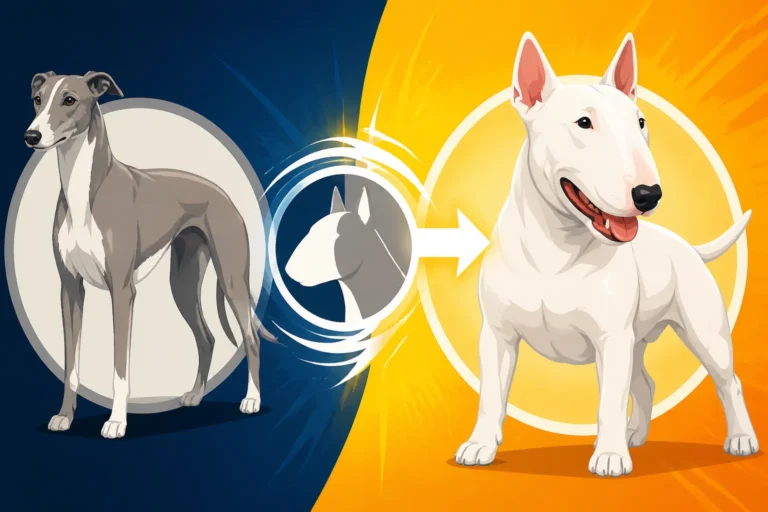
The Bull Terrier developed in England as a distinct breed during the 19th century. Its familiar profile—the long, gently curving head and strong, compact body—became a defining feature as breeders established a recognizable type. You can read more about that background in Which Breeds Went Into the Bull Terrier.
The American Pit Bull Terrier, often shortened to APBT, has a different history and is recognized by registries such as the United Kennel Club and the American Dog Breeders Association. It is not simply another name for a Bull Terrier. The breed name also gets tangled up with the phrase “pit bull,” which people may use to mean an APBT, a related breed, or a dog with a certain general appearance.
That distinction matters in everyday situations. Someone may call a muscular, short-coated dog a “pit bull” based on looks, while the dog’s paperwork or ancestry tells a different story. Likewise, a Bull Terrier may be mistaken for a pit bull because both breeds are sturdy and powerful. A visual guess is not the same as a confirmed breed identification.
Why “pit bull” can mean different things
“Pit bull” is not used consistently by everyone. In some contexts it refers specifically to the American Pit Bull Terrier; in others, it’s an umbrella term that may include American Staffordshire Terriers, Staffordshire Bull Terriers, mixes, and dogs thought to resemble them. That lack of a shared definition can make conversations about breed restrictions, adoption records, and insurance confusing.
The Bull Terrier is a separate, named breed rather than a type of American Pit Bull Terrier. It is also distinct from the Staffordshire Bull Terrier, despite the similar-sounding names. For a closer comparison with that other breed, see How a Bull Terrier Differs From a Staffordshire Bull Terrier. A Bull Terrier and an APBT can share broad traits—muscular build, short coat, energy, and a strong jaw—without being the same breed.
If you’re identifying a particular dog, ask what evidence the label is based on. Registration documents and reliable records from a breeder or rescue can help, though records may be incomplete. A dog’s appearance by itself is not a dependable way to establish its ancestry. Even a DNA test can have limitations, particularly when a dog’s background includes mixed or poorly documented lines.
The easiest physical differences to spot
Head shape is the clearest visual clue
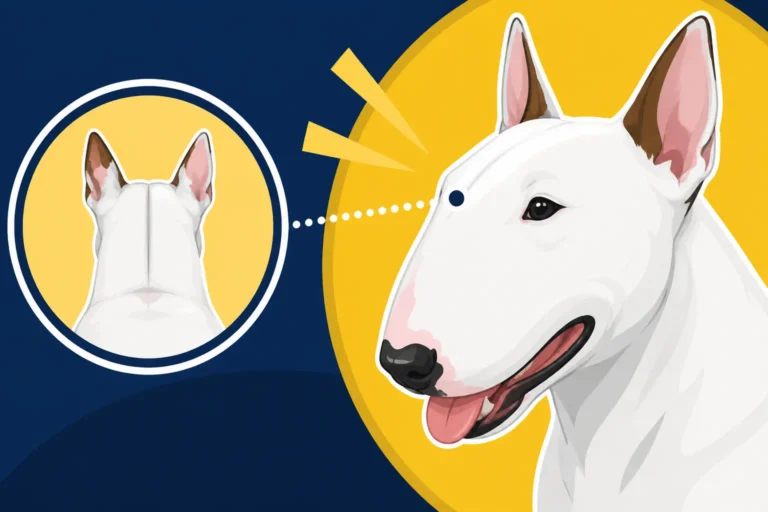
A typical Bull Terrier has a distinctive egg-shaped head, a curved profile without a pronounced stop, and small, triangular eyes set close to the head’s outline. Its muzzle blends into the skull rather than appearing sharply separated from it. Ears are naturally erect, and the overall effect is unusual enough that many people recognize the breed once they know what to look for.
An APBT generally has a more conventional dog head shape, with a clearer transition between forehead and muzzle. The head can be broad and substantial, but it does not have the Bull Terrier’s characteristic continuous, downfaced profile. APBTs may vary quite a bit in appearance because different registries and breeding lines emphasize somewhat different proportions.
A side-by-side photo can make the contrast seem obvious, but real dogs are not always textbook examples. A mix may inherit a broad head without the Bull Terrier’s profile, while a lean Bull Terrier may not look as massive as someone expects. If the head shape is your main point of comparison, it helps to look at the whole dog rather than treating one feature as proof of ancestry. What a Bull Terrier's Downface Is explains the Bull Terrier profile in more detail.
Build, size, and coat vary within both breeds
Bull Terriers tend to have a compact, muscular body, a deep chest, and a distinctive outline. Breed standards do not set a single ideal weight in the same way some standards define a narrow weight range, so individuals can differ noticeably in size. The basic outline and head shape are usually more helpful clues than a number on the scale. For more on typical proportions, see What a Bull Terrier Weighs and How Tall It Stands.
American Pit Bull Terriers are often described as athletic and muscular, but their build can range from lean and leggy to heavier and broader. Their exact appearance depends on the individual, breeding line, and registry standard being considered. It’s risky to use a photo, a dog’s weight, or a single body feature as a definitive breed test.
Coat color is another weak clue. Bull Terriers come in white and several colored patterns, while APBTs may also appear in a wide range of colors and markings. Many coat colors occur in dogs with mixed ancestry too. A coat that looks “typical” of one breed does not prove that a dog belongs to it. You can explore the Bull Terrier’s recognized variety in Which Colors a Bull Terrier Comes In.
| Feature | Bull Terrier | American Pit Bull Terrier |
|---|---|---|
| Breed identity | A distinct breed with a recognizable egg-shaped head and downfaced profile | A distinct breed recognized by registries including the UKC and ADBA |
| Head and face | Long, curved profile; small triangular eyes; little visible stop | Usually a more conventional head profile; shape and proportions vary |
| Body | Compact, muscular, and strongly outlined | Often athletic and muscular; build varies between lines |
| Coat | White or colored, with several recognized patterns | Many colors and markings occur |
| Name confusion | Sometimes mistakenly called a pit bull because of its build | Sometimes confused with the broader, inconsistently used “pit bull” label |
| Best way to confirm identity | Check reliable records; don’t rely on looks alone | Check reliable records; don’t rely on looks alone |
Temperament and daily life are not determined by a label
Both dogs need thoughtful training and management
A Bull Terrier is often exuberant, playful, and physically expressive. That can be charming when the dog flops against you on the sofa, but less charming when a strong, excited adult barrels through a doorway or pulls toward something interesting. Short, engaging training sessions and clear routines often work better than repeating a cue endlessly. What a Bull Terrier's Temperament Is Really Like offers a broader look at the breed’s day-to-day personality.
APBTs are also individuals rather than a single behavioral template. A dog’s temperament is influenced by its genetic background, early experiences, health, training, and surroundings. You cannot predict that a dog will be friendly, difficult, calm, or reactive simply from a breed label. Meeting the dog and learning its actual history is more useful than relying on assumptions.
With either breed, focus on practical skills: walking calmly on leash, settling around visitors, responding to cues, and being comfortable with routine handling. A well-fitted harness or collar, a secure leash, and thoughtful training can make walks safer and less stressful. If you’re shopping for walking gear, a retailer such as Chewy may be one place to compare options, but fit matters more than a product’s breed label. Measure the dog and check that equipment does not rub, slip, or restrict movement.
Energy and dog interactions call for individual assessment
Both breeds can be strong, energetic companions. That does not mean every dog needs the same exercise plan or will behave the same way around other dogs. Age, health, conditioning, previous experiences, and individual preferences all matter. A young dog that gets overstimulated may need calmer, structured activity rather than simply more time in a busy dog park.
Pay attention to the dog in front of you. Does it recover quickly after excitement? Can it disengage from another dog when called? Does it play with loose, relaxed movements, or does it become stiff and fixated? Those observations are more useful than assumptions based on breed. For Bull Terrier-specific guidance on dog interactions, see How a Bull Terrier Gets On With Other Dogs.
A strong leash walker can be difficult to manage even if the dog is friendly, and a dog that is uncomfortable around other dogs needs space and careful handling—not forced greetings. A trainer who uses reward-based methods can help you build reliable everyday skills. For more on managing pulling, How Strong a Bull Terrier Is on a Leash discusses a common challenge for owners of this powerful breed.
Choosing or identifying a dog with care
Ask for records instead of relying on appearance
If you’re considering a puppy, ask the breeder what breed the parents are registered as and request the relevant records. A responsible breeder should be willing to explain the lines, show documentation, and answer questions about health and temperament. The same principle applies when adopting: ask what the rescue or shelter knows about the dog’s background and how it reached its current breed description.
Breed labels on adoption listings are often estimates, particularly for dogs without documented ancestry. A shelter may use a familiar label to describe a dog’s appearance, not to claim that every ancestor is known. That can be understandable, but it means the label should be treated as a starting point rather than a guarantee. Whether a Bull Terrier Is a Bully Breed explores why these labels can be confusing.
If a housing rule, local ordinance, or insurance policy makes breed identification important, read the actual wording and ask the relevant organization how it defines the breed. Rules and definitions can differ by location and provider. Don’t assume that a shelter’s label, a neighbor’s opinion, or a visual assessment will settle a formal question.
Match the dog to your household, not to a stereotype
Whether you’re considering a Bull Terrier or an APBT, think through the routine the dog will actually live with. How much time can you give to exercise, training, and companionship? Are there children, other pets, or frequent visitors in the home? Is your yard secure, and can you comfortably handle a powerful dog on leash? These questions are more practical than trying to choose based on a reputation.
Arrange a calm meeting when possible, and ask how the dog behaves in situations you’ll encounter regularly. If you have another dog, ask about safe introductions and whether the rescue or breeder has observed the dog with other dogs. If the dog has a known history of reactivity, resource guarding, or separation distress, ask what support is available and whether a qualified trainer or behavior professional should be involved.
Even ordinary supplies are best chosen for the individual dog. For example, a chewing dog may need durable, appropriately sized items and supervision, while a dog with sensitive skin may need a different approach to grooming products. Chewy can be a convenient place to browse basic supplies, but check sizing, ingredients, and safety guidance rather than assuming that a product suited to one breed will suit another. If you’re still comparing breeds, How a Bull Terrier Differs From a Miniature Bull Terrier can help clarify one more common source of mix-ups.
Disclaimer
This article is for general informational purposes only and does not constitute professional advice. Laws, prices and regulations vary by location and change over time. Consult a qualified professional for guidance on your specific situation.