Whether Bull Terriers Were Used on Badger
A Bull Terrier’s muscular build and terrier ancestry can make its past seem obvious, but breed history is easy to oversimplify. This guide explains the difference between early bull-and-terrier dogs and the Bull Terrier as a recognized breed, what badger baiting involved, and what the historical record can—and cannot—tell us about modern Bull Terriers.
The short answer about Bull Terriers and badger baiting
Early bull-and-terrier dogs were used in blood sports
In Britain, dogs described as bull-and-terriers existed before the modern Bull Terrier became a distinct, recognizable breed. These were crosses shaped by the sporting tastes of the time, combining traits associated with bulldogs and terriers. Their names described a type of dog more than a settled breed with consistent appearance, documented pedigrees, or one universally agreed purpose.
Some dogs of this broad type were used in blood sports, including badger baiting. That does not mean every bull-and-terrier was used against badgers, or that badger work was the sole reason these dogs existed. Historical reports and popular accounts often group different dogs and activities together, making it difficult to say exactly which individual animals were involved.
It is also important not to treat the modern Bull Terrier’s history as interchangeable with the history of every earlier bull-and-terrier. The background of the broader type is part of the story, but it does not establish that the standardized breed was created specifically for badger baiting. For more on the older category, see What the Bull and Terrier Was.
The modern breed emerged later
The Bull Terrier is generally associated with James Hinks, who developed and promoted a more recognizable type in nineteenth-century Birmingham. By then, dog breeding and showing were changing how people thought about dogs. A dog could be valued for its appearance, companionship, and presence in the show ring—not only for a sporting role.
This shift matters when answering whether Bull Terriers were used on badger. If “Bull Terrier” means any dog with bull-and-terrier ancestry, some may have been involved in baiting. If it means the later, more standardized breed associated with Hinks, the answer is less straightforward: its background sits close to a period when blood sports and dog fighting were part of the wider culture, but that is not the same as proving that badger baiting was its defining purpose.
The breed’s history includes both harsh sporting traditions and a deliberate move toward a polished companion and show dog. Where the Bull Terrier Comes From and Who James Hinks Was offer useful background on how that transition took shape.
What badger baiting involved
Baiting was different from ordinary hunting
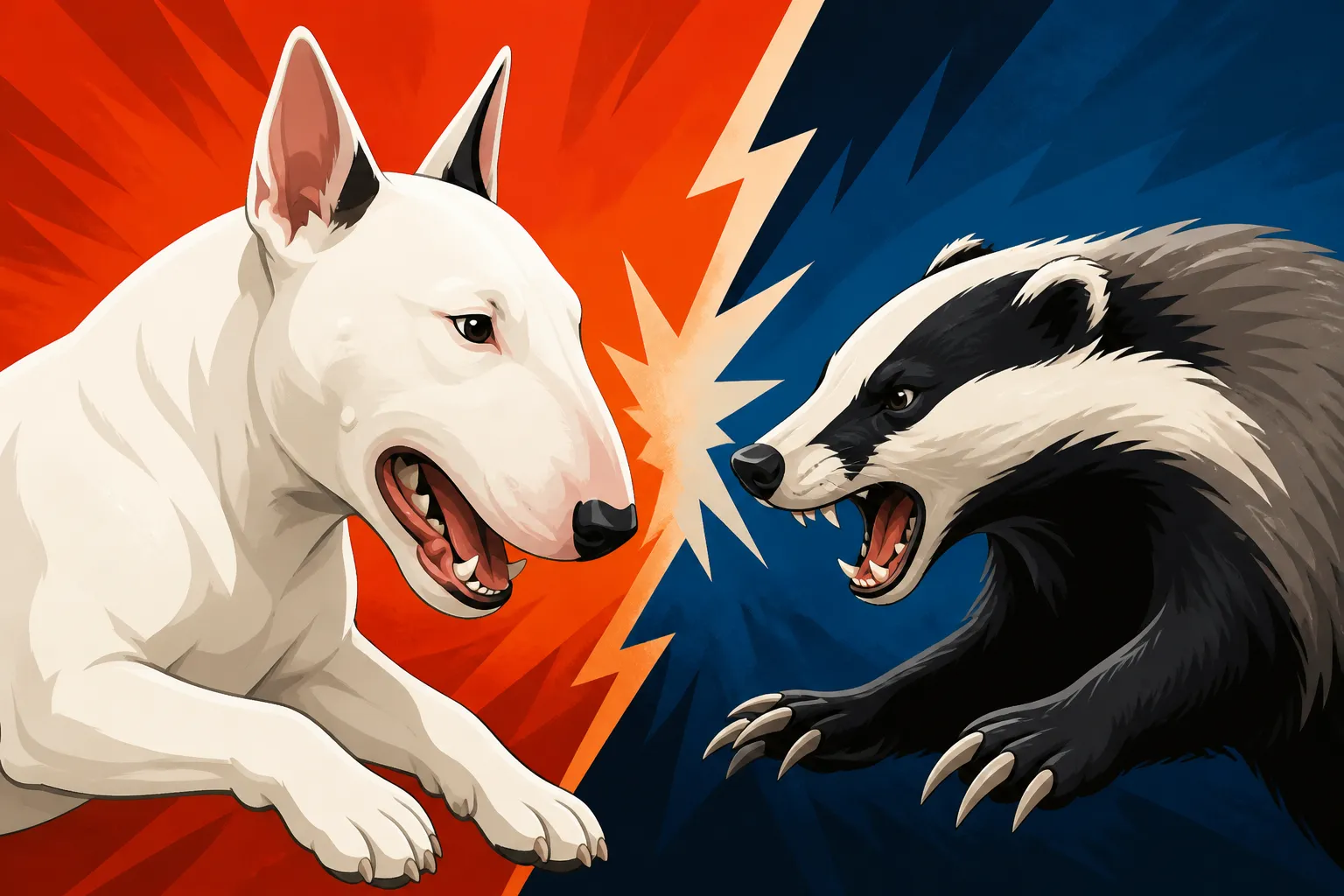
Badger baiting was a form of animal baiting in which a dog was set against a badger, often after the animal had been located or confined. It was not simply a dog sniffing around a field, following a scent, or being used to find wildlife. The defining feature was the forced confrontation between animals, commonly organized as a spectacle or contest.
That distinction helps clear up a common confusion: a dog’s willingness to dig, chase, or investigate a burrow does not prove it was bred for badger baiting. Terriers can be curious and persistent around underground smells, but an instinct to explore is not evidence of a specific historical job. Many behaviors that look “purpose-built” to modern owners can arise from a mix of ancestry, individual temperament, learning, and opportunity.
Historical descriptions of baiting can be unsettling, and they are not a guide to handling dogs today. There is no safe or humane way to recreate such encounters. Badgers are powerful wild animals, and forcing a dog into contact with one risks severe injury to both animals.
The law and public attitudes changed over time
Blood sports were part of a wider landscape of public entertainment and working-dog culture in Britain, but attitudes and laws did not remain fixed. The Cruelty to Animals Act of 1835 targeted practices such as bull and bear baiting, while other forms of animal fighting and baiting persisted in different ways and were subject to changing restrictions and enforcement.
It would be misleading to suggest that one law instantly ended every kind of animal baiting or that every community responded in the same way. Practices could continue privately or illegally even as public opinion shifted and authorities tried to suppress them. The history of the Bull Terrier therefore overlaps with a period of change rather than a clean break between “working dog” and “companion dog.”
This context also helps explain why historical accounts may use broad labels loosely. A writer might describe a dog by its appearance, its ancestry, or the activity it was involved in, without using breed names with the precision expected today. The story of Whether the Bull Terrier Was a Fighting Dog explores another part of that difficult history, while What Happened at the 1862 Cremorne Show gives a window into the breed’s emerging show-dog identity.
What the history does and does not tell us
“Used on badger” does not describe every Bull Terrier
A breed’s history is not a behavioral prediction for every dog living today. Even if a particular ancestor or dog of a related type was used in baiting, that does not mean a present-day Bull Terrier will seek out badgers, behave aggressively toward wildlife, or be impossible to manage. Individual dogs vary, and behavior is shaped by their health, temperament, early experiences, training, and environment.
It is equally unhelpful to swing too far in the other direction and pretend the breed developed in a historical vacuum. Bull Terriers have roots in a period when people bred and used dogs for a range of demanding and sometimes cruel purposes. A truthful account can acknowledge that history without treating it as destiny or using it to stereotype every dog.
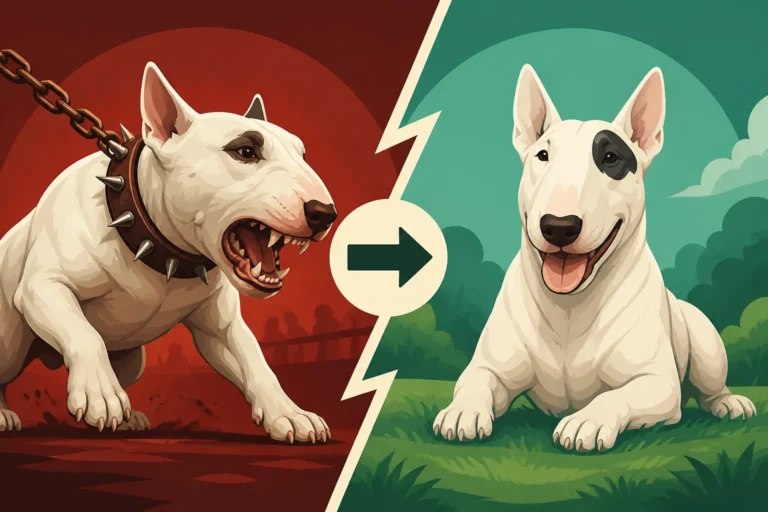
For readers tracing the breed’s shift in public image, Why the Bull Terrier Is Called the White Cavalier is relevant: the nickname reflects a different ideal of the dog from the one associated with baiting. It does not erase earlier sporting culture, but it helps show how breed identity and public expectations changed.
A dog showing interest in wildlife needs management, not a history lesson
If your Bull Terrier digs at a burrow, fixates on a wild animal, or strains toward a scent, the practical response is to prevent access and redirect the dog calmly. Keep the dog on leash where wildlife may be present, secure fencing, and avoid allowing it to investigate holes or dens. A curious dog can be injured by an animal it does not understand, even without any aggressive intent.
For example, imagine a dog on a countryside walk that suddenly pulls toward a hedge or bank. Calling it once may not be enough if it is highly aroused. Create distance, use a secure lead, and reward the dog when it turns its attention back to you. If the behavior is intense, recurring, or difficult to interrupt, a qualified trainer or veterinary behavior professional can help you build a safer plan.
At home, offer appropriate outlets for sniffing, chewing, and problem-solving rather than letting a dog rehearse risky wildlife-seeking behavior. Some owners browse enrichment toys and chews through retailers such as Chewy, but choose items that suit the dog’s size and chewing style, supervise use, and replace damaged toys. Chewy may also be one place to compare basic walking or enrichment supplies; the important point is choosing safe options rather than trying to suppress every instinct.
Comparing the historical dog with the modern Bull Terrier
The word “Bull Terrier” can refer to different things depending on the period being discussed. This table separates the broad historical type from the later breed and from the individual dog in your home.
| Question | Early bull-and-terrier type | Later recognized Bull Terrier | Individual dog today |
|---|---|---|---|
| What does the label mean? | A broad description of dogs with bull and terrier ancestry | A more consistent breed shaped by deliberate breeding and showing | One dog with its own temperament, history, and training |
| Were some used in baiting? | Some dogs of related types were used in blood sports, including badger baiting | The breed’s background overlaps with that culture, but badger baiting is not a simple definition of its purpose | History alone cannot tell you how a particular dog will behave |
| Does the label prove badger work? | No; the type covered dogs with different roles and experiences | No; breed development and purpose changed over time | No; behavior must be assessed from the dog in front of you |
| What should owners focus on? | Understanding the broader historical context | Recognizing a complicated transition in breed identity | Safe management, training, enrichment, and respect for wildlife |
Be careful with claims about “what the breed was made for”
Statements such as “Bull Terriers were bred to bait badgers” compress a complicated history into a sentence that sounds more certain than the evidence allows. They can also confuse an earlier, less standardized dog type with the later breed. It is more accurate to say that bull-and-terrier dogs existed in a culture where blood sports occurred, and that some dogs of related types were used in those activities.
The same care applies to claims that the Bull Terrier was always only a companion dog. That description overlooks the sporting environment in which its ancestry developed. The breed’s story includes changing tastes, breeding goals, and social attitudes—not one permanent role stretching unchanged from its earliest origins.
The related history of When the English White Terrier Died Out and Whether a Bull Terrier Was Bred to Start Fights can help readers distinguish breed development from assumptions about a single original purpose.
Modern ownership is about the dog in front of you
Knowing the past can make owners more thoughtful, but it should not replace ordinary observation. Notice what excites your dog, what helps it settle, and where it needs boundaries. A Bull Terrier that chases movement or digs at a scent may benefit from structured play, scent games, recall practice, and secure management. Those activities do not require contact with wildlife.
If you are choosing enrichment, use products for their intended purpose and watch how your dog handles them. Chewy is one example of a retailer where owners may look for puzzle feeders or durable play items, but no toy is truly indestructible for every dog. Check regularly for cracks, loose pieces, or swallowed fragments, and ask your veterinarian if your dog has a habit of gulping or destroying objects.
A dog’s ancestors do not excuse unsafe behavior, but they also do not condemn the dog to it. Clear routines, humane training, and responsible control around wildlife matter far more than repeating a dramatic historical label. If you want a broader view of how the breed’s image changed, The White Cavalier: Why the Bull Terrier Never Started Fights places that identity in its wider cultural setting.
Disclaimer
This article is for general informational purposes only and does not constitute professional advice. Laws, prices and regulations vary by location and change over time. Consult a qualified professional for guidance on your specific situation.