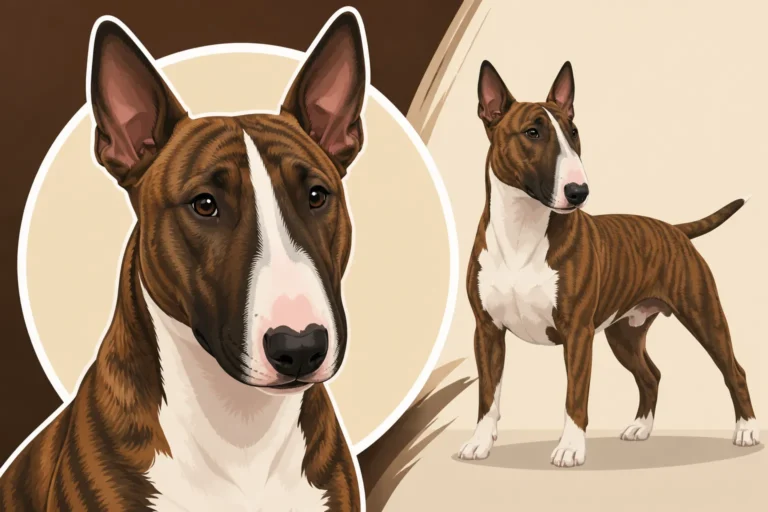
Whether Markings on a White Bull Terrier Are Allowed
A white Bull Terrier can have some markings and still be a perfectly ordinary, healthy Bull Terrier. The confusing part is that “allowed” can mean different things: acceptable under a breed standard, eligible for a particular show class, or simply normal in a pet dog. Here’s how to tell head markings from body markings, what the rules may mean in practice, and when a spot is worth asking your vet about.
Which markings are allowed on a white Bull Terrier
Head markings are treated differently from body markings
In many Bull Terrier breed standards, a white dog may have markings on the head without losing its white classification. A colored patch over an ear or around an eye, for example, can be permitted. The dog is still generally considered a white Bull Terrier rather than a colored one.
The exact wording and judging consequences depend on the organization and country. Some standards permit head markings but strongly penalize color elsewhere on the coat. That distinction matters most if you are entering conformation shows or choosing a puppy with show prospects. It usually does not affect whether the dog can be a much-loved family companion.
If you’re comparing coat patterns, Which Colors a Bull Terrier Comes In gives useful background on the difference between white and colored varieties. The history of those categories is a little more complicated than simply “all white” versus “has any color,” as Colored Bull Terriers Were a Separate Fight explains.
Body patches may affect show evaluation
A colored patch on the back, flank, or another part of a white dog’s body is different from a head marking under many show standards. It may be considered a fault, and the seriousness of that fault varies with the standard being used. A judge may evaluate the dog’s overall type and other qualities too, but a body patch can matter in the ring.
That does not automatically mean the dog is defective, unhealthy, or not a purebred Bull Terrier. Show standards describe how dogs are assessed against a written ideal; they are not a health diagnosis. A pet owner seeing a dark patch on a white puppy does not need to panic or assume the dog is “the wrong color.”
If the puppy is being sold as a show prospect, ask the breeder to explain how the markings fit the specific registry’s standard. A responsible breeder should be able to tell you whether the marking is expected to affect show eligibility or placement, rather than making a vague promise that the dog is “perfect.”
| What you see | How it is commonly viewed | What to keep in mind |
|---|---|---|
| Colored patch on the head | Often permitted on a white Bull Terrier | Check the standard used by the show organization |
| Colored patch on the body | May be faulted or strongly discouraged in the white variety | Usually a show consideration, not a health concern by itself |
| Small dark spot beneath white hair | May be skin pigmentation rather than a coat marking | Part the hair and look at whether the fur itself is colored |
| New, changing, or irritated spot | Not simply a coat-standard question | Ask a veterinarian if it changes, bleeds, itches, or becomes sore |
How to tell a coat marking from skin pigmentation
Look at the hair as well as the skin
A mark that looks like a dark patch may be pigment in the skin showing through sparse or short white hair. To check, gently part the coat in good light. If the hair itself is white but the skin underneath is gray, brown, or mottled, you may be looking at pigmentation rather than a colored coat patch.
If the fur is distinctly colored, that is more likely to be a coat marking. The difference can be subtle, especially on a short-coated dog, and a puppy’s appearance may change as the coat develops. If you are uncertain and the dog is being assessed for showing, take clear photos and ask the breeder or the relevant breed club how the standard is interpreted.
Pigmented skin is not automatically a problem. White Bull Terriers can have pink skin, darker spots, or a mixture of both. That is separate from whether the coat meets a show ideal. For a closer look at why skin color varies, see Why a White Bull Terrier's Skin Is Pink.
Keep an eye on spots that change
A stable pigment spot that has been there for a long time is different from a new patch that grows, becomes raised, crusts, bleeds, or seems painful. Changes like these are not questions about breed standards; they are reasons to contact your veterinarian. It can help to take a photo in consistent lighting and note when you first noticed the spot, so you can describe any changes clearly.
White skin also deserves sensible sun protection. The nose, ear edges, eyelids, and areas with little hair can be especially exposed. A dog that loves lying in a sunny window or stretching out on a patio may get more sun than its owner realizes. Why a White Bull Terrier Sunburns and Whether a White Bull Terrier Needs Sunscreen cover the practical side of protecting exposed skin.
When shopping for dog sunscreen or other skin-care supplies, check that the product is made for dogs and ask your vet whether it is suitable for your dog’s skin and habits. Some owners browse retailers such as Chewy for pet-care items, but a product listing is not a substitute for checking the ingredients and getting veterinary guidance. Prevent licking where the product is applied, and follow the label directions.
What markings mean for showing and choosing a puppy
Confirm the rules for the show you have in mind
There is no single answer that applies to every show organization. Before entering a dog, check the current breed standard and show rules for the registry or country where you plan to compete. If the wording is unclear, a breed club or experienced Bull Terrier show breeder can help explain how judges typically interpret it.
A breeder may describe a puppy as “white with a head marking” or “white with body color.” Those descriptions are useful, but ask what they mean in practical terms. For example: Is the mark on the hair or only the skin? Is the puppy still registered in the white variety? Could the marking affect conformation-show eligibility or evaluation? Specific questions tend to get clearer answers than asking only whether the puppy is “show quality.”
If showing is not part of your plans, there is usually no reason to treat a permitted or disfavored marking as a measure of the dog’s value as a companion. Temperament, health, responsible breeding, and the fit between the dog and your household matter far more to everyday life than a patch of color.
Don’t use coat color as a shortcut for health
Markings alone do not tell you whether a Bull Terrier can hear normally or predict its overall health. If hearing is a concern, ask about appropriate hearing assessment rather than trying to infer the answer from the coat. Why a White Bull Terrier Should Be BAER Tested explains what that screening is intended to check, and What a BAER Test Tells a Bull Terrier Owner describes how results can be useful.
Likewise, a white dog is not automatically unhealthy, and a colored dog is not automatically healthier. Coat color and individual health are different questions. When speaking with a breeder, focus on documented health screening, the health history of the parents, and the care puppies receive. If you want more context on how variety and health are separate issues, see Whether a Colored Bull Terrier Is Safer From Deafness.
This is also a good point to ask for written records rather than relying on a quick verbal assurance. A reputable breeder should be comfortable explaining the puppy’s registration details, the parents’ health testing, and any known concerns. A marking may affect how a dog is judged in a show ring; it should not be used to distract from questions about health and care.
Practical care for a white Bull Terrier with markings
Make skin checks part of your routine
Whether your dog is solid white, has a colored ear, or has a small body patch, regular skin checks are useful. Once a week, run your hands gently over the coat and look at the face, belly, feet, ear edges, and tail. Notice new redness, scabs, bald patches, or areas your dog keeps licking or scratching.
Keep notes or take a photo if a spot looks different from the week before. A photo can make gradual change easier to notice, and it gives your veterinarian a clearer history if you need an appointment. A change in pigmentation may be harmless, but persistent irritation, swelling, bleeding, or rapid growth deserves professional attention.
For more on routine checks and skin concerns, read A Bull Terrier's Skin Is Its Weakest Point. If your dog develops itching or recurrent irritation, avoid trying several shampoos or creams at once. Changing multiple products makes it harder to identify what is helping or causing a reaction.
Choose skin products carefully
White Bull Terriers may have exposed pink skin, so sun protection can be part of warm-weather care. Provide shade, avoid leaving your dog in direct sun for long stretches, and ask your vet about a dog-safe sunscreen for exposed areas. A light shirt can help in some situations, but it needs to fit comfortably and should not make the dog overheat.
If you browse Chewy or another pet retailer for sunscreen, shampoo, or protective clothing, read the product label closely and confirm it is intended for dogs. Don’t assume a human product is safe just because it is sold for sensitive skin. If your Bull Terrier has allergies or a history of skin reactions, ask your veterinarian before trying something new.
The same cautious approach applies to spots themselves. Do not scrub, bleach, dye, or apply human acne or skin products to a marking in an attempt to change how it looks. Those steps will not make a dog more suitable for a show standard and could irritate the skin. If the appearance matters for showing, get an expert interpretation of the coat; if the area looks medically abnormal, seek veterinary advice.
Chewy may be one place owners look for dog-specific grooming and sun-care supplies, but the important part is choosing a suitable product and using it as directed. If your dog licks the area, develops redness, or seems uncomfortable after an application, stop using the product and contact your vet for advice.
The simplest way to judge a marking
For a pet Bull Terrier, a marking is usually just a physical feature—not a verdict on the dog’s health, temperament, or worth. For a show dog, the location of the color and the rules of the specific organization matter. Head markings are commonly treated more leniently than color on the body, but always confirm the applicable standard instead of relying on a general rule of thumb.
When in doubt, separate the question into three parts: Is the hair colored, or is the skin pigmented? Are you asking about show evaluation or health? Has the spot changed or become irritated? Those answers will point you toward the right next step: a breeder or breed club for show-standard questions, and a veterinarian for health concerns.
Disclaimer
This article is for general informational purposes only and does not constitute professional advice. Laws, prices and regulations vary by location and change over time. Consult a qualified professional for guidance on your specific situation.