What a Roman Finish Means on a Bull Terrier
A Bull Terrier’s profile can look unusual at first, especially when the forehead seems to flow straight into the muzzle without a visible stop. “Roman finish” is an informal phrase sometimes used to describe the breed’s smooth, downward-curving head profile and turned-down nose tip. Here’s what the term means, what the breed standard actually describes, and how to tell normal shape from a concern.
What Roman finish means on a Bull Terrier
The smooth sweep from skull to nose
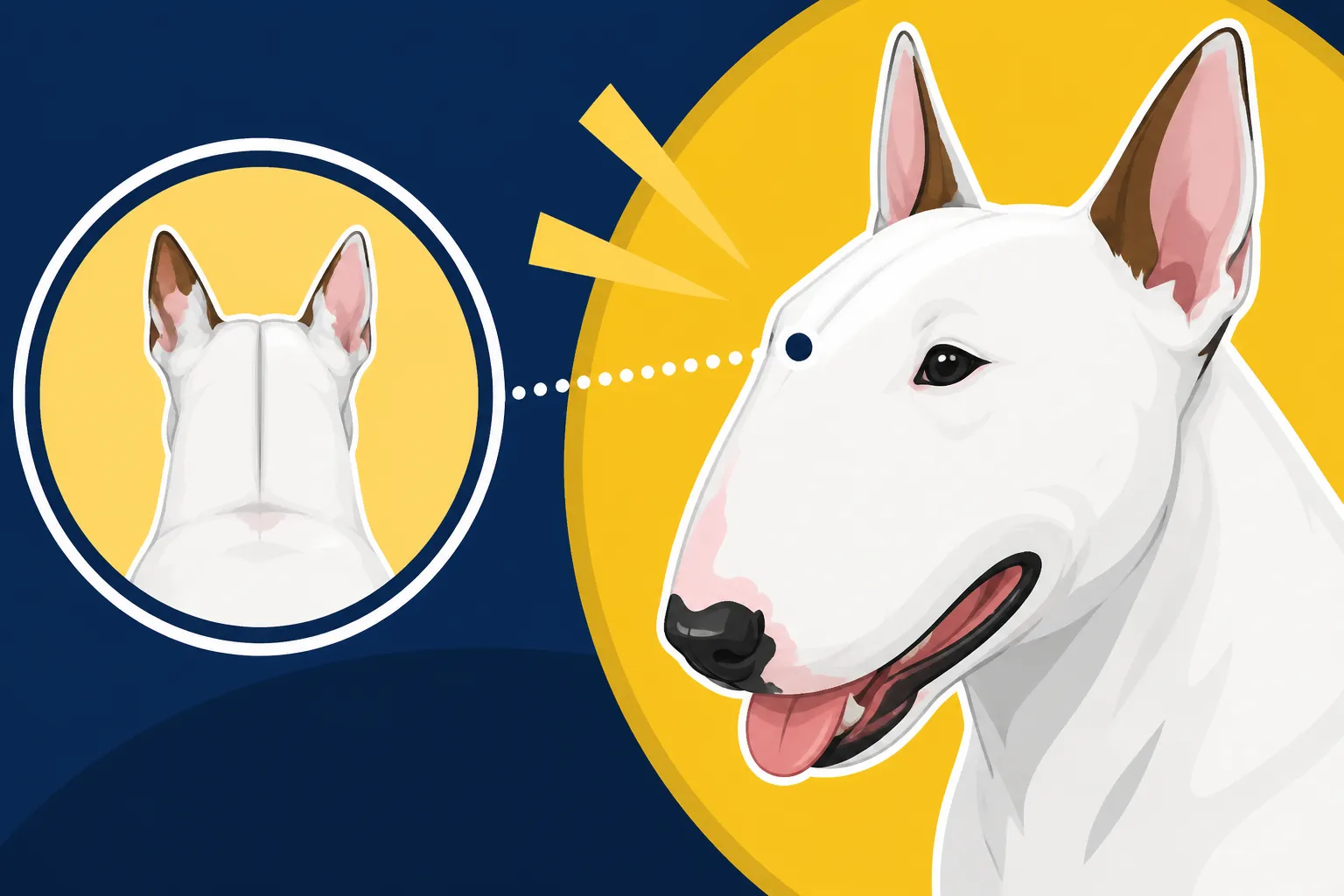
When people describe a Bull Terrier as having a Roman finish, they are usually talking about the outline of its head in profile. Rather than showing a sharp dip between forehead and muzzle, the line runs in a continuous curve from the top of the skull down toward the nose. The nose tip itself turns slightly downward, completing the characteristic profile.
The phrase is descriptive rather than a precise technical measurement. It is not a separate feature that can be judged in isolation from the rest of the head. A well-shaped Bull Terrier head is meant to look cohesive: the skull, face, and muzzle blend into one another instead of appearing like distinct pieces.
This profile is part of the breed’s familiar “egg-shaped” look, but it does not mean every Bull Terrier’s head will have exactly the same curve. Age, individual build, and breeding lines can all affect how pronounced the outline appears. The key idea is a smooth, unbroken sweep, not a dramatic bump or a sharply hooked nose.
How the nose tip fits into the profile
The nose tip is one detail that helps finish the silhouette. In the breed standard, the profile curves downward toward the nose, and the tip is described as turning down. That turn should look like part of the overall line—not like a separate kink, a pinched nose, or an exaggerated curl.
When you look at a Bull Terrier from the side, try following the outline with your eye from the skull down the face. A typical profile appears continuous, with no obvious stop or deep hollow between the forehead and muzzle. The nostrils should also be open and well developed, rather than appearing tightly pinched.
That description can help explain the term, but “Roman finish” is not the wording used to define the whole breed head. For a fuller explanation of the sloping facial profile, see What a Bull Terrier's Downface Is. The phrase Roman finish is best understood as conversational shorthand for part of the outline, not a health diagnosis or a guarantee of quality.
Roman finish compared with other Bull Terrier head features
No stop, downface, and egg-shaped head
A “stop” is the indentation between the forehead and muzzle that many dog breeds have. Bull Terriers are known for having little to no visible stop, which is why the forehead seems to continue directly into the face. The absence of a stop is related to the overall profile, but it is not the same thing as the nose turning downward. You can read more in Why a Bull Terrier Has No Stop.
“Downface” refers to the way the facial line slopes downward from the skull toward the nose. The nose tip’s downward turn is one part of that outline, while the broader sweep involves the entire profile. “Egg-shaped” describes the head as a whole when viewed from the front or in three dimensions. These terms overlap when people discuss the breed’s appearance, but they describe different aspects of it.
| Term | What it describes | What to look for |
|---|---|---|
| Roman finish | Informal description of part of the profile | A smooth curve toward the turned-down nose tip |
| Downface | The downward slope of the facial profile | A continuous line from skull toward nose |
| No stop | The lack of a pronounced forehead-to-muzzle indentation | No sharp dip between forehead and face |
| Egg-shaped head | The overall head shape | A rounded, filled outline without obvious hollows |
These labels are useful when talking about appearance, but they shouldn’t be treated like a checklist of unrelated parts. The Bull Terrier’s head is designed to read as one integrated shape. For historical context on how that distinctive outline developed, see How the Bull Terrier's Head Changed Over Time.
What the phrase does not mean
A Roman finish does not mean that a Bull Terrier should have an unusually hooked nose, a sharp ridge, or a deep hollow somewhere along the face. It also does not mean that the head should be so exaggerated that the dog has trouble breathing, eating, or seeing. The breed’s profile is distinctive, but a striking outline on its own does not tell you whether a dog is healthy.
Nor does the phrase tell you whether a puppy’s head is finished growing. Young dogs change as they mature, and their proportions can look different from those of an adult. A puppy may have a less pronounced profile simply because its head and body are still developing. If you are comparing a puppy with a mature show dog, allow for age and individual variation rather than expecting an exact match.
Finally, “Roman finish” is not a diagnosis and cannot confirm that a dog meets every part of the breed standard. If you are choosing a puppy, ask the breeder to explain the parents’ structure and health, and look at the dog moving and behaving normally—not only in a posed side-on photo.
How to assess the profile without overinterpreting it
Look at the whole head, not one angle
A side view is helpful for seeing the profile, but it can be misleading if the dog is holding its head at an unusual angle or the photo is taken close to the face. Camera perspective can make a nose look larger, shorten the muzzle, or alter the curve. Lighting can also create shadows that resemble hollows or bumps.
If you want to understand a dog’s head shape, look at it standing naturally and from more than one angle. A side view can show the sweep toward the nose; a front view gives a better sense of whether the head appears filled and balanced. Avoid judging a dog from a single image, especially if it has been heavily edited or the head is tilted.
The overall structure matters more than whether you can attach one specific label to the nose. The skull should blend into the face, and the outline should look smooth rather than abruptly broken. For more detail about the breed’s head shape, see How a Bull Terrier's Skull Is Filled Out.
Distinguish normal variation from a health concern
A head shape that looks different from another Bull Terrier is not automatically a problem. Individual dogs vary, and appearance can also change with age. But if your concern is not simply about the profile—if your dog seems unable to breathe comfortably, has difficulty eating, or shows pain or swelling around the nose or face—contact a veterinarian. Those symptoms deserve assessment on their own, regardless of the dog’s head shape.
A dry or cracked nose is also a different issue from a Roman finish. Nose texture and comfort can change for many reasons, and persistent cracking, bleeding, sores, or a sudden change in appearance should be discussed with your vet. Avoid applying a human product just because it seems mild. If your vet recommends a dog-safe nose balm, you can check its ingredients and directions before buying through a retailer such as Chewy or another pet supplier. Chewy listings may be useful for reviewing product details, but a retailer’s description is not a substitute for veterinary guidance.
For general reference, Whether the Egg Head Causes a Bull Terrier Any Problem separates the breed’s characteristic outline from symptoms that may need attention. A normal-looking head does not rule out unrelated health issues, and an unusual-looking profile does not by itself prove that a dog is unwell.
What to consider when choosing or caring for a Bull Terrier
Ask practical questions if you are talking with a breeder
If a breeder uses the phrase Roman finish, ask what they mean by it. A thoughtful answer should connect the phrase to the dog’s overall profile, rather than suggesting that a particular curve alone proves quality. Ask to see the dog in a natural stance and, if possible, to meet the parents or view clear, unedited photos of them from more than one angle.
It is also reasonable to ask about health screening and the puppy’s general development. A head profile is only one small part of choosing a dog. Temperament, health history, the breeder’s care practices, and whether the puppy’s needs fit your home matter far more than a specific descriptive phrase. For broader background on the breed’s distinctive eye and head shape, see The Bull Terrier Is the Only Breed With a Triangular Eye.
If you are comparing puppies, be cautious of claims that a particular nose shape guarantees health, temperament, or show success. No one feature can promise those outcomes. A breeder should be able to discuss the puppy as an individual and answer questions without pressuring you to make a decision based on appearance alone.
Keep appearance separate from everyday care
A Roman finish does not call for a special grooming routine. The muzzle and nose can be checked during ordinary handling, alongside the eyes, ears, skin, and paws. Notice whether the dog is comfortable and whether anything has changed from its usual condition. A quick routine check is often more useful than repeatedly comparing the dog’s profile with pictures online.
If your dog has a persistent skin or nose concern, keep notes on when it began, whether it is getting worse, and whether there are other symptoms. A photo taken in consistent lighting can help you show your veterinarian what has changed. Do not use a cosmetic product to try to reshape or “correct” a dog’s nose; the profile is part of the dog’s natural anatomy, and appearance products cannot change its underlying structure.
It is easy to get caught up in breed terminology, particularly when you are looking at an unusual head shape for the first time. The simple takeaway is that Roman finish usually refers to a smooth profile ending in a downward-turning nose tip. It is informal language, not a standalone measure of health or a substitute for looking at the whole dog.
Disclaimer
This article is for general informational purposes only and does not constitute professional advice. Laws, prices and regulations vary by location and change over time. Consult a qualified professional for guidance on your specific situation.