Whether a Dremel Suits a Bull Terrier’s Nails
The struggle is real when it comes to keeping a Bull Terrier's nails in check. Many of us have faced the exasperating dance of wrestling a stubborn, strong-willed Bull Terrier, armed with traditional clippers, only to be met with resistance, fear, and the ever-present dread of cutting too far. This guide is all about whether a Dremel tool is the secret weapon you've been searching for to turn nail care from a dreaded chore into a manageable routine for both you and your unique companion.
The Perils of Traditional Nail Trimming with a Bull Terrier
Let's be honest, trying to trim a Bull Terrier's nails with traditional scissor clippers often feels less like a grooming task and more like a wrestling match with a very determined, very muscular opponent. It's a source of anxiety for many Bull Terrier owners, and for good reason. The challenges are numerous, and they often build upon each other, making the experience worse with every attempt.
Why Scissor Clippers Are a Battle for Many Bull Terrier Owners
Bull Terriers are not known for their delicate nature, and their nails are no exception. They tend to have incredibly strong, thick nails that feel almost impenetrable to standard clippers. This isn't some dainty Poodle nail we're talking about; these are tough, often dark, dense nails that require a significant amount of force to clip. Imagine trying to cut through a piece of hardwood with kitchen shears – that's often how it feels to owners.
Beyond the sheer physical challenge, there's the Bull Terrier's famous stubborn streak. They are intelligent dogs who quickly figure out what they like and, more importantly, what they don't like. And for many, nail clipping falls firmly into the "don't like" category. Their natural inclination to lean into you, to throw their weight around, or simply brace their sturdy legs can turn a simple trim into a full-blown tug-of-war. They might not be fighting you with aggression, but with pure, unadulterated Bull Terrier stubbornness, making it almost impossible to get a good, clean clip without a struggle that leaves both parties exhausted and frustrated. Owners often confide in me that trying to clip their dog's nails feels like they are betraying their trust, and that feeling alone can make the task unbearable. It's a common lament that they just want to get it over with, which often leads to rushing and mistakes.
The 'Quick' Conundrum: A Bull Terrier's Hidden Challenge
The "quick" is every dog owner's nightmare, especially those with dark-nailed breeds like many Bull Terriers. It's the living part of the nail, containing blood vessels and nerves. If you cut into the quick, it's painful for your dog, it bleeds, and it makes them incredibly apprehensive about future nail trims. For Bull Terriers with their thick, often black or dark brown nails, seeing where the quick ends is like trying to find a black cat in a coal cellar. It's virtually impossible with the naked eye. This inherent uncertainty causes immense stress for owners.
Many of us have accidentally "quicked" our dogs, even just once, and the memory of their yelp, the sudden bleed, and their subsequent avoidance of nail clippers is enough to induce cold sweats. This fear creates a vicious cycle: you're scared to cut, so you only trim tiny bits, or you put it off entirely. When you put it off, the quick itself grows longer, extending further down the nail. This makes it even more likely that you'll hit it next time, perpetuating the problem. A Bull Terrier's active life, full of zoomies and vigorous play, means their nails take a beating, but if they aren't regularly maintained, those long quicks become a permanent fixture. This can even impact their gait and paw health over time, causing discomfort that isn't immediately obvious, as a Bull Terrier is quite adept at How a Bull Terrier Hides Pain. The thought of causing pain to our beloved dogs is heartbreaking, and this fear often makes us give up on traditional clippers entirely.
Embracing the Dremel: A Smoother Alternative for Bull Terrier Paws
Given the frustrations that come with traditional clippers, it's no wonder many Bull Terrier owners start looking for alternatives. This is where the Dremel, or a similar rotary tool, enters the picture. For many, it's a game-changer, offering a less intimidating and more controlled way to manage those formidable Bull Terrier nails.
How a Dremel Works and Its Advantages for Bull Terriers
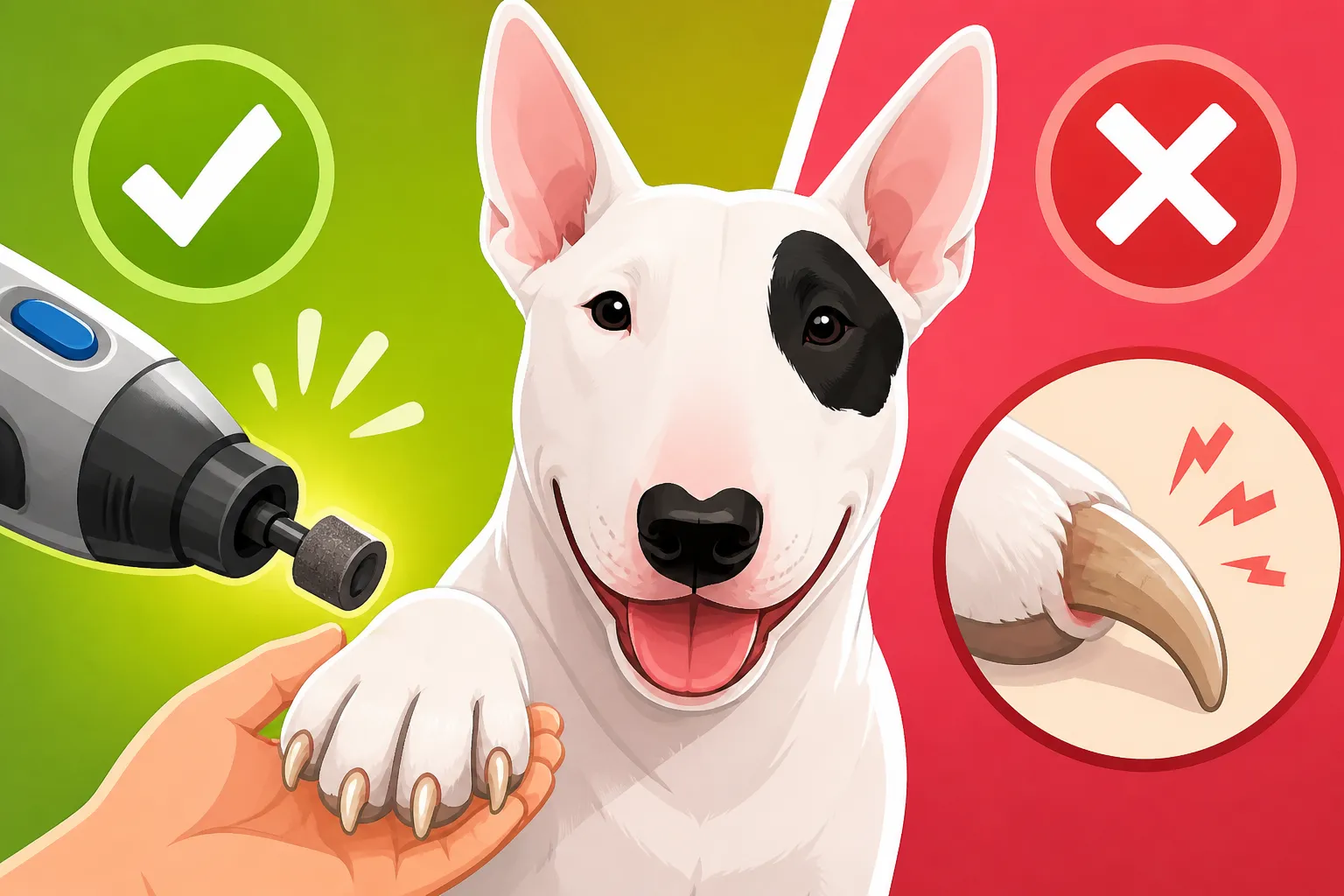
A Dremel tool for pet nails is essentially a small, handheld rotary device fitted with a sanding drum or grinding stone. Instead of cutting the nail, it grinds it down. Think of it like a very fine, continuous sanding process. This method offers several distinct advantages, especially for our thick-nailed, sometimes wary Bull Terriers.
Firstly, the biggest benefit is control. You're removing the nail material little by little, in fine layers. This significantly reduces the risk of accidentally cutting into the quick, which is a huge relief for both you and your dog. You can watch as you grind, seeing the nail thin out and, if you have lighter nails, even observe the quick receding slightly with each session. This gradual approach is far less startling for a dog than the sharp "snip" of clippers, which can often be associated with past pain. The lack of a sudden jolt can be a huge step towards making nail trims a more positive experience. Over time, with consistent dremeling, the quick actually tends to recede further back into the nail bed, allowing you to gradually shorten the nails more effectively than you often can with clippers. This is a massive win, especially if your Bull Terrier has historically had very long quicks.
Secondly, a Dremel leaves the nail smooth and rounded. No more sharp, jagged edges that can snag on carpets, scratch furniture, or, let's be honest, leave unintentional marks on your legs when your affectionate Bull Terrier jumps up for a greeting! The smooth finish is not only aesthetically pleasing but also more comfortable for your dog and safer for your household. Most Dremel tools come with various attachments and speed settings, allowing you to customize the grinding experience to your Bull Terrier's nails and comfort level. You can start with a lower speed for nervous dogs or fine-tuning, and move to a higher speed for quicker material removal on thicker nails, giving you flexibility that traditional clippers simply can't match.
The Initial Learning Curve: Introducing Your Bull Terrier to the Dremel
Now, let's be realistic: a Dremel isn't a magic wand. You can't just unbox it, turn it on, and expect your Bull Terrier to calmly present their paw. There’s an initial learning curve, and it requires patience, positive reinforcement, and a slow, steady approach. Your Bull Terrier needs to learn that this buzzing, vibrating thing is not a monster.
The key here is desensitization. Start by simply letting your Bull Terrier see the Dremel, turned off. Place it on the floor, let them sniff it, and reward them with high-value treats and praise. Repeat this over several days. Then, move to the sound. Turn the Dremel on, away from your dog at first, then gradually closer. Let them associate the buzzing sound with good things, like their favorite Which Chews Are Safe for a Bull Terrier or a special treat from Chewy. Don't rush this step; some Bull Terriers might be more sensitive to the noise than others. They might eye it suspiciously, wondering Why a Bull Terrier Decides a Cue Is Optional when you ask them to stay calm.
Once they're comfortable with the sound, introduce the vibration. With the Dremel off, gently touch the back of the tool (not the grinding bit) to their paw, then quickly reward. Repeat. Then, with the Dremel on but held away from them, gently touch a toe to mimic the vibration without actually grinding. The goal is to build positive associations, so keep sessions short, positive, and full of rewards. A good strategy is to use the Dremel for just a few seconds, then immediately stop and lavish praise and treats. You might even want to try asking them to perform a simple behavior like Teaching a Bull Terrier to Settle on a Mat during these sessions to help them associate the dremel with calm obedience. Remember, Bull Terriers often don't give you many reps before they lose interest, so How Many Reps a Bull Terrier Gives You will dictate how long your sessions can be. If you're struggling, read up on How a Clicker Lands With a Bull Terrier for an effective positive reinforcement technique that can speed up the process.
Practical Tips for Dremeling Your Bull Terrier's Nails
So, you've decided to give the Dremel a try, and you've introduced it slowly to your Bull Terrier. Now comes the actual process. Setting yourself up for success is crucial, both in terms of your environment and your technique. This isn't just about grinding nails; it's about building a positive, consistent routine that serves both you and your dog.
Setting Up for Success: Environment and Equipment
Before you even plug in the Dremel, take a moment to prepare your space. Choose a quiet, calm area where your Bull Terrier feels relaxed and there are minimal distractions. A kitchen floor with good lighting, or even an outdoor spot on a nice day, can work well. The goal is to minimize anything that might make your Bull Terrier more anxious or prone to sudden movements. Good lighting is essential so you can clearly see the nail and identify the quick as you grind.
When it comes to the Dremel itself, you have options. Corded models tend to be more powerful and won't lose charge mid-trim, but the cord can be a nuisance. Cordless models offer flexibility but require charging and might have less sustained power. Look for a variable speed Dremel, as this allows you to adjust the intensity based on your dog's comfort and the thickness of their nails. Brands like Dremel itself offer dedicated pet nail grinding kits, or you can adapt a standard rotary tool. Many owners find good deals on these tools on Amazon. As for grinding bits, sanding bands are common and effective, but they wear out and need frequent replacement. Diamond bits are more durable and long-lasting, though often a higher initial investment. Whichever you choose, ensure it's clean and in good condition before you start.
And here's a non-negotiable item: styptic powder. Accidents happen, even with a Dremel. If you graze the quick, having styptic powder immediately on hand can stop the bleeding quickly and minimize your dog's distress. You can easily find it at pet stores or online retailers like Chewy. A non-slip surface under your Bull Terrier can also prevent them from sliding around, making them feel more secure and less likely to resist. For very wiggly Bull Terriers, having a second person on hand to gently hold them or provide high-value distractions (like a lick mat smeared with peanut butter or a bully stick) can be incredibly helpful. This ensures your focus remains on the nail, not on restraining your dog.
The Dremeling Technique: A Step-by-Step Guide
Once you're set up, it's time to get grinding. Remember, consistency and a gentle touch are key. Start by holding your Bull Terrier's paw firmly but gently, isolating the toe you're working on. You want to extend the nail slightly, making sure the fur is out of the way to prevent it from getting caught in the grinding bit – that would be an unpleasant surprise for everyone!
Turn the Dremel on to a low or medium speed. Touch the grinding bit to the tip of the nail for just a second or two, then pull it away. This short-burst technique is crucial for two reasons: it prevents heat buildup on the nail, which can be uncomfortable or even painful for your Bull Terrier, and it allows you to assess your progress. You can actually feel the nail for warmth if you touch it lightly with your finger after a brief grind. Repeat this process, gradually working your way down the nail. Focus on the very tip first, and then gently angle the Dremel to grind the sides, creating a smooth, rounded edge. You want the nail to be short enough so it doesn't touch the ground when your Bull Terrier stands naturally.
As you get closer to the quick, you'll start to see a small, dark dot appear in the center of the nail, almost like a "bullseye." This is your warning sign that you're getting very close to the quick and need to proceed with extreme caution, taking off even smaller amounts. If, despite your best efforts, you do nick the quick, don't panic. Immediately apply styptic powder with firm pressure for a few seconds. Stay calm; your Bull Terrier will pick up on your anxiety. Offer a treat and move on to another nail, or end the session if they're too distressed. This is all part of learning how to manage your unique Bull Terrier’s needs, understanding that How often a Bull Terrier's nails need trimming will become a regular, but hopefully less stressful, part of your routine.
Maintaining the Routine: Consistency and Observation
Dremeling is not a one-and-done solution; it's an ongoing commitment. Consistency is vital not just for keeping the nails short, but also for encouraging the quick to recede over time. Aim for weekly or bi-weekly Dremel sessions. Short, frequent sessions are far more effective and less stressful than infrequent, long, drawn-out battles. Think of it as chipping away at a stone, rather than trying to cleave it in one go.
Regular observation of your Bull Terrier's nails will help you gauge how quickly they grow and how well the quick is receding. You want to be able to hear very little, if any, clicking on hard floors when your Bull Terrier walks. Beyond just the nails, these regular paw-handling sessions are an excellent opportunity to perform quick checks on their paw pads for cuts, cracks, or foreign objects, and to inspect between their toes. Bull Terriers can be prone to skin sensitivities, and issues like itchy feet (Whether a Bull Terrier's Feet Itch) can sometimes manifest in paw irritation, making regular checks an important part of their overall health care. This consistent routine will not only keep their nails in top shape but also reinforce positive associations with paw handling, which is beneficial for vet visits and general grooming throughout their life.
Common Challenges and Troubleshooting
Even with the best intentions and the right tools, you might encounter some bumps in the road when Dremeling your Bull Terrier's nails. Their strong personalities and physical quirks can present unique challenges, but with a bit of understanding and persistence, most can be overcome.
Dealing with Resistance and Fear
Despite your best efforts at desensitization, some Bull Terriers will still put up a fight. Their inherent stubbornness means they often do things on their own terms, and nail care might simply not be on their agenda. If your Bull Terrier continues to show significant resistance or fear, don't force it. Forcing the issue can create a negative association that’s incredibly hard to break, potentially undoing all your hard work. Remember, Trimming a Bull Terrier's Nails While It Fights You is not a pleasant experience for either of you.
In these situations, it's perfectly okay to seek professional help. Many vet clinics have veterinary technicians who are skilled at handling nervous dogs for nail trims. Professional groomers are also experts in this area. They often have specific techniques and the experience to get the job done efficiently and with minimal stress. Watching a professional can also give you valuable insights and confidence to try again at home. If the fear is extreme, discuss it with your veterinarian. They might suggest behavior modification plans, or even mild sedatives for particularly anxious dogs to make the experience less traumatic while you continue desensitization at home. Sometimes, a simple trick like the "peanut butter on the forehead" (smearing a dollop of peanut butter on a surface above their head while they're lying down) can distract them long enough to get a paw done. The key is to find what works for your individual Bull Terrier.
Overheating and Nail Damage
A common mistake with Dremeling, especially when you're trying to get a lot done quickly, is letting the tool generate too much heat. The friction from continuous grinding can quickly heat up the nail, causing discomfort or even a burn to the quick, which can be just as painful as a clipper mishap. If your Bull Terrier suddenly pulls their paw away or whines, heat is likely the culprit.
To avoid this, always use the short-burst technique mentioned earlier: grind for 1-2 seconds, then remove the Dremel for a few seconds. This allows the nail to cool down. You can also quickly touch the nail with your finger to check its temperature. If it feels warm, give it a longer break before resuming. Additionally, ensure your grinding bit isn't worn down. A dull or clogged sanding band will generate more friction and heat, and will also be less effective at removing nail material. Replace sanding bands frequently, and keep diamond bits clean.
Another potential issue is nail damage like splitting or chipping. This usually happens if the Dremel is pressed too hard against the nail, if the speed is too high for the type of nail, or if the nail is already compromised (e.g., very dry or brittle). The goal is a smooth, gentle abrasion, not forceful removal. Observe your Bull Terrier's nails closely during and after each session. If you notice any splitting, adjust your technique or consider if there's an underlying issue with their nail health that needs veterinary attention. By being mindful of these potential pitfalls, you can ensure the Dremel remains a positive and safe grooming tool for your Bull Terrier.
Dremel vs. Clippers: A Quick Comparison for Bull Terrier Owners
Deciding between a Dremel and traditional clippers really comes down to what works best for you and your Bull Terrier. Both have their pros and cons, and understanding them can help you make an informed choice.
| Feature | Traditional Clippers | Dremel (Rotary Tool) |
|---|---|---|
| Method | Snips/cuts the nail | Grinds/sands the nail down |
| Speed | Very fast for experienced users | Slower, more gradual process |
| Risk of Quicking | High, especially with dark nails and nervous dogs | Low, as material is removed gradually |
| Nail Finish | Can leave sharp edges, potential for splitting | Smooth, rounded finish |
| Sound | Quick 'snip' sound, can be startling | Consistent buzzing/whirring, can be intimidating initially |
| Training Needs | Dog needs to tolerate restraint and quick cuts | Dog needs desensitization to sound/vibration |
| Equipment Cost | Relatively low | Higher initial cost, ongoing cost for bits |
| Quick Recess | Little to no effect, or can make quick longer | Encourages quick to recede with consistent use |
| Physical Effort | Requires firm grip and hand strength | Requires steady hand and focus |
| Best For | Dogs tolerant of clipping, lighter nails, quick trims | Nervous dogs, dark nails, receding the quick, smooth finish |
For many Bull Terrier owners, the Dremel's ability to minimize the risk of hitting the quick and provide a smoother finish makes it a superior option, even with the initial learning curve. It transforms a high-stress event into a controlled, manageable routine, which ultimately benefits both dog and owner.
Disclaimer
This article is for general informational purposes only and does not constitute professional advice. Laws, prices and regulations vary by location and change over time. Consult a qualified professional for guidance on your specific situation.