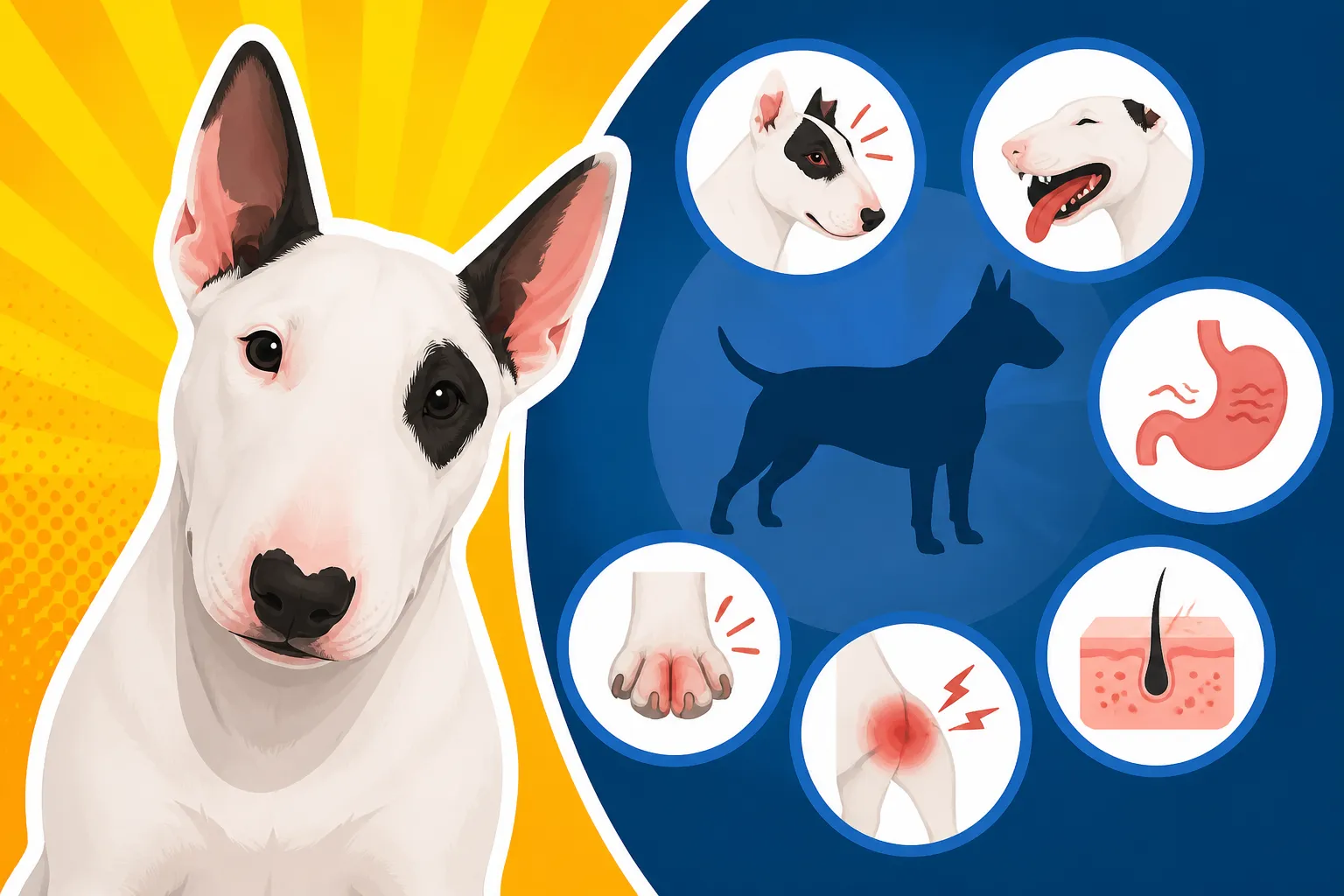
Which Problems the Miniature Bull Terrier Has Instead
A Miniature Bull Terrier may look like a smaller version of the standard Bull Terrier, but its health risks are not simply scaled down. Some concerns overlap between the varieties, while others deserve particular attention when choosing a puppy or caring for an adult. This guide explains the main problems to ask about, what screening can and cannot tell you, and which changes merit a veterinary visit.
Miniature Bull Terrier health risks are not just about size
A smaller body does not automatically mean fewer health problems. Miniature Bull Terriers share much of their breed background with standard Bull Terriers, and both can develop inherited conditions. At the same time, the conditions breeders prioritize may differ in emphasis, so it is worth asking specifically about Miniature Bull Terrier health testing rather than assuming that a general Bull Terrier health panel tells the whole story.
The Miniature Bull Terrier Is a Different Breed guide explains why the Miniature is treated as its own breed. For a prospective owner, the practical point is simple: look for health information that applies to Miniature Bull Terriers, and ask for the actual results behind any broad claim that a puppy’s parents are “health tested.”
Primary lens luxation is a key issue to ask about
Primary lens luxation, often shortened to PLL, affects the eye’s lens. The lens is held in position by fine fibers; when those fibers weaken, the lens can shift from its normal place. This can be painful and may threaten vision, particularly if the lens moves forward and interferes with fluid drainage inside the eye.
A dog may not show an obvious problem before an episode begins. Warning signs can include sudden squinting, redness, tearing, cloudiness, rubbing at the eye, or a change in how the eye looks. Sudden eye pain or a cloudy, red eye should be treated as urgent rather than watched for several days. A veterinarian can examine the eye and advise whether referral to a veterinary ophthalmologist is needed.
Ask a breeder whether both parents have had the relevant DNA testing and request to see the results, not just a verbal assurance. A DNA result can help assess inherited risk, but it does not replace an eye examination when symptoms appear. For more on the condition itself, see Primary Lens Luxation in a Bull Terrier.
Kidney and heart screening still matter
Kidney disease is another important subject to raise before bringing home a Miniature Bull Terrier. Inherited kidney conditions can be difficult for owners to spot early because a dog may seem well while abnormalities are developing. A normal appetite and playful behavior do not, on their own, confirm that a dog’s kidneys are healthy.
Ask what kidney screening has been performed on the parents and what follow-up the breeder recommends for puppies as they grow. Depending on the dog’s history and veterinary advice, checks may include urine testing, bloodwork, or imaging. A urine protein measurement can help a veterinarian decide whether further assessment is needed; it is not a stand-alone diagnosis. The related guide How a Bull Terrier's UPC Sample Is Collected explains what owners can expect when a urine protein-to-creatinine ratio is measured.
Heart screening is also worth discussing. A veterinarian may listen for a murmur during routine examinations, but a murmur alone does not explain the cause or severity of a heart problem. If an exam raises concern, the vet may recommend additional evaluation, such as an echocardiogram. The article The Heart Murmur a Bull Terrier Puppy Should Be Checked For covers why a puppy’s heart check is more than a quick formality.
Problems that may deserve particular attention in a Miniature
Some conditions are shared across Bull Terrier varieties, but their relevance and screening priorities can vary. This is why it is better to ask, “What conditions are you screening for in this Miniature Bull Terrier line?” than to rely on a general breed label or assume that every risk applies equally to every dog.
| Concern | Why owners should know about it | Useful next step |
|---|---|---|
| Primary lens luxation | A displaced lens can cause pain and threaten vision | Ask about DNA testing and seek prompt care for sudden eye symptoms |
| Kidney disease | Early changes may not be obvious at home | Ask about parental screening and a veterinary plan for urine and blood checks |
| Heart disease | A murmur may need further investigation | Keep routine exams and follow up on any finding |
| Patellar luxation | A kneecap may move out of its normal position | Ask the vet to assess gait and knees, especially if limping occurs |
| Deafness | Hearing ability cannot be judged reliably by coat color or casual observation | Ask whether the puppy has had a BAER hearing test |
| Lethal acrodermatitis | A rare inherited condition can affect growth, skin, and immunity | Ask about testing and the family history |
Patellar luxation can affect movement
Patellar luxation occurs when the kneecap moves out of its usual track. Some dogs show little obvious discomfort, while others may skip, briefly hold up a hind leg, or develop a persistent limp. Owners sometimes mistake a few skipping steps for a quirky gait, particularly when a lively young dog quickly returns to running around.
If you notice repeated skipping, stiffness, reluctance to jump, or an uneven gait, make a veterinary appointment instead of assuming the dog has simply pulled a muscle. A vet can assess the knees and determine whether monitoring, activity adjustments, or further treatment is appropriate. A breeder’s screening information can be useful, but it cannot guarantee that a puppy will never develop a problem. See Patellar Luxation in a Bull Terrier for a fuller explanation of the condition.
Hearing should be checked rather than guessed
Deafness can occur in Bull Terriers, and coat color alone is not a reliable way to determine whether an individual dog can hear. A puppy that does not respond to a sound might be distracted, asleep, or still learning; conversely, a puppy may appear to respond by noticing vibration or watching people rather than hearing the sound.
A BAER test measures the brain’s response to sound and can identify hearing status in each ear. That distinction matters: a dog may hear normally in both ears, have hearing in one ear, or be deaf in both. Ask whether the breeder has BAER test results for the puppy, and request the result rather than relying on a general statement that the litter “seems to hear.” What a BAER Test Tells a Bull Terrier Owner describes what the test can establish.
Lethal acrodermatitis is rare but worth discussing
Lethal acrodermatitis, or LAD, is a serious inherited condition associated with Bull Terriers. Affected puppies may have problems involving growth, skin, paws, and immune function. It is not something owners can reliably rule out by looking at a puppy once; questions about testing and family history belong in a careful breeder conversation.
Ask whether the parents have been tested where testing is available and how the breeder interprets the results. A carrier is not the same as an affected dog, and a result should be explained in context rather than treated as a reason to panic. For Miniature-specific context, read Whether a Miniature Bull Terrier Carries Acrodermatitis. General background is also available in What a Bull Terrier Breeder Should Have Tested.
Choosing a puppy and keeping track of health
Health testing is useful when it is specific, documented, and connected to a sensible plan for the dog. It cannot promise that a puppy will never become ill. Still, asking good questions before a purchase or adoption can help you understand known risks, budget for routine monitoring, and avoid being left with vague assurances.
Ask the breeder for records and a clear explanation
Start with practical questions: Which tests were performed on the sire and dam? Which results can you see? Were the tests done by an appropriate laboratory or veterinary professional? What screening does the breeder recommend as the puppy matures? A responsible answer should be specific enough that you can follow up with your veterinarian.
It is also reasonable to ask about the health of close relatives, while understanding that a family history cannot predict an individual dog’s future with certainty. If a breeder tells you that a condition “doesn’t happen in this line,” ask what records support that statement. The broader checklist in Which Health Tests a Bull Terrier Breeder Should Run can help you organize the conversation, though you should confirm which tests are relevant to the Miniature variety and the specific family.
For a puppy you already own, gather the breeder’s records and bring them to the first veterinary visit. Your vet can help decide what to repeat, what to monitor, and what is already adequately documented. Keeping test reports in one folder, alongside vaccination and visit records, can make follow-up much less stressful.
Build a simple routine for noticing changes
At home, focus on changes from your dog’s normal behavior rather than trying to diagnose a condition yourself. Notice whether your dog is eating and drinking as usual, moving comfortably, responding to familiar sounds, and keeping its eyes open without squinting or rubbing. A short note on your phone about when a change started can be useful during an appointment.
Routine veterinary examinations give your vet a chance to discuss the dog’s history and decide whether screening is appropriate. Do not wait for the next scheduled check if you notice sudden eye pain, repeated limping, a major change in thirst or urination, unusual weakness, or a sudden change in hearing or responsiveness. The right next step depends on the symptom and the dog’s individual history.
If a veterinarian recommends ongoing medication or a particular diet, follow the exact instructions and check with the clinic before substituting products. Owners may arrange prescribed supplies through their veterinary practice or a retailer such as Chewy, but the product and formulation should match the vet’s recommendation. Chewy is one possible place to check for an item your clinic has already approved; it is not a substitute for deciding what treatment the dog needs.
Caring for a Miniature Bull Terrier with a diagnosed condition
A diagnosis can feel overwhelming, especially when the dog still looks cheerful and energetic. That mismatch is common: some health problems require monitoring before they cause obvious day-to-day changes. Ask the vet to explain what is known, what remains uncertain, which signs matter at home, and when to schedule the next check.
Keep monitoring manageable and consistent
If your vet recommends repeat urine, blood, eye, or heart checks, write down the reason for each one and the proposed timing. Ask what result would lead to a change in the plan. Understanding the purpose of monitoring makes it easier to follow through and less likely that a missed appointment turns into a long period of uncertainty.
For kidney concerns, do not change food, restrict protein, or add supplements without veterinary guidance. The right approach depends on the diagnosis and test results. If a prescribed food is recommended, check with your vet before changing formulas; if you use a retailer such as Chewy to obtain an approved diet, confirm that you have selected the exact product your vet discussed.
For an eye condition, follow the prescribed treatment and keep any recheck appointments even if the dog seems more comfortable. Eye problems can change quickly, and an owner may not be able to judge whether the underlying issue has resolved simply by looking at the dog. If symptoms worsen or new pain appears, contact the clinic promptly.
Avoid treating every possible risk as a diagnosis
A breed predisposition is a reason to ask questions and stay observant, not a prediction that your dog will develop every condition on a list. A Miniature Bull Terrier can live a happy, active life without developing the problems discussed here. Conversely, being from a well-screened litter does not mean that routine veterinary care can be skipped.
Try to keep prevention practical: choose a breeder who shares relevant records, establish care with a veterinarian, keep up with recommended exams, and act when you see a meaningful change. For long-term prescription refills, use the route that works for your household and is approved by your vet. If you order through Chewy or another pharmacy, check the medication name, strength, and instructions against the current prescription before giving it.
The most useful question is not whether a Miniature Bull Terrier is “healthy” or “unhealthy” as a whole. It is whether you understand the risks that matter for this dog, have reliable records where available, and know whom to call when something changes. That gives you a grounded way to care for a spirited little dog without letting every possible condition take over everyday life.
Disclaimer
This article is for general informational purposes only and does not constitute professional advice. Laws, prices and regulations vary by location and change over time. Consult a qualified professional for guidance on your specific situation.