What the Bull and Terrier Did Before the Bull Terrier
A Bull and Terrier was not a single standardized breed, but a practical kind of dog shaped by the work people expected it to do. Its history is often reduced to fighting, yet that misses the changing mix of bull-baiting, ratting, hunting, and companionship behind the type. This guide explains what these dogs did, how their roles changed, and how they relate to the Bull Terrier.
What the Bull and Terrier Was
A working type rather than a registered breed
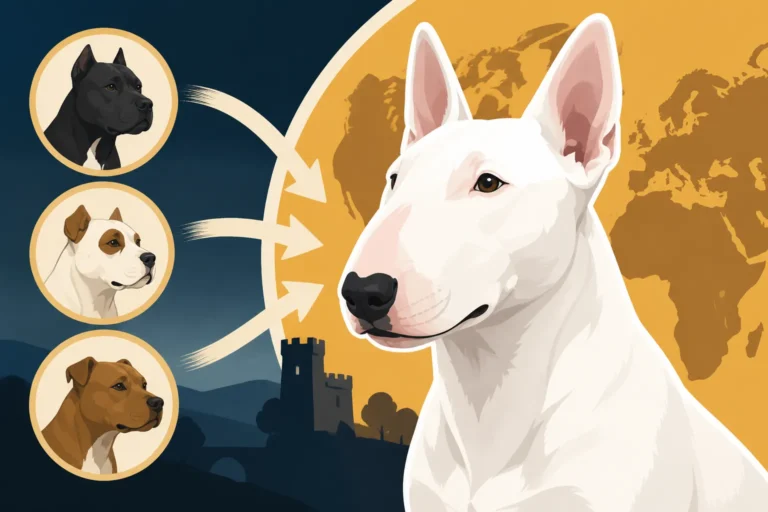
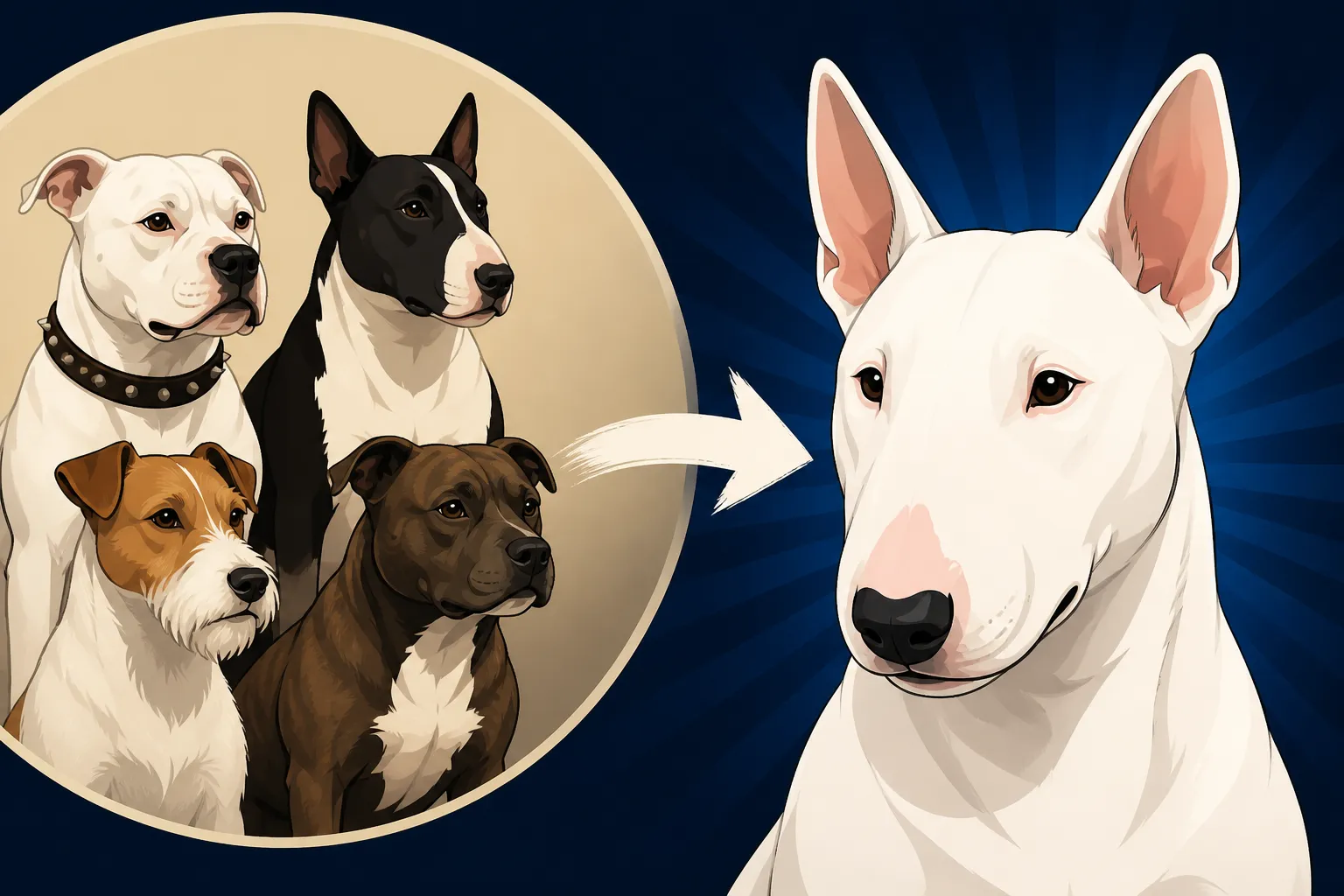
“Bull and Terrier” described dogs produced by crossing bulldog-type dogs with terriers. The name referred to a broad type, not a consistently defined breed with a shared written standard. Dogs called Bull and Terriers could vary in size, build, coat, and temperament depending on their ancestry and the work their owners wanted them to do.
The bulldog side of the cross was associated with strength and tenacity, while terrier types were valued for agility and the ability to pursue small animals. These broad descriptions should not be taken as a precise recipe: historical breeding records are limited, and the dogs themselves were not uniform. Different communities and breeders could use similar names for dogs with different backgrounds.
The type also predates the modern Bull Terrier. It is useful to think of the Bull and Terrier as one part of a much wider history of working dogs, rather than as a fully formed version of the breed recognized today. For a closer look at the later breed’s development, see Which Breeds Went Into the Bull Terrier.
Why people combined bulldogs and terriers
People often bred dogs for a task rather than for a modern breed label. A dog that needed to work in close quarters might be expected to combine physical strength with speed and persistence. Crossing bulldog-type dogs and terriers was one way people tried to bring those qualities together.
That does not mean every dog from such a cross had the same abilities, or that the results were predictable. A dog’s usefulness also depended on its individual build, health, training, and environment. Historical descriptions can make the dogs sound like carefully engineered tools, but breeding practices were not necessarily systematic, and surviving records rarely tell us much about the individual animals.
It is also easy to project present-day breed categories backward onto the past. The Bull Terrier’s later name and recognizable appearance can make earlier Bull and Terriers seem like direct, unchanged ancestors. In reality, the path from mixed working dogs to established breeds involved many generations, local preferences, and changes in what people wanted from a dog. What the Bull and Terrier Was
The difference between a Bull and Terrier and a Bull Terrier
The names are similar, but they do not mean exactly the same thing. “Bull and Terrier” generally refers to a historical type or group of crosses. “Bull Terrier” refers to a later breed developed into a more recognizable and consistent form. The distinction matters because stories about early Bull and Terriers are not automatically descriptions of every modern Bull Terrier.
The modern breed’s development is associated with nineteenth-century Britain and with breeders who selected dogs for a more distinctive appearance and role. By then, the social world around dogs was changing too. Some traditional blood sports were being restricted, urban life was expanding, and showing dogs became an increasingly visible pastime. Those shifts helped move breeding away from a purely practical working identity.
For more on the transition from earlier dogs to the breed, read Where the Bull Terrier Comes From and Who James Hinks Was. The history is not a perfectly documented family tree, so it is more accurate to describe the modern Bull Terrier as emerging from a broad working-dog background than to claim that every detail of its ancestry is certain.
The Jobs Bull and Terriers Were Used For
Bull-baiting and other blood sports
One of the best-known historical associations is bull-baiting, in which dogs were set against a tethered bull as public entertainment. The practice was cruel to the animals involved, and it belongs to a period when organized animal baiting was treated as spectacle. Bull-baiting was not simply a test of a dog’s everyday usefulness; it was a deliberately staged contest.
It is important to distinguish bull-baiting from dog fighting. They were different activities, even though both involved animal cruelty and are sometimes blurred together in simplified accounts. Dogs bred or used for one purpose might be discussed alongside dogs used for another, but that does not establish that all Bull and Terriers took part in every blood sport.
A dog’s historical association with these practices is not a reason to romanticize them. Words such as “courage” and “tenacity” sometimes appear in old accounts, but they can make violent entertainment sound admirable. A more honest account recognizes both the traits people sought and the harm inflicted on animals. Whether the Bull Terrier Was a Fighting Dog
Ratting and controlling vermin
Ratting was another activity associated with terrier-type dogs. In the past, rats could be a serious nuisance around stables, warehouses, farms, and crowded urban buildings. Dogs that could locate and catch small animals had a practical role in environments where people wanted to control vermin.
This kind of work differed from bull-baiting. It involved pursuing or catching small animals rather than confronting a large one in a public contest. Ratting also helps explain why people valued quick movement and persistence in terriers. Still, historical references to ratting vary, and it would be too sweeping to say that every dog described as a Bull and Terrier regularly performed it.
People sometimes confuse ratting with the later idea that every terrier was bred for exactly the same purpose. In practice, the word “terrier” covered a range of dogs and working traditions. A dog might be kept for practical pest control, sport, companionship, or several of those reasons at once. For context on the broader working background, see Whether Bull Terriers Were Ratters.
Hunting and other practical roles
Some Bull and Terrier-type dogs were also associated with hunting or with work that required them to pursue and hold onto animals. But broad historical labels can conceal substantial differences between local practices. A dog used in one region or household might not have shared the duties of another dog given the same general name.
It is safer to describe the type as part of a wider working-dog culture than to assign it one definitive job. People valued dogs for traits they believed would help with particular tasks, and the same dog could be expected to serve more than one purpose. The records do not support a neat list of standardized duties for all Bull and Terriers.
| Historical role | What it involved | What to keep in mind |
|---|---|---|
| Bull-baiting | Dogs were set against a tethered bull for public entertainment | It was a cruel blood sport, not an everyday household task |
| Dog fighting | Dogs were made to fight one another | This was distinct from bull-baiting, though accounts may discuss both |
| Ratting | Dogs pursued or caught rats, often in working or urban settings | It was associated with terrier types, but not necessarily every Bull and Terrier |
| Hunting or pursuit | Dogs might be used to chase or hold animals | Practices and terminology varied across time and place |
| Companionship | Dogs could also live with people as household animals | Working and companion roles were not always mutually exclusive |
How the Bull and Terrier’s Role Changed
Laws and changing public attitudes
In Britain, the Cruelty to Animals Act of 1835 prohibited bull-baiting and several other forms of animal baiting and fighting. Laws did not instantly erase every practice, and illegal activities could continue. But restrictions changed the public landscape in which these events took place and contributed to a gradual shift in how dogs were bred, displayed, and valued.
A legal change can be only one part of a cultural change. People’s leisure habits, urban conditions, and ideas about respectable animal ownership also evolved. As some blood sports became less publicly acceptable, dog keeping increasingly included other roles, including companionship and exhibition. The change was uneven, and it should not be described as a clean overnight transformation.
This context helps explain why the Bull and Terrier’s history is not simply a story of one job being replaced by another. Some older practices persisted, while new preferences grew around them. For more on the shift in the breed’s public identity, see How a Fighting Ban Changed the Bull Terrier.
From working dogs to a more recognizable breed
As dog shows and breed standards became more influential, breeders began selecting for a more consistent appearance. The broad, variable Bull and Terrier type gradually gave way to distinct breeds and lines. The Bull Terrier became associated with a recognizable outline and a more deliberate identity as a breed, rather than remaining only a description of a cross.
This development reflects a wider change in dog breeding. Instead of judging a dog solely by whether it could perform a practical task, people increasingly judged dogs by appearance, pedigree, and conformity to a written ideal. That did not mean working traits disappeared from every dog, nor that all early breeders shared the same aims. It meant that the reasons people bred dogs were becoming more varied.
The breed’s history is covered in more detail in When the Bull Terrier Reached America and How the Bull Terrier's Head Changed Over Time. Those later developments help separate the modern breed from the earlier working type, whose dogs were less standardized and less consistently documented.
Why old accounts need careful reading
Historical writing about dogs often uses dramatic language. Accounts may praise a dog’s toughness or describe a contest in vivid terms, but that language reflects the culture and values of the people recording the event. It does not provide a neutral measure of the dog’s character, nor does it tell us what every dog of that type was like.
Names are another source of confusion. A label such as “Bull and Terrier” could be used loosely, and the same name might not mean the same thing across places or decades. Some accounts discuss particular dogs or events; others make broad claims about a category that was never formally standardized. Treating every historical description as a precise breed record can lead to confident but misleading conclusions.
A careful reading separates what is well established from what is inferred. It is well established that bulldog and terrier types were crossed and that dogs in this broad category were associated with blood sports and practical work. The exact ancestry, duties, and behavior of every individual dog are much harder to reconstruct. Whether Hinks Bred the Fight Out of the Bull Terrier
What This History Does and Does Not Tell Us About Modern Bull Terriers
A historical role is not a complete temperament profile
The Bull and Terrier’s past does not tell you exactly how a modern Bull Terrier will behave in a home. Individual temperament is shaped by many factors, including genetics, early experience, health, training, and the environment the dog lives in. A historical association with strength or persistence should not be treated as a prediction that every Bull Terrier will be aggressive or difficult.
At the same time, history can help explain why people may describe the breed as strong-willed, energetic, or physically powerful. Those traits are not a guarantee of any particular behavior, but they are useful reminders that responsible ownership involves thoughtful training, supervision, and suitable outlets for energy. The most helpful approach is to assess the dog in front of you rather than rely on either frightening stereotypes or romantic breed stories.
For a fuller look at public perceptions and the breed’s changing identity, see What People Get Wrong About the Bull Terrier. Historical context adds perspective, but it cannot replace learning about an individual dog’s needs and behavior.
Why it is worth separating history from myth
Breed histories are often told as simple origin stories: one cross created one kind of dog, which then became a modern breed in a straight line. Real histories are usually messier. Breeding practices changed, different dogs were grouped under similar labels, and people’s expectations of dogs shifted over time.
Separating history from myth also helps avoid two opposite mistakes. One is to treat the past as proof that a modern dog must be dangerous. The other is to soften or celebrate the past so much that cruelty disappears from the account. A balanced explanation can acknowledge the dogs’ historical uses without endorsing the practices they were subjected to.
The Bull and Terrier is best understood as part of a changing working-dog tradition: a broad type shaped by human choices, then followed by more clearly defined breeds. That distinction makes the history more accurate and keeps the modern Bull Terrier from being reduced to a single old label.
The clearest answer to what they did
Bull and Terriers were associated with several roles, and those roles varied. Some were used in blood sports such as bull-baiting or dog fighting; terrier-type dogs were also connected with ratting and other practical work. Dogs could additionally be kept as companions, and the boundaries between work, sport, and household life were not always clear.
So the most accurate answer is not that every Bull and Terrier did one specific job. The name described a varied type of dog in a period when people bred and used dogs for different purposes. Over time, laws, changing social attitudes, and dog shows helped shift the emphasis toward distinct breeds and companionship. Understanding that history gives a clearer picture of how the Bull Terrier emerged without confusing its modern identity with the less standardized dogs that came before it.
Disclaimer
This article is for general informational purposes only and does not constitute professional advice. Laws, prices and regulations vary by location and change over time. Consult a qualified professional for guidance on your specific situation.