How the Bull Terrier’s Head Changed Over Time
The Bull Terrier's distinctive, egg-shaped head is arguably its most recognizable feature, a true marvel of selective breeding that sets it apart from every other dog breed. But if you're like many Bull Terrier enthusiasts, you might assume this unique profile was always a part of the breed. The truth is, it wasn't! The journey from its rugged ancestors to the sleek, downfaced "White Cavalier" we know today is a fascinating story of vision, persistence, and quite a bit of artistic sculpting by early breeders. This guide will walk you through the remarkable transformation of the Bull Terrier's head, revealing how its iconic look came to be.
The Foundation: Early Bull and Terrier Head Characteristics
Before the Bull Terrier as we know it existed, there were "Bull and Terriers," dogs bred for fighting and ratting, combining the tenacious spirit of bulldogs with the agility of various terriers. Their heads were a far cry from the smooth, egg-like shape we adore today.
The Rough and Ready Bulldog Ancestry
The earliest ancestors of the Bull Terrier were working dogs, primarily the now-extinct Old English Bulldog. These dogs were built for strength, grip, and resilience, and their heads reflected this purpose. Imagine a broad, powerful head with a pronounced "stop" – that indentation where the forehead meets the muzzle. Their muzzles were typically shorter and wider, designed for gripping and holding. The overall impression was one of raw power and brute force, which was exactly what was needed for their original roles. There was little thought given to aesthetic refinement; function was paramount. These were dogs meant to confront and overpower, and their heads were perfectly suited for that. Where the Bull Terrier Comes From traces these early lines.
When these bulldogs were crossed with various terriers, the resulting "Bull and Terriers" inherited many of these traits. Their heads retained much of the bulldog's robust structure, with a noticeable stop and a powerful, albeit slightly longer, muzzle. They were formidable animals, valued for their courage and bite, and their appearance was a testament to their working heritage.
Influence of the English White Terrier on Refinement
As dog fighting became less socially acceptable, there was a growing desire among some breeders to refine these working dogs, moving them towards a more companionable and aesthetically pleasing form. This is where the English White Terrier, another now-extinct breed, played a crucial role. This elegant, all-white terrier contributed a degree of refinement and a cleaner, more streamlined head shape to the emerging Bull Terrier. While still possessing a stop, the English White Terrier's head was finer and less coarse than that of the Old English Bulldog.
The infusion of English White Terrier blood began to smooth out some of the rougher features, introducing a more elegant skull and a slightly longer, more tapered muzzle. This was the first significant step away from the purely utilitarian head of the original Bull and Terriers. Breeders were starting to consider form as well as function, aiming for a dog that was still powerful but possessed a more aristocratic bearing.
What an Early Bull and Terrier Head Looked Like
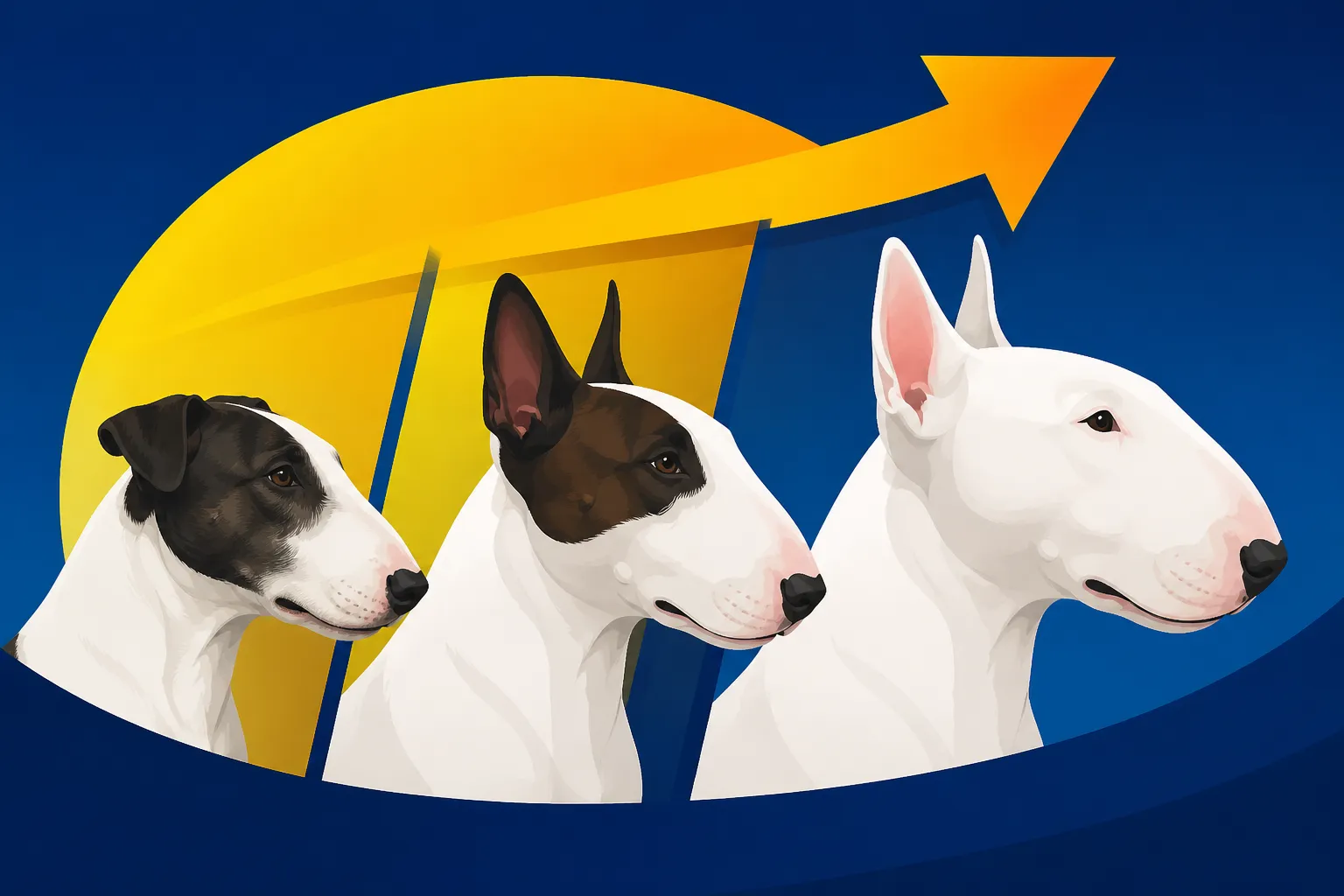
If you were to see an early Bull Terrier from the mid-19th century, before James Hinks began his transformative work, you might struggle to recognize it as the breed we know today. The head would have been noticeably different. It would have featured a definite stop, a wider muzzle, and a less filled-out skull. The eyes would have been more round and often lighter in color, sitting more prominently within the face rather than the deep-set, triangular shape characteristic of modern Bull Terriers.
The profile wouldn't have had that smooth, continuous curve from the top of the skull to the tip of the nose. Instead, there would have been a distinct break at the stop, giving the head a more conventional dog-like appearance. The jaw, while strong, might not have had the same depth and breadth that would later become a hallmark. This early head was a canvas, waiting for a master breeder to sculpt it into an icon. For more on these initial ancestors, explore What the Bull and Terrier Was.
James Hinks and the Dawn of the Modern Profile
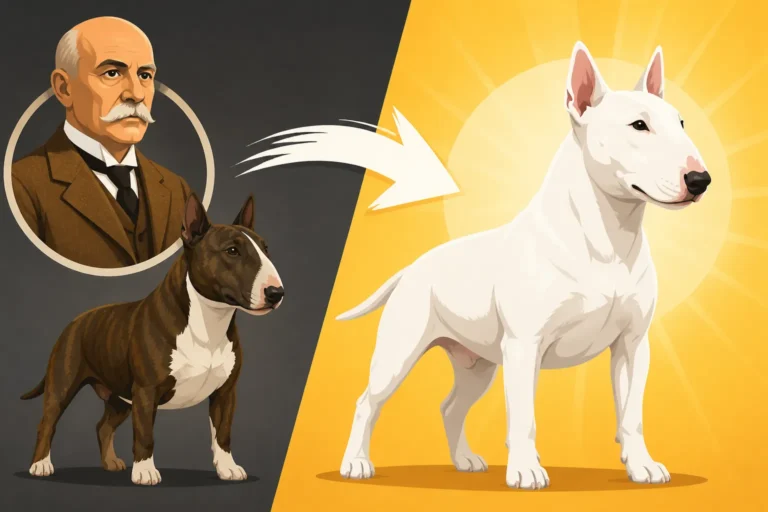
The true architect of the modern Bull Terrier's head was James Hinks, a dog dealer from Birmingham, England. Hinks had a clear vision for a new type of dog: an all-white, powerful yet elegant companion, often referred to as the "White Cavalier." His breeding program in the 1860s was revolutionary, and the changes he wrought upon the Bull Terrier's head shape were perhaps his most significant contribution.
Hinks' Vision for a "White Cavalier"
Hinks was dissatisfied with the existing Bull and Terrier types. He wanted a dog that combined the gameness of its ancestors with a refined, gentlemanly appearance. He envisioned a dog that was powerful but without the brutishness associated with fighting dogs. For him, the head was paramount in achieving this sophisticated aesthetic. He aimed for a cleaner, more symmetrical head with fewer exaggerated features like prominent stops or wide, coarse muzzles. Who James Hinks Was details his pivotal role.
His ambition was to create an animal that was truly unique, a dog that would stand out not only for its spirit but also for its distinctive beauty. The "White Cavalier" moniker reflects this aspiration for elegance and courage, and the head shape he began to cultivate was central to this new image. He consciously moved away from the more traditional terrier or bulldog head, looking to create something entirely new.
Introducing the Roman Finish Concept
One of Hinks' most important innovations was the introduction of what would become known as the "Roman Finish" to the Bull Terrier's head. This term refers to the elegant, slightly convex curve of the muzzle, particularly the bridge of the nose, resembling the aquiline nose often seen in Roman busts. This was a deliberate move away from the flat or slightly dished muzzles common in other breeds. It added a touch of aristocratic grace to the powerful head.
The Roman finish wasn't just about the nose; it was part of a larger concept of a smooth, flowing profile. Hinks sought to reduce the abruptness of the stop, beginning the long process of creating a head that flowed seamlessly from skull to nose. This vision required careful selection of breeding stock, including outcrosses to other breeds that possessed some of these desired traits, such as the Dalmatian.
The Initial Steps Towards the Downface
While the full "downface" as we know it today took more time to develop, Hinks certainly laid the groundwork. He began to breed for a head that had less of a pronounced stop, gradually softening the angle where the forehead met the muzzle. This was a radical departure from the traditional dog head, which almost universally featured a distinct stop. His goal was a head where the planes merged more smoothly.
This initial smoothing of the stop was a crucial evolutionary step. It created a longer, more elegant appearance to the muzzle and skull, contributing to the "Roman Finish" and setting the stage for the extreme egg shape that would follow. Breeders who followed Hinks would take his initial work and push it further, eventually creating the truly unique profile seen in modern Bull Terriers.
The Age of Refinement: Sculpting the Egg Shape
After James Hinks, succeeding generations of Bull Terrier breeders continued his work with a fervent dedication to perfecting the breed's distinctive head. Their goal was to move beyond simply reducing the stop and to actively sculpt a head that was truly one of a kind—the iconic egg.
The Gradual Elimination of the Stop
The complete elimination of the stop was not an overnight achievement; it was a gradual process spanning decades of selective breeding. Breeders meticulously chose dogs that exhibited the least pronounced stop, favoring those whose profiles already showed a hint of the desired continuity. This required an almost artistic eye, visualizing the ideal form and working backward through generations. The objective was a head where, when viewed from the side, there was no noticeable indentation between the forehead and the muzzle.
This persistent effort to flatten the plane of the face and remove the stop distinguished the Bull Terrier from virtually all other breeds. It wasn't just about removing a feature; it was about creating a new, unbroken line that would contribute significantly to the breed's unique silhouette. When the Bull Terrier's Egg Head Appeared marks a critical point in this evolution.
Breeding for a Smooth, Continuous Arch
The "egg" shape isn't just about the absence of a stop; it's about the entire skull and muzzle forming a continuous, unbroken arch. Imagine a perfect, smooth curve extending from the top of the skull, over the forehead, down the muzzle, and finally tapering to the tip of the nose. This is the "downface" or "Roman Finish" at its peak. Achieving this meant selecting dogs with skulls that were not too flat on top, but rather slightly domed, and muzzles that were not pinched or too narrow.
Breeders worked tirelessly to ensure this curve was smooth, without bumps or dips, and that the head was deep from the top of the skull to the lower jaw. This depth, combined with the smooth curve, gave the head its powerful yet refined appearance, making it instantly recognizable even without seeing the rest of the dog. Finding the right balance between robustness and elegance was key.
Filling the Forehead and Backskull
Another crucial aspect of developing the egg-shaped head was "filling" the skull. Early Bull and Terriers often had flatter, less developed foreheads and backskulls. To achieve the desired egg shape, breeders sought dogs with full, well-rounded skulls, particularly between the ears and over the forehead. This "filling" gave the head its characteristic width and substance, especially when viewed from the front, contributing to the oval appearance.
This emphasis on a well-filled skull meant that the forehead was not narrow or pointed but rather broad and muscular, flowing smoothly into the muzzle. This added to the sense of power and solidity that was desired, without sacrificing the sleek lines. It’s a testament to the dedication of these breeders, who spent generations perfecting these subtle yet profound changes. You can read more about this specific feature in How a Bull Terrier's Skull Is Filled Out.
The Triangular Eye and Jaw: Defining Features
As the head evolved into its iconic egg shape, other features adapted alongside it, creating a harmonious and truly distinctive breed standard. The eyes and jaw, in particular, became integral components of the Bull Terrier's unique facial architecture.
Why the Eye Became Small and Triangular
The transformation of the Bull Terrier's head inevitably impacted its eyes. With the gradual flattening of the face and the elimination of the stop, the eyes began to sit deeper in the skull. Breeders also actively selected for small, dark, and triangular eyes, often described as "piercing" or "wicked" in expression. These small, almond-shaped eyes contribute significantly to the breed's unique, somewhat mischievous or intense gaze, and they fit perfectly into the smooth, unbroken curve of the head.
The triangular shape and deep-set nature of the eyes are not accidental. They complement the overall downface, preventing the eyes from appearing round or prominent, which would disrupt the desired smooth flow of the profile. This characteristic eye shape is so distinctive that it's often cited as one of the breed's defining traits. Why a Bull Terrier's Eye Is the Smallest of Any Breed further explores this fascinating aspect.
The Impact on Jaw Strength and Dentition
While the head's aesthetic underwent a significant transformation, the Bull Terrier's ancestral strength, particularly in its jaw, was never compromised. In fact, the deep, powerful jaw became a crucial part of the breed standard. The strong, broad underjaw complements the length and depth of the muzzle, creating a powerful biting apparatus. Despite the refinement of the head, the ability to grip and hold remained essential, reflecting the breed's origins.
The dentition, too, is expected to be strong and correct, with a perfect scissor bite where the upper teeth just overlap the lower. The powerful musculature that supports this formidable jaw is evident in the Bull Terrier's pronounced cheeks, which contribute to the fullness of the head beneath the eyes. This combination of elegance in profile and undeniable power in the jaw is a testament to the breed's unique balance of form and function. Owners often turn to sources like Chewy for sturdy chew toys that can withstand these powerful jaws, ensuring dental health and mental stimulation.
The Overall Aesthetic of the Modern Bull Terrier Head
The modern Bull Terrier head is a masterpiece of selective breeding. It is characterized by its perfect egg shape, with a continuous, smooth curve from the top of the skull to the tip of the nose, devoid of any stop. The skull is full and broad, creating the width necessary for the oval appearance. The deep, powerful underjaw and strong teeth are encased within this unique structure, maintaining the breed's heritage of strength.
The small, dark, and triangular eyes, set obliquely and deep, complete the picture, giving the Bull Terrier its unmistakable expression. When viewed from the front, the head is wide and substantial, tapering slightly towards the nose. From the side, the downface is undeniable, a hallmark that truly sets the Bull Terrier apart as a unique creation in the canine world. This striking head is often what draws people to the breed, captivated by its distinct and powerful beauty.
Variations and Future Considerations for Head Shape
While the iconic egg-shaped head is the standard for the Bull Terrier, variations exist, particularly within the Miniature Bull Terrier, and ongoing discussions often revolve around the health implications of extreme breed characteristics.
The Miniature Bull Terrier's Head Profile
The Miniature Bull Terrier is, in many ways, a smaller replica of its standard cousin. As such, its head profile is expected to mirror the standard Bull Terrier's egg shape, downface, and triangular eyes. The breeding efforts to achieve this distinctive head in a smaller package followed a similar path of careful selection and refinement. Just like the standard, the Miniature Bull Terrier's head should exhibit a smooth, unbroken curve from the skull to the nose, with a full, well-rounded forehead and a deep, powerful jaw.
However, sometimes in the pursuit of miniaturization, or simply due to genetic variations, the head shape in Miniature Bull Terriers can occasionally appear slightly less exaggerated or, conversely, sometimes too refined to the point of appearing delicate. Reputable breeders strive to maintain the same robust, powerful egg head in the miniature version, understanding that it is a fundamental aspect of the breed's identity. They carefully select breeding pairs to ensure that the iconic head shape is preserved, and these smaller versions can still be quite formidable chewers, with many owners purchasing durable chews from retailers like Chewy. How a Bull Terrier Differs From a Miniature Bull Terrier provides a deeper comparison.
Health Implications of Extreme Head Shapes
While the Bull Terrier's head is undeniably striking, the pursuit of extreme characteristics in any breed can sometimes lead to health considerations. The deep-set, small, and sometimes obliquely placed eyes, while contributing to the breed's unique look, could theoretically be associated with certain eye issues, though Bull Terriers are generally considered a healthy breed in this regard compared to some other brachycephalic breeds. The breed's powerful jaw and dentition are typically robust, but careful attention to dental hygiene is always important for all dogs.
Breeders are increasingly focused on balancing the aesthetic demands of the breed standard with overall health and well-being. The extreme downface does not typically lead to the same respiratory issues seen in ultra-short-nosed breeds, as the Bull Terrier's nostrils are generally wide and its air passages clear. However, vigilance is always key in responsible breeding to ensure that desired cosmetic traits do not inadvertently introduce health vulnerabilities.
Maintaining Breed Type While Prioritizing Health
The future of the Bull Terrier's head shape lies in the hands of dedicated breeders who understand the delicate balance between preserving historical breed type and prioritizing the health of the dogs. The egg-shaped head is so central to the Bull Terrier's identity that it would be almost impossible to imagine the breed without it. Therefore, efforts continue to produce dogs that conform to the standard's description of the perfect head: a long, strong, deep head, right to the end of the muzzle, but without coarseness, with a full oval outline, and no indentation (stop).
Responsible breeders diligently test their dogs for various health conditions, ensuring that physical traits do not compromise vitality. They carefully study pedigrees and structure, aiming to produce healthy, long-lived dogs that proudly display the iconic head that James Hinks began to sculpt so many years ago. It’s a continuous journey of refinement, a commitment to both the legacy of the breed and the well-being of its future generations. This commitment extends to every aspect of care, including providing a healthy diet and enrichment products, many of which are readily available through online platforms like Chewy.
| Feature | Early Bull and Terrier (Mid-19th Century) | James Hinks Era (Late 19th Century) | Modern Bull Terrier (20th Century Onwards) |
|---|---|---|---|
| Stop Presence | Pronounced | Significantly reduced | Virtually absent (smooth profile) |
| Overall Profile | More conventional, blocky | Cleaner, beginning to curve | Continuous, unbroken egg-shaped curve |
| Muzzle Shape | Shorter, wider, powerful | Longer, developing "Roman Finish" | Deep, powerful, tapering to nose |
| Skull Shape | Flatter, less filled | Rounding, more substance | Full, well-rounded, especially on forehead |
| Eye Shape/Set | Rounder, more prominent | Darker, beginning to be smaller | Small, dark, triangular, deep-set |
| Jaw Depth | Good, but less refined | Improved, more defined | Excellent depth and power |
Disclaimer
This article is for general informational purposes only and does not constitute professional advice. Laws, prices and regulations vary by location and change over time. Consult a qualified professional for guidance on your specific situation.