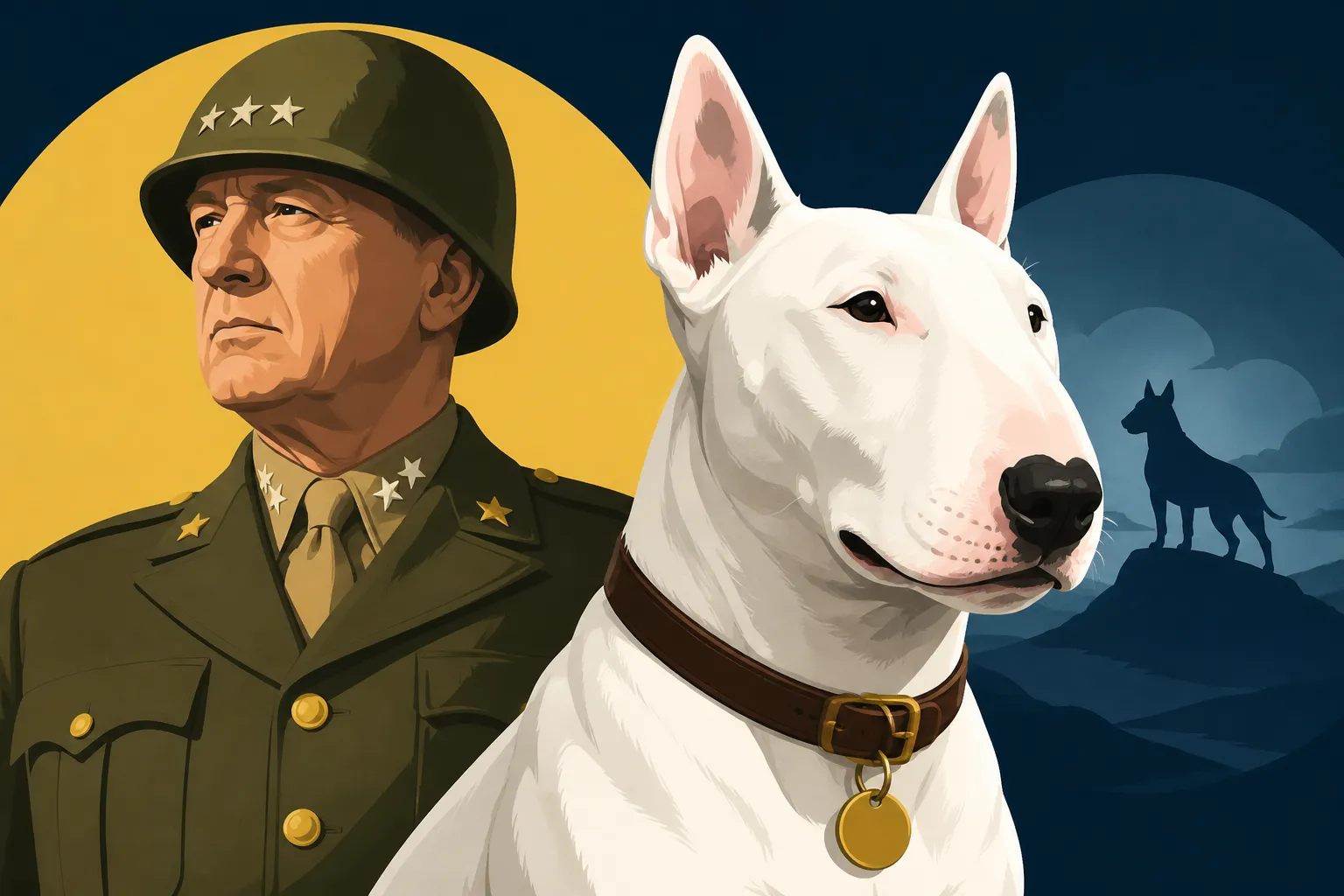
What Happened to Patton’s Bull Terrier Willie
General George S. Patton’s Bull Terrier, Willie, became a familiar presence in stories and photographs from the Second World War. But what happened to him after Patton died? Willie survived his famous owner, returned to the United States, and spent his later life with Patton’s wife, Beatrice. This guide separates the well-known details from the parts of Willie’s story that are less firmly documented.
Who Willie Was
Patton’s Bull Terrier and his full name
Willie was Patton’s Bull Terrier, best known by that short name. His full name was William the Conqueror, a grand title for a dog who became one of the general’s most recognizable companions. He was a black-and-white Bull Terrier, and photographs of him with Patton helped make the dog a small but enduring part of the general’s public image.
Patton was known for his strong personality and military career, but Willie added a more intimate detail to the public picture of him. The dog was not simply a mascot appearing in a staged photograph. Accounts describe Willie as Patton’s companion, traveling with him and sharing the routines of military life where circumstances allowed.
For readers curious about how Willie fits into the wider history of famous dogs, Which Bull Terrier General Patton Owned offers a closely related look at the dog and his place beside the general. Willie also belongs among the Bull Terriers remembered well beyond their own households, alongside dogs whose fame came through popular culture or notable owners. See Which Famous Bull Terriers Everyone Remembers for more examples.
How Willie accompanied Patton during the war
Willie traveled with Patton during his service in Europe. That did not mean a dog could go everywhere a soldier could, or that military life was easy for him. A wartime headquarters was not a normal home: people moved, schedules changed, transport could be uncomfortable, and the surroundings could be noisy and unpredictable. Willie’s presence was a reminder that even a high-ranking officer’s life included familiar, personal routines.
Stories and images of the pair are memorable partly because they contrast with Patton’s stern public reputation. A photograph of a general in uniform beside his dog offers a glimpse of companionship outside the formal chain of command. It is a small humanizing detail, though it should not be mistaken for a complete account of either man’s private life.
Willie’s fame rests on more than his breed or appearance. He is remembered because he was connected to a major historical figure at a dramatic moment in history. That connection helped preserve his name, even though the surviving public record about his day-to-day life is much thinner than the record of Patton’s military career.
A brief timeline of Willie’s story
| Period | What is generally reported |
|---|---|
| During the Second World War | Willie accompanied Patton during his service in Europe |
| December 1945 | Patton died after a car accident in Germany |
| After Patton’s death | Willie returned to the United States and lived with Beatrice Patton |
| Later years | Accounts commonly report that Willie lived until 1955 |
The timeline gives the broad outline, not a detailed diary of Willie’s life. Dates and events concerning Patton are extensively recorded, while a companion dog’s later routine was not documented with the same precision. That difference explains why some details about Willie are repeated more often than they are carefully described.
What Happened to Willie After Patton Died
Willie survived Patton
Patton died in December 1945, following a car accident in Germany. Willie survived him. He was not, as some readers may wonder, lost in combat with Patton or killed in the accident. The commonly reported account is that Willie returned to the United States after his owner’s death.
That simple fact answers the central question, but it can get lost amid the dramatic setting of the war and Patton’s sudden death. Willie was a dog living alongside a military figure, not a soldier. His story continued after the general’s, even if the surviving record becomes less detailed at that point.
It is also worth being cautious about versions of the story that add vivid but unsupported scenes. A touching anecdote may sound plausible, but unless it is tied to a dependable account, it is better not to treat it as established history. The broad outline—Willie survived Patton and returned home—is more useful than a string of unverified details.
Willie’s life with Beatrice Patton
After Patton’s death, Willie is generally reported to have lived with Beatrice Patton, the general’s wife. This is the clearest answer to what became of him: he returned to family life in the United States rather than remaining in Europe. Accounts commonly say he lived until 1955, several years after Patton died.
The change must have been significant for a dog who had spent time in a mobile wartime environment. Returning home meant a different rhythm: fewer military movements, a more settled household, and the presence of a familiar person from Patton’s family. We cannot know exactly how Willie experienced that transition, but it is reasonable to recognize that his life did not end with the end of Patton’s.
The record is not as rich as a modern pet owner might expect. Today, families document a dog’s life through photos, veterinary records, social media, and everyday updates. In the 1940s, a dog’s later years could pass with little public attention, even when the dog had once been photographed beside a famous person. That gap explains why Willie’s final years are usually summarized rather than narrated in detail.
How to read the uncertain parts of the story
When looking up Willie, readers may encounter conflicting details or stories that are repeated without much context. A helpful way to sort them is to distinguish the broad, commonly accepted outline from claims about specific incidents, dates, or behavior. The former is easier to state confidently; the latter may vary between retellings.
| Detail | What can be said carefully |
|---|---|
| Willie’s identity | He was Patton’s Bull Terrier, also known as William the Conqueror |
| His wartime connection | He accompanied Patton during his service in Europe |
| His fate after Patton died | He survived and is reported to have returned to the United States |
| His later home | Accounts place him with Beatrice Patton |
| His death | Accounts commonly give 1955, though detailed records of his later life are limited |
That distinction does not make Willie’s story less meaningful. It simply keeps a historical account honest. The most responsible version does not pretend that every detail of the dog’s private life has been preserved.
Why Willie Became Such a Memorable Bull Terrier
A dog beside a famous general
Willie’s fame grew from his association with Patton, but the photographs matter too. Images make history feel immediate: a person is no longer only a name in a book, and a dog is no longer an abstract detail. Willie gave people a tangible point of connection to Patton’s life away from speeches, uniforms, and battlefield strategy.
There is also a natural curiosity about the private companions of famous people. Readers want to know who was beside them at home or during demanding periods of their lives. Willie’s story meets that curiosity without needing to turn him into a symbol of the war or a character with invented motives. He was a dog who accompanied his owner and outlived him.
Willie is also part of the Bull Terrier’s public history. The breed’s distinctive appearance makes it instantly recognizable in old photographs, while its association with a well-known owner gives people an easy way into the breed’s past. For a broader introduction to the breed’s background, Where the Bull Terrier Comes From explains how it developed and became recognizable.
Willie’s appearance and the Bull Terrier image
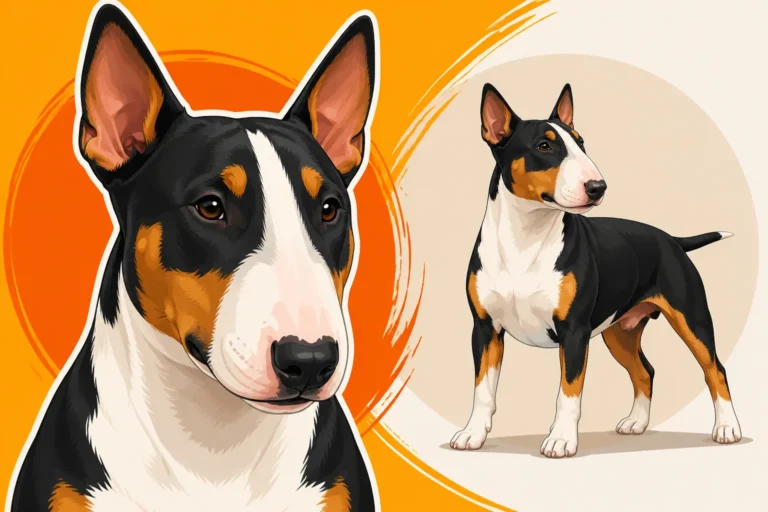
Bull Terriers are often recognized by their strong, muscular bodies and distinctive, gently curved head profile. Willie’s black-and-white coat made him stand out in photographs, but his story should not be reduced to a description of his markings. A dog’s color does not reveal its temperament, training, or individual character.
Breed appearance has changed in some ways over time, and individual dogs do not all look exactly alike. If Willie’s photographs prompt questions about size or build, What a Bull Terrier Weighs and How Tall It Stands offers a general overview of the breed’s proportions. For a closer look at coat patterns and color, see Which Colors a Bull Terrier Comes In.
It is easy to assume that a memorable photograph tells us everything about a dog. In reality, a picture shows one moment. It cannot tell us how Willie behaved at home, how he responded to unfamiliar people, or what routines helped him settle during travel. Those details are part of the story people may want to know, but they are not all preserved in the public record.
What Willie’s story does and does not tell us about the breed
Willie’s life can make the Bull Terrier seem like a breed naturally suited to traveling alongside a busy owner. But one famous dog cannot stand in for every Bull Terrier. Individual temperament depends on the dog, its early experiences, health, training, and the environment it lives in. A historical anecdote is not a substitute for learning what daily ownership involves.
Bull Terriers are often described as energetic, people-oriented, and exuberant, but those broad descriptions do not guarantee that every dog will act alike. Someone considering the breed should think about practical realities such as exercise, supervision, training, and compatibility with their household. What a Bull Terrier's Temperament Is Really Like can help set more realistic expectations than a single photograph can.
It is equally important not to mistake a famous owner’s lifestyle for a recommendation. Patton’s wartime circumstances were unusual, and the fact that Willie accompanied him does not mean every dog should travel in similarly demanding conditions. Modern owners can take inspiration from the companionship in Willie’s story while making decisions based on their own dog’s needs.
What Modern Owners Can Take From Willie’s Story
Companionship matters, but so does routine
The most relatable part of Willie’s story may be the simplest: he was a companion who remained connected to Patton’s family after Patton died. For many dog owners, the bond is built through ordinary patterns—meals, walks, resting in the same room, and the familiar sound of someone coming home. Those routines may not become historical anecdotes, but they are what make a dog feel secure.
A Bull Terrier can bring a lot of energy and personality into a household. That can be delightful, but it also means a family should plan for consistent activity and clear boundaries rather than assuming affection alone will solve every challenge. Readers interested in the breed’s reputation and the assumptions people make about it may also find What People Get Wrong About the Bull Terrier useful.
For a new owner, small practical details can support those routines. Food storage, walking gear, grooming items, and safe enrichment toys are everyday needs, not glamorous parts of dog ownership. Some families use Chewy to organize routine pet supplies; whichever retailer they choose, it is sensible to check that products suit the individual dog and to ask a veterinarian about diet or health-related choices. Chewy is one option for replacing familiar food or basic supplies when a household needs a convenient ordering routine.
Remember the individual dog, not just the famous name
Willie is easy to remember because his name appears alongside Patton’s. But Willie was also an individual dog, and the most respectful way to discuss him is not to invent a personality from a few photographs. We can say that he accompanied Patton and later lived with Beatrice; we should be more careful about claims that go beyond what the record supports.
That lesson applies to living dogs as well. A Bull Terrier may be bold in one situation and uncertain in another, affectionate at home and overexcited around visitors. Owners get better results by watching the dog in front of them than by assuming every breed stereotype—or every famous dog story—will predict their pet’s behavior.
If you are preparing for a Bull Terrier, focus on what the dog in your home needs: suitable food, regular veterinary care, safe outlets for energy, and patient training. Chewy may help with recurring basics such as food or everyday care items, but product choices should fit your dog’s needs rather than a celebrity dog’s image. Willie’s place in history is a reminder of the bond people form with dogs, not a checklist for how every Bull Terrier should live.
The lasting answer
So, what happened to Patton’s Bull Terrier Willie? He survived Patton, returned to the United States, and is generally reported to have lived with Beatrice Patton until his death, commonly dated to 1955. His later years were quieter and less extensively recorded than his wartime life.
That quieter ending is still a meaningful one. Willie was not only a dog in a photograph or a footnote to a general’s biography. He was a companion whose life continued after the public story of Patton ended. Remembering him with care means keeping to the facts we can support—and appreciating the ordinary loyalty that made his story worth telling in the first place.
Disclaimer
This article is for general informational purposes only and does not constitute professional advice. Laws, prices and regulations vary by location and change over time. Consult a qualified professional for guidance on your specific situation.