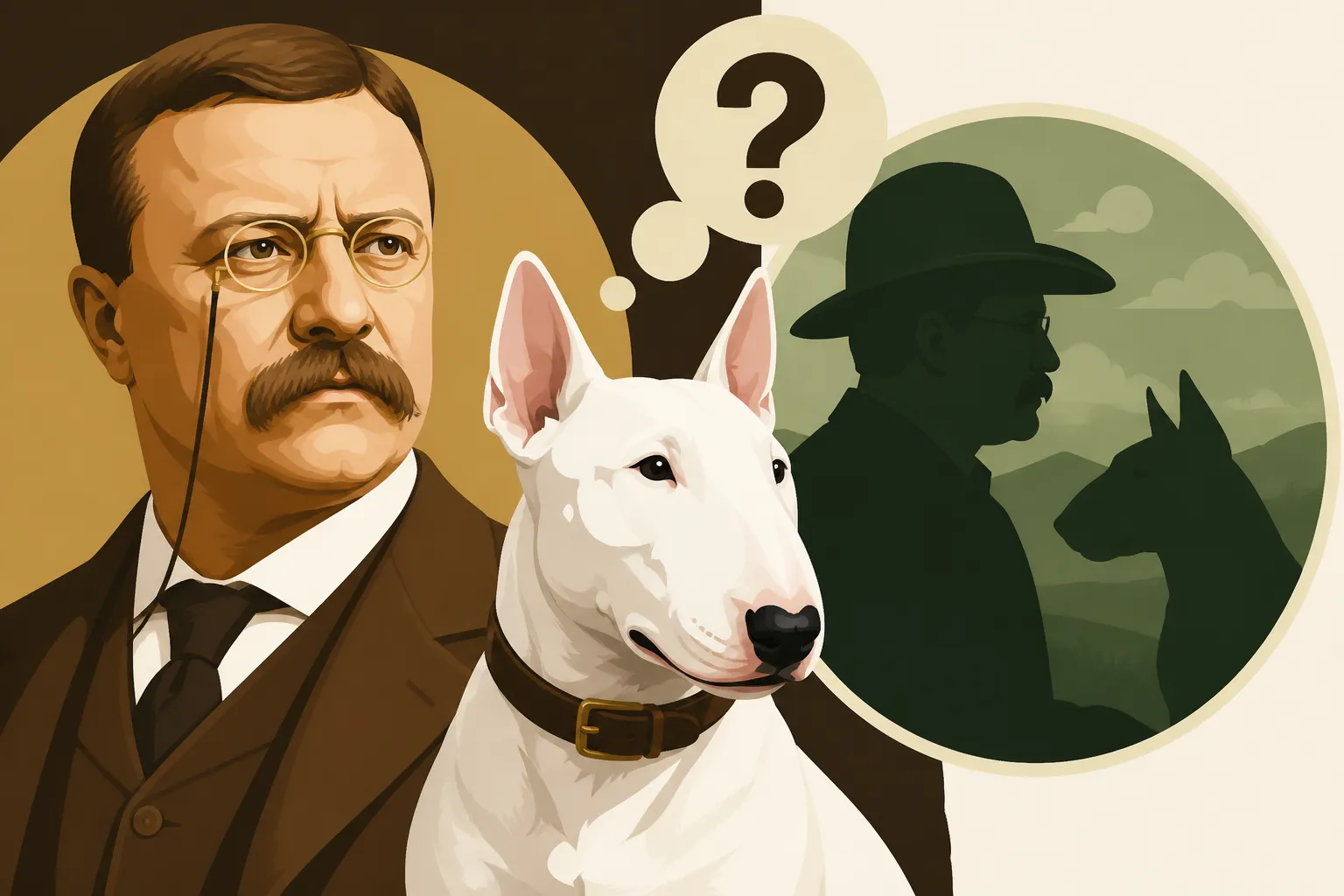
Whether Theodore Roosevelt Kept a Bull Terrier
Theodore Roosevelt did keep a Bull Terrier: a dog named Pete who became part of the Roosevelt family’s White House-era menagerie. But details about Pete’s behavior and what happened after he caused trouble are often repeated as colorful anecdotes, with versions that do not always agree. Here’s what the story can tell us—and what it can’t—about Roosevelt, Pete, and the breed.
Theodore Roosevelt’s Bull Terrier Named Pete
Pete was one of the Roosevelt family’s many pets
Yes, Theodore Roosevelt is widely associated with a Bull Terrier named Pete. He was one member of a notably large household of animals, rather than the family’s only dog. Accounts of the Roosevelts’ pets also name dogs such as Jack, a terrier, and Skip, a mixed-breed dog, alongside animals from other species.
That busy household helps explain why Pete’s story stuck. The Roosevelt family was publicly associated with an energetic collection of pets, and stories about presidential animals were an easy way for people to picture daily life around the White House. A Bull Terrier—compact, strong, and unmistakable in appearance—was memorable in its own right.
Pete is generally identified as a Bull Terrier, not a Miniature Bull Terrier. Those are distinct varieties, and the historical references to Pete do not usually describe him as a miniature. If you’re curious about how the standard breed differs from its smaller relative, How a Bull Terrier Differs From a Miniature Bull Terrier offers useful context.
Pete’s White House reputation comes largely from anecdotes
The most frequently repeated part of Pete’s story is that he got into trouble after biting or otherwise causing an incident involving a foreign diplomat. Some retellings identify the person as the French ambassador; other versions vary in their wording and detail. Pete is also said to have been sent away from the White House to the Roosevelt home at Sagamore Hill after the incident.
It’s sensible to treat the story as a historical anecdote, not as a perfectly documented incident with every detail settled. The broad point—that Pete was a real Roosevelt family Bull Terrier and that his behavior reportedly created a problem—is repeated in accounts of the presidential pets. The exact circumstances are less consistently described.
That distinction matters because entertaining stories tend to get sharpened as they are passed along. “Pete caused a diplomatic embarrassment” is a tidy, dramatic line, but it can make a complicated family-and-pet story sound more certain than the surviving retellings warrant. It is safer to say that Pete was reportedly involved in an incident and was moved away from the White House, rather than to embellish the event with specifics that vary between accounts.
How to Separate the Historical Record From the Colorful Story
What can be stated with confidence
The core answer is straightforward: Roosevelt kept a dog named Pete, and Pete is identified as a Bull Terrier in accounts of the Roosevelt family’s pets. The White House connection is part of why the dog is remembered. Pete’s reported move to Sagamore Hill also fits the broader family story: the Roosevelts maintained a home outside Washington, and their animals were not simply a collection of ceremonial White House props.
It is also fair to say that Pete was remembered as a lively, difficult-to-manage dog. That description should not be turned into a claim that Bull Terriers as a breed are naturally dangerous or incapable of living in a family. One dog’s behavior, especially as recounted through anecdote, cannot stand in for an entire breed.
The breed itself has a history that reaches back well before Roosevelt’s presidency. For more on its origins, see Where the Bull Terrier Comes From. That history helps put Pete in context: he was a representative of a breed already established by the time Roosevelt became president, not a newly created or unusual type of dog.
What should be treated cautiously
Claims about the exact bite, the precise person involved, what Pete did immediately afterward, or the timing of his departure should be handled carefully when different versions do not match. A small variation in a story can be innocent, but several variations together are a clue not to present every detail as settled fact.
A useful way to read these accounts is to separate the central claim from the narrative flourishes. The central claim is that Roosevelt had a Bull Terrier named Pete. The anecdotal layer is the story of Pete’s misbehavior and removal from the White House. The more dramatic the detail, the more important it is to ask whether it is repeated consistently or simply makes the story more entertaining.
| Claim about Pete | How to treat it |
|---|---|
| Theodore Roosevelt kept a dog named Pete | The central historical claim |
| Pete was a Bull Terrier | The breed identification commonly associated with him |
| Pete caused trouble at the White House | A frequently repeated account, best described as an anecdote |
| Pete bit a particular diplomat in a precisely described way | Details vary across retellings, so avoid stating them as certain |
| Pete was sent to Sagamore Hill | Commonly reported as the outcome of the trouble |
This approach is useful well beyond presidential pet history. Famous dogs often acquire stories that blend family memory, newspaper coverage, later retellings, and a little embellishment. The result can be charming, but it is not always a clean record of exactly what happened.
What Pete’s Story Says About Bull Terriers
One memorable dog is not a breed verdict
Pete’s reported trouble can make for a lively story, but it is a poor basis for judging Bull Terriers as a whole. A dog’s behavior depends on many things: individual temperament, early experience, socialization, training, health, and the environment around the dog. A short historical anecdote rarely gives enough information to assess those factors.
The breed’s public image has often been shaped by strong, memorable stories—some about famous individual dogs, others about its history and appearance. For a broader look at how those impressions can become oversimplified, read What People Get Wrong About the Bull Terrier. It is worth keeping the same perspective when discussing Pete: he was one dog in one household, not evidence that every Bull Terrier behaves as he reportedly did.
That distinction is especially important for families who are researching the breed today. A story about a dog getting into trouble does not answer practical questions about the breed’s exercise needs, training, or fit with a particular home. Those questions require a much wider view of the dog’s temperament and day-to-day care.
Roosevelt’s pet-owning world was unusually visible
A president’s dog attracts attention partly because the owner is famous. Roosevelt’s pets were discussed as part of the personality of his household, and Pete’s breed gave the story an extra hook. The dog was not just “a pet”; he was a Bull Terrier connected to a president whose family life and public image drew considerable interest.
That helps explain why Pete is remembered alongside other celebrated Bull Terriers. For a wider look at the breed’s best-known public appearances, see Which Famous Bull Terriers Everyone Remembers. And for another historical example of a Bull Terrier connected with a prominent American figure, Which Bull Terrier General Patton Owned explores a different dog and a different period.
The comparison is helpful, but it should not blur the dogs together. Pete belonged to Roosevelt’s household; General Patton’s dog Willie belongs to a separate story. Their fame comes from different people, settings, and anecdotes. The shared breed name is the connection—not proof that the dogs had similar personalities or lives.
What Pete’s Story Means for People Considering a Bull Terrier Today
Use history as a starting point, not a care manual
Historical stories can make a breed feel vivid. They may prompt questions about how Bull Terriers were viewed, who kept them, and what their lives were like in a prominent household. But they cannot tell you how to train a modern dog or whether one will suit your daily routine.
If you are considering living with a Bull Terrier, focus on the practical realities: the individual dog’s temperament, the time you can spend exercising and engaging with them, and the kind of training and boundaries your household can consistently provide. The breed’s history adds interesting context, but it should sit alongside careful conversations with knowledgeable breeders, rescue groups, and veterinary professionals—not replace them.
It can also help to make a realistic care list before bringing a dog home. Some owners use retailers such as Chewy to browse everyday supplies while planning, but a shopping list is only one small part of responsible ownership. The important questions are whether your home, schedule, and experience are a good match for the particular dog.
Enjoy the anecdote without overreading it
Pete’s story is memorable because it combines a famous president, a distinctive breed, and a reported White House mishap. You can enjoy that story while still being careful about what it proves. The most reliable takeaway is that Theodore Roosevelt kept a Bull Terrier named Pete; the more precise details of the dog’s alleged diplomatic trouble are best presented as commonly repeated anecdote rather than unquestionable fact.
For readers who want to connect the old story to the breed’s broader history, Whether a Bull Terrier Was a Gentleman's Companion offers another angle on the roles Bull Terriers have occupied. And if the practical side of modern dog ownership is what brought you here, browsing supplies through Chewy may help you think through basic preparation—but it will not answer the deeper question of whether a Bull Terrier is right for your household.
Pete remains a small but entertaining part of Roosevelt-era pet history. His story is most useful when it is told with both parts intact: the confirmed association between Roosevelt and a Bull Terrier named Pete, and the caution that a good anecdote can become more definite in the retelling than the details justify. For a new owner assembling a home-preparation checklist, Chewy can be one place to consider for routine pet essentials, while the decision to welcome a Bull Terrier should rest on the dog’s needs and your capacity to meet them.
Disclaimer
This article is for general informational purposes only and does not constitute professional advice. Laws, prices and regulations vary by location and change over time. Consult a qualified professional for guidance on your specific situation.