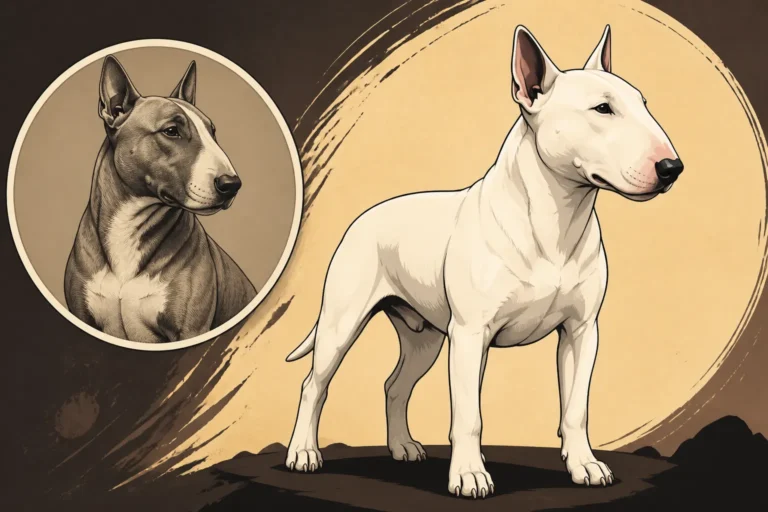
What a Tricolor Bull Terrier Looks Like
A tricolor Bull Terrier can be mistaken for a black-and-white dog with random tan patches, especially in puppy photos where the markings are still developing. The pattern usually combines a dark base, tan points and white areas, but no two dogs have exactly the same layout. This guide explains what to look for, how the pattern differs from similar colors, and what it means for the breed standard.
The tricolor Bull Terrier pattern
The three colors and where they appear
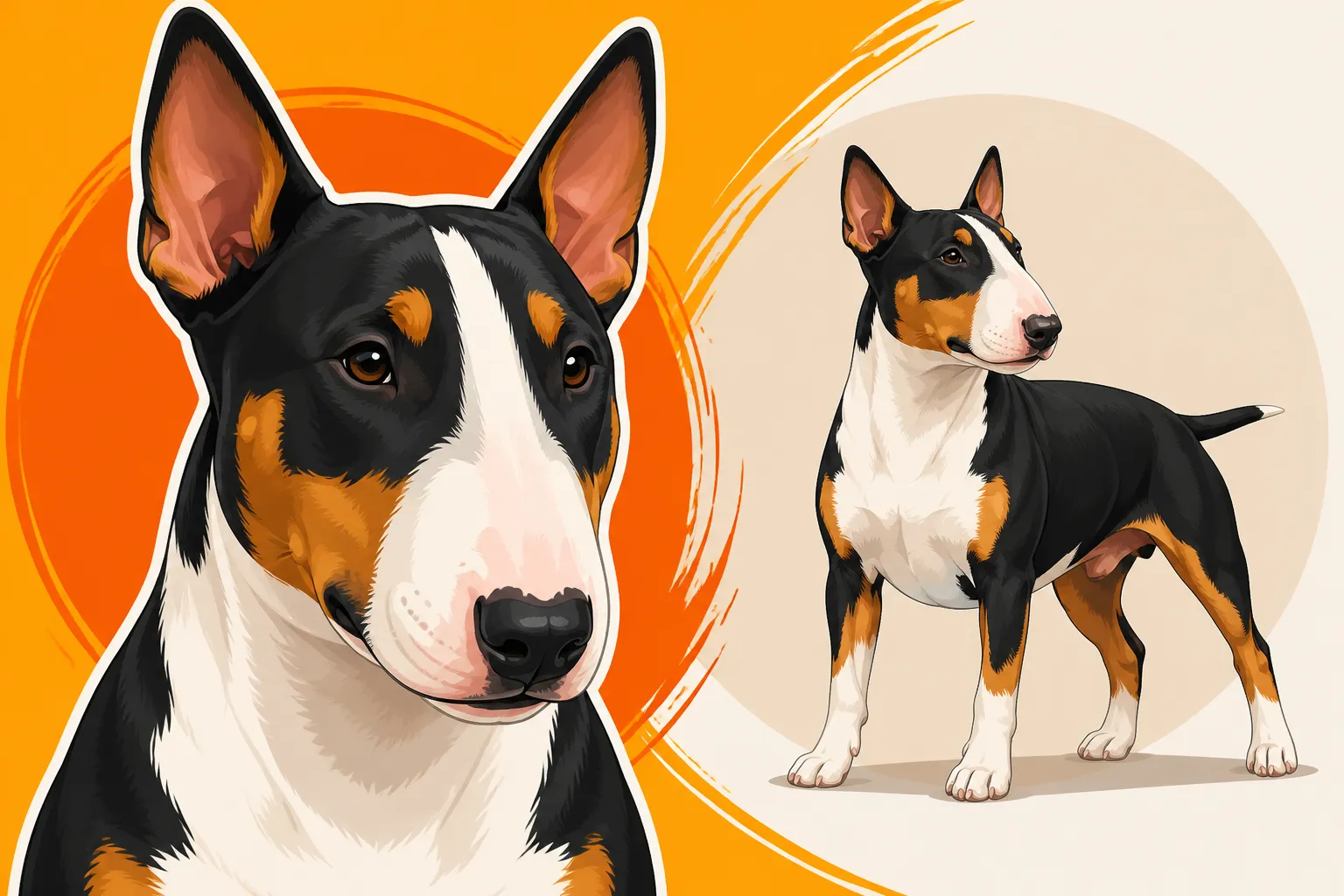
A tricolor Bull Terrier typically has a black or very dark coat, tan markings, and white markings. The tan often appears in recognizable “points,” such as above the eyes, on the cheeks, around the muzzle, on the chest, or on the lower legs. White may show on the chest, feet, muzzle, neck, or parts of the face. The exact arrangement varies from dog to dog.
The word tricolor describes the combination of colors, not a precise map of where every patch must sit. One dog may have a broad white chest and white socks, while another has only a small white mark on the chest and toes. Tan points may be easy to see on the eyebrows and legs, or they may be subtle against a very dark coat.
The Bull Terrier’s short, close coat makes the pattern easy to see. There is no long fringe hiding the outline of a marking, though lighting and camera exposure can make black areas look brown or charcoal in photos. A picture taken in bright sun may also make the tan points appear lighter than they look indoors.
What the pattern looks like on the head and body
The breed’s distinctive egg-shaped head gives its markings a particular look. A tricolor dog may have a dark head with tan above the eyes, on the cheeks, or around the lower muzzle. White can interrupt that dark area, perhaps as a blaze or a patch on the muzzle. The pattern does not change the Bull Terrier’s characteristic head shape, small triangular eyes, or erect ears.
On the body, tricolor markings can look quite different from one dog to another. Some have a mostly dark back with white across the chest and lower legs. Others have a larger white area along the neck or underside. Tan may be visible on the legs and face while remaining absent from most of the torso. These variations are normal features of coat pattern, rather than signs that the dog is a different breed.
Photos can be misleading when a puppy is very young, when the coat is wet, or when the dog is photographed against a dark background. If you are trying to identify a particular dog, look at several clear images in natural light, including the face, chest, legs, and sides. A single close-up of the head may show the tan points but leave out the white markings that help complete the overall pattern.
How tricolor compares with similar Bull Terrier colors
Tricolor versus black and tan
A black-and-tan Bull Terrier has a dark base with tan points, but may have little or no white. A tricolor usually adds visible white markings to that combination. In practice, people sometimes use the labels loosely, especially when a dog has only a tiny white patch that is difficult to see in a photograph.
The distinction is most useful when describing the dog’s overall appearance. If you are filling out paperwork, discussing a puppy with a breeder, or comparing a dog to a written standard, use the color description that the relevant registry or breeder uses. Color terminology can vary, and a brief label may not capture every detail of a dog’s markings.
White markings may be particularly noticeable on the chest, feet, muzzle, or neck. If the dog has a dark coat and tan points but no obvious white, “black and tan” may be a clearer everyday description. If all three colors are plainly present, “tricolor” communicates the combination more fully.
Tricolor versus brindle and white
Brindle is a pattern of darker stripes or streaks over a lighter base color. It can be easy to confuse brindle with a tricolor pattern in a blurry photo, especially if the coat is dark and the lighting is poor. Look closely at the dark areas: brindle typically has a striped or streaked appearance, whereas a tricolor dog’s dark areas are more solid, with separate tan and white markings.
A dog can also have white markings alongside brindle. That does not automatically make the dog tricolor in the usual sense, because the key question is whether distinct tan points are present as well. If the coat is difficult to classify, describe what you can actually see rather than trying to force it into a label based on one small patch.
The following comparison is a practical visual guide. It is not a substitute for a registry’s official color definitions, which may phrase categories differently.
| Everyday description | Main coat appearance | Markings to look for |
|---|---|---|
| Tricolor | Usually a dark base with three visible colors | Tan points plus white markings |
| Black and tan | Dark base with tan points | White may be absent or very limited |
| Brindle and white | Striped or streaked coat with white areas | Brindle pattern; tan points may not be present |
| White Bull Terrier | Predominantly white coat | Colored markings may appear, depending on the individual and the standard used |
For a broader overview of coat possibilities, see Which Colors a Bull Terrier Comes In. If you are comparing a solid dark dog with a tricolor, Whether a Bull Terrier Can Be All Black explains why a dog’s appearance can be more complicated than a quick color label suggests.
Breed standards and the history of colored Bull Terriers
What “color predominates” means
Breed standards generally distinguish between white and colored Bull Terriers. In the colored category, the colored part of the coat is expected to predominate, though white markings may be present. The exact wording and judging guidance depend on the kennel club or registry, so the standard relevant to a particular show or registration should be checked directly.
That distinction is about coat color and conformation, not about whether a dog is a “real” Bull Terrier. A tricolor Bull Terrier is still a Bull Terrier. The pattern does not change the dog’s breed identity, temperament, or physical needs, and it does not tell you whether the dog will be a good fit for a particular household.
Show evaluation is broader than color alone. A judge considers the dog’s overall structure and how it measures against the applicable breed standard. Owners sometimes worry that an unusual or striking pattern means their dog is somehow outside the breed; in ordinary conversation, that concern is usually misplaced. The relevant question is how the dog fits the written standard used by the organization involved.
How colored varieties became part of the breed
The Bull Terrier’s early development included a strong emphasis on white dogs. Colored Bull Terriers later became an important part of the breed, and the history of their acceptance is tied to breeders’ efforts to preserve and strengthen colored lines. That history helps explain why white and colored varieties are often discussed separately, even though both belong to the same breed.
If the background interests you, When Colored Bull Terriers Were Accepted covers the change in recognition, while Who Bred the First Colored Bull Terriers looks at the breeders associated with those early colored dogs. The history is useful context, but it does not mean that a modern tricolor dog should be judged by a different standard of care or treated as a separate type of pet.
It is also worth keeping appearance separate from health assumptions. A tricolor coat does not, by itself, establish that a dog is healthier or less healthy than a white Bull Terrier. Health depends on many factors, including inherited conditions, screening, general care, and the individual dog. For a closer look at that distinction, see Whether a Colored Bull Terrier Is Healthier.
Living with and caring for a tricolor Bull Terrier
Coat care and checking the skin
A Bull Terrier’s short coat is relatively straightforward to maintain, but short hair does not mean the skin can be ignored. Regular brushing can lift loose hair and give you a good opportunity to check for redness, scabs, dry patches, or areas of irritation. Pay attention to the ears, paws, belly, and any place where a collar or harness rubs.
The dark and tan markings do not require separate grooming routines. Use products that are suitable for dogs, follow their label directions, and avoid assuming that a coat looks healthy just because the hair is shiny. If you are choosing a brush or basic coat-care supplies, What a Bull Terrier's Coat Is Like offers useful background. Owners who shop at Chewy may find it helpful to compare the intended use and directions on grooming products rather than choosing something solely because it is marketed for a particular coat color.
White areas can make dirt or skin changes more visible, while dark areas can make subtle redness harder to notice. Check the whole dog in good light, moving the coat with your fingers rather than relying only on a quick glance. If a patch is persistent, itchy, painful, or spreading, ask a veterinarian to assess it instead of trying a series of shampoos or supplements at random.
Sun exposure and everyday decisions
A tricolor Bull Terrier may have exposed or lightly pigmented skin around the muzzle, belly, or other areas where the coat is sparse. A dark coat does not guarantee that every part of the skin is protected from the sun. For outdoor time, provide shade and avoid leaving the dog in direct sun for long stretches, particularly when the dog is resting and cannot choose a cooler spot.
If you are considering sunscreen, choose a product made for dogs and check its instructions with your veterinarian, especially if your dog is likely to lick the area. Human sunscreen is not automatically safe for pets. Chewy can be one place owners look for pet-care supplies, but read the product label carefully and confirm that it is appropriate for your dog’s intended use before applying it.
The same practical approach applies to clothing and outdoor gear. A lightweight shirt may help cover exposed skin in some situations, but the dog should not overheat, and clothing should fit without rubbing or restricting movement. If a tricolor Bull Terrier develops a new dark, crusted, bleeding, or changing skin spot, do not assume it is simply a color marking. Take a clear photo and arrange veterinary advice.
Choosing a puppy by appearance without overlooking health
A striking tricolor coat can catch your eye, but color should not be the only factor when choosing a Bull Terrier puppy. Ask about the parents’ health, the screening relevant to the breed, the puppy’s veterinary care, and the breeder’s approach to raising and socializing the litter. Request to see records and ask what the results mean; a confident explanation is more useful than a vague promise that the dogs are “healthy.”
It is also sensible to ask how the breeder describes the puppy’s color and whether that description matches the registration or show terminology they use. This is especially helpful if you plan to show the dog or need paperwork to match a registry’s classification. If the puppy is a pet, the precise label matters much less than a good match between the dog’s needs and your home.
Before bringing a puppy home, set up the basics, including food, safe chew options, a comfortable resting area, and grooming supplies. Chewy is one retailer owners may consult when organizing those everyday items, but the puppy’s breeder and veterinarian should guide decisions about diet, skin concerns, and any health-specific products. For a fuller view of how appearance fits into the breed’s broader traits, explore How a Bull Terrier Differs From a Miniature Bull Terrier only if you are also comparing the standard and miniature varieties.
Disclaimer
This article is for general informational purposes only and does not constitute professional advice. Laws, prices and regulations vary by location and change over time. Consult a qualified professional for guidance on your specific situation.