Which Bull Terrier Plays Target’s Bullseye
A familiar question comes up whenever Bullseye appears in a Target ad: is it always the same dog? The short answer is no. Bullseye is a character played by Bull Terriers, and the dogs behind the mascot can change over time. Here’s how the role works, what makes the breed recognizable, and what to keep in mind when separating a polished ad dog from everyday life with one.
Which Bull Terrier plays Target’s Bullseye
Bullseye is Target’s mascot, not the permanent stage name of one dog. The character is portrayed by Bull Terriers, with trained dogs taking on appearances and performances as needed. So if you spot Bullseye in a commercial, a live event, or a campaign, it may not be the same individual dog you saw previously.
That distinction matters because brand mascots can feel like single, familiar personalities. Viewers see the same white coat and red target marking and naturally assume the same dog has returned. In practice, the mascot is a role: different dogs can represent it at different times.
Bullseye is a character played by dogs
The safest, clearest answer is that Bullseye is played by Bull Terriers, rather than one dog serving as the mascot forever. Public appearances and advertising work can involve different dogs, and details about an individual dog may not be shared every time the character appears.
This is common for animal roles. A production may need a dog comfortable with a particular location, set, handler, or task. Another trained dog may be better suited to a different scene. The change can be invisible to viewers, especially when the dogs share the breed’s familiar white coat and the signature red circle around one eye.
It’s also worth distinguishing the character from the canine performer. “Bullseye” is the mascot’s name; it doesn’t necessarily tell you the individual dog’s registered or everyday name. If you’re trying to identify the dog in one particular commercial, the campaign’s own credits or publicity are the most useful clues.
For a wider look at other memorable examples of the breed in popular culture, see Which Famous Bull Terriers Everyone Remembers. Bullseye is one of the best-known modern examples, but the breed’s visibility in media extends beyond this mascot.
What breed is Bullseye
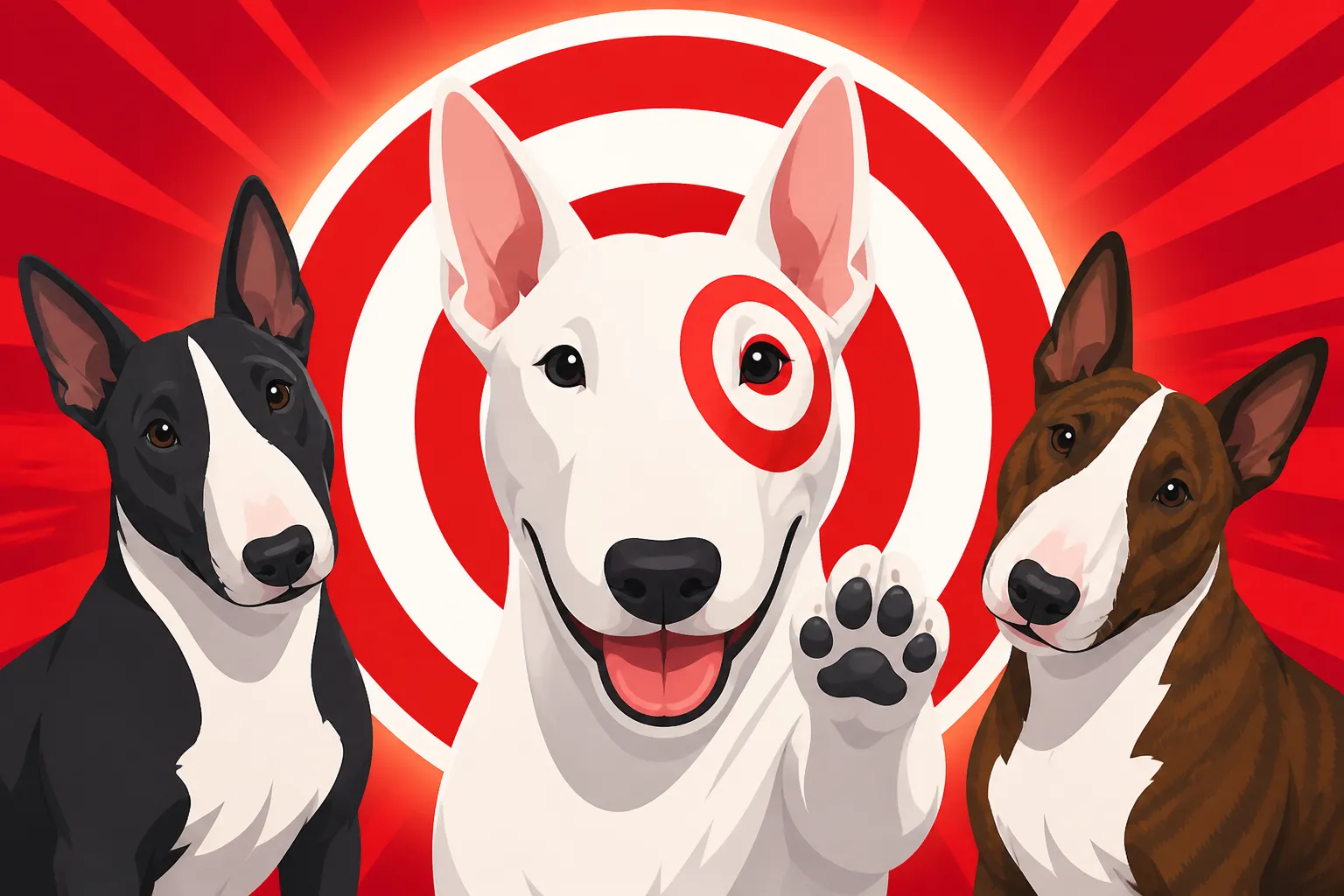
Bullseye is represented as a Bull Terrier. The breed’s distinctive, egg-shaped head, small triangular eyes, and upright ears make it recognizable even when the dog is only on screen briefly. The white coat also gives the red target marking strong contrast, helping the mascot read clearly in advertising.
The target around the eye is a visual design choice, not a natural marking that identifies one specific dog. It helps connect the dog to the retailer’s bullseye symbol. Because the marking is so prominent, viewers may focus on it first and overlook the dog’s breed characteristics.
Bull Terriers also have a compact, muscular build and an animated expression. Those traits can make them memorable in a short commercial, but no single feature tells you an individual dog’s temperament. The breed’s appearance is described in more detail in Why a Bull Terrier's Eye Is the Smallest of Any Breed and How a Bull Terrier's Head Changed Over Time.
Why the individual dog may not be named
A campaign often promotes the mascot rather than the animal performer. That means a commercial might introduce Bullseye without telling viewers which dog appears in the scene. Even when a particular dog is named in an interview or promotional feature, that name may apply to one performance or period rather than every appearance of the character.
There’s another wrinkle: advertising is produced across multiple formats. A dog used in a still photograph may not be the one in a moving scene, and event appearances may involve another trained performer. Audiences generally see a consistent character, while the work behind the scenes can involve a team.
If you’re checking a specific appearance, look for the campaign date, event details, or a feature that names the dog and its handler. Without that information, it’s better to say “a Bull Terrier playing Bullseye” than to confidently attach one dog’s name to every version of the mascot.
How the Bull Terrier became such a recognizable mascot
Bullseye’s look is simple and easy to remember: a white Bull Terrier, a red circle around one eye, and a confident, playful presence. That combination makes the character recognizable in a print ad, on a screen, or at a public event. The design also connects the dog directly to the retailer’s name and visual identity.
The mascot’s appeal isn’t only about looks. A real dog brings movement, expression, and personality to a campaign. A head tilt, a steady gaze, or a well-timed turn can make a short advertisement feel more engaging than a static logo alone.
The red marking is the mascot’s signature
The red target marking around Bullseye’s eye is part of the character’s presentation. It is applied for the role rather than being a breed standard or a natural feature shared by Bull Terriers. That distinction is easy to miss because the design has become so strongly associated with the dog.
The marking also works at a glance. Advertising often has just a moment to get a viewer’s attention, and a bold, simple symbol can be easier to recognize than a more detailed costume or complicated design. The white coat gives the red circle a clear backdrop, while the dog’s eye keeps the image expressive.
It’s sensible to treat the mascot styling as a performance and production choice, not something to copy casually onto a pet. Any product used on a dog should be appropriate for animals and kept away from the eyes unless a veterinarian or qualified professional has confirmed it is safe. If an owner is shopping for everyday dog supplies, Chewy is one retailer people may encounter, but mascot makeup and pet-care products are not interchangeable.
Why the breed works on camera
Bull Terriers have a striking outline that can remain recognizable even in a quick shot. Their profile is distinctive, their ears stand upright, and their compact, muscular bodies give them a strong presence. A camera can capture those features clearly without needing elaborate styling.
Their expressive behavior can also suit short-form advertising. A trained dog may hold a position, look toward a handler, or repeat a familiar action. That doesn’t mean every Bull Terrier will naturally behave like a polished performer. The dog on screen has typically been prepared for the situation, and its handler plays an important role in keeping the work safe and manageable.
A mascot appearance should not be mistaken for a complete picture of breed temperament. The Bull Terrier has a long history as a companion as well as a working breed, and individual dogs differ in energy, sociability, and training needs. Whether a Bull Terrier Is a Gentleman's Companion offers useful historical context for understanding how the breed has been presented and kept.
Bullseye’s popularity is not a breed-care guide
It’s easy to see a cheerful dog in a commercial and imagine that living with one will be just as effortless. Ads show a carefully chosen moment, not a full day of exercise, training, grooming, or veterinary care. The dog may be experienced, conditioned to the environment, and working with a familiar trainer.
Bull Terriers are strong, active dogs. They need thoughtful handling, enrichment, and consistent training, and their enthusiasm can be a lot to manage for someone expecting a low-energy companion. A dog that appears calm under studio lights may be lively at home or in a new environment.
If Bullseye has made you curious about the breed, start by learning about its everyday needs rather than choosing based on its mascot image. Breed history and appearance can help set expectations, but time with adult dogs and candid conversations with responsible owners are useful too. A retailer such as Chewy may be part of a new owner’s supply-shopping routine; it can’t replace preparation for training, exercise, and veterinary care.
Bullseye on screen and the real dog behind the image
The dog in an advertisement is working in a designed setting. There may be handlers nearby, cues outside the camera frame, pauses between takes, and careful choices about what the dog is asked to do. The result is a few seconds of smooth performance, not a spontaneous snapshot of how any dog behaves all day.
Thinking about those differences helps answer two common questions: why the dog looks so composed, and whether a family can expect the same behavior from a Bull Terrier at home. The first is about training and production. The second depends on the individual dog, its background, and the care it receives.
A commercial performance takes preparation
A dog that is comfortable on camera has usually had gradual exposure to people, equipment, movement, and unfamiliar surroundings. Trainers work within the dog’s abilities and use cues the dog understands. Depending on the shoot, a scene may be recorded in short segments rather than as one long performance.
That kind of preparation matters for the animal’s welfare. A busy set can include bright lights, unfamiliar sounds, repeated activity, and people moving around. A responsible production needs to manage the environment and give the dog appropriate breaks. What viewers see as a relaxed moment may be the result of thoughtful planning behind the scenes.
The same principle applies to event appearances. A dog should have space, a handler who knows its signals, and a way to step away when it needs a rest. The mascot costume or marking may be the part people notice, but the dog’s comfort and safety should come first.
A mascot does not represent every Bull Terrier
One dog’s public behavior cannot predict how another Bull Terrier will act. Dogs vary in confidence, tolerance for handling, interest in strangers, and response to noise. Age, experience, health, and training all shape what a dog can comfortably manage.
Families sometimes underestimate the breed because the mascot appears sweet and easygoing. The more realistic expectation is a capable, energetic companion who needs structure and interaction. A Bull Terrier may be affectionate and comical, but it may also be persistent, physically strong, and quick to invent its own entertainment when bored.
Before choosing a dog, consider your routine and resources. Think about who will provide daily walks, training, supervision, and veterinary care. If you’re comparing coat colors or assuming a particular color guarantees a particular personality, Which Colors a Bull Terrier Comes In can help separate appearance from assumptions about behavior and health.
What to know before buying mascot-style products
Some fans may look for a red circle, dog accessories, or Bull Terrier-themed items after seeing Bullseye. It helps to separate official character merchandise from products intended for a pet. A design that looks appealing in a campaign may not be comfortable or suitable for a dog to wear.
For anything placed on a dog, check that it fits properly, does not restrict movement or vision, and can be removed easily. Avoid products that encourage putting material near the eyes or that cause irritation. If a dog paws at an item, tries to remove it, or seems uncomfortable, take it off and reassess.
Chewy is one place owners may browse for ordinary pet supplies, but the important questions are practical: is the item designed for dogs, does it fit the individual animal, and can the dog wear or use it safely? A mascot look should never take priority over comfort.
Bullseye’s place in Bull Terrier history
Bullseye has helped introduce the Bull Terrier to people who may not know the breed by name. The dog’s unmistakable head shape and the red target design make the character easy to remember, and repeated appearances can make the breed feel familiar to a broad audience.
Still, a mascot is only one small part of the breed’s story. Bull Terriers developed as a distinct breed in Britain and later became companions and show dogs. Their public image has shifted over time, shaped by popular culture, individual dogs, and the people who cared for them. Spuds, Bullseye and the Bull Terriers America Remembers looks at that broader cultural footprint.
A mascot can influence how people picture a breed
When a breed appears often in advertising, people may form an impression from a few repeated images. Bullseye presents the Bull Terrier as confident, friendly, and photogenic. Those qualities may be true of the individual dog in a campaign, but they do not describe every dog or cover the demands of ownership.
This is true of any famous animal. A movie dog may seem naturally obedient because viewers see the finished scene, not the training sessions. A mascot may look content surrounded by attention, though another dog could find the same crowd overwhelming. Individual temperament and welfare needs should stay at the center of the conversation.
A more complete picture comes from learning about the breed’s history, care, and behavior. The Bull Terrier’s shape and personality make it distinctive, but the real experience of living with one includes ordinary days: walks in poor weather, practice with training cues, routine health care, and quiet time at home.
What the mascot can and cannot tell you
Bullseye can tell you that the character is represented by a Bull Terrier and that the breed has a memorable visual profile. The mascot may also spark interest in the breed’s history and in other well-known Bull Terriers.
It cannot tell you which individual dog appears in every advertisement, whether a particular Bull Terrier will be easy to train, or what the breed will be like in your household. Nor does it establish that the red eye marking is natural or that the dog is wearing it in every appearance. Those are details that depend on a specific campaign and its production.
So, when someone asks, “Which Bull Terrier plays Target’s Bullseye?” the most accurate everyday answer is: Bullseye is a mascot portrayed by Bull Terriers, and different dogs can take the role. Unless a specific campaign identifies its canine performer, the individual dog’s name may not be publicly clear.
Disclaimer
This article is for general informational purposes only and does not constitute professional advice. Laws, prices and regulations vary by location and change over time. Consult a qualified professional for guidance on your specific situation.