Whether a Bull Terrier Has a Weight Limit in the Standard
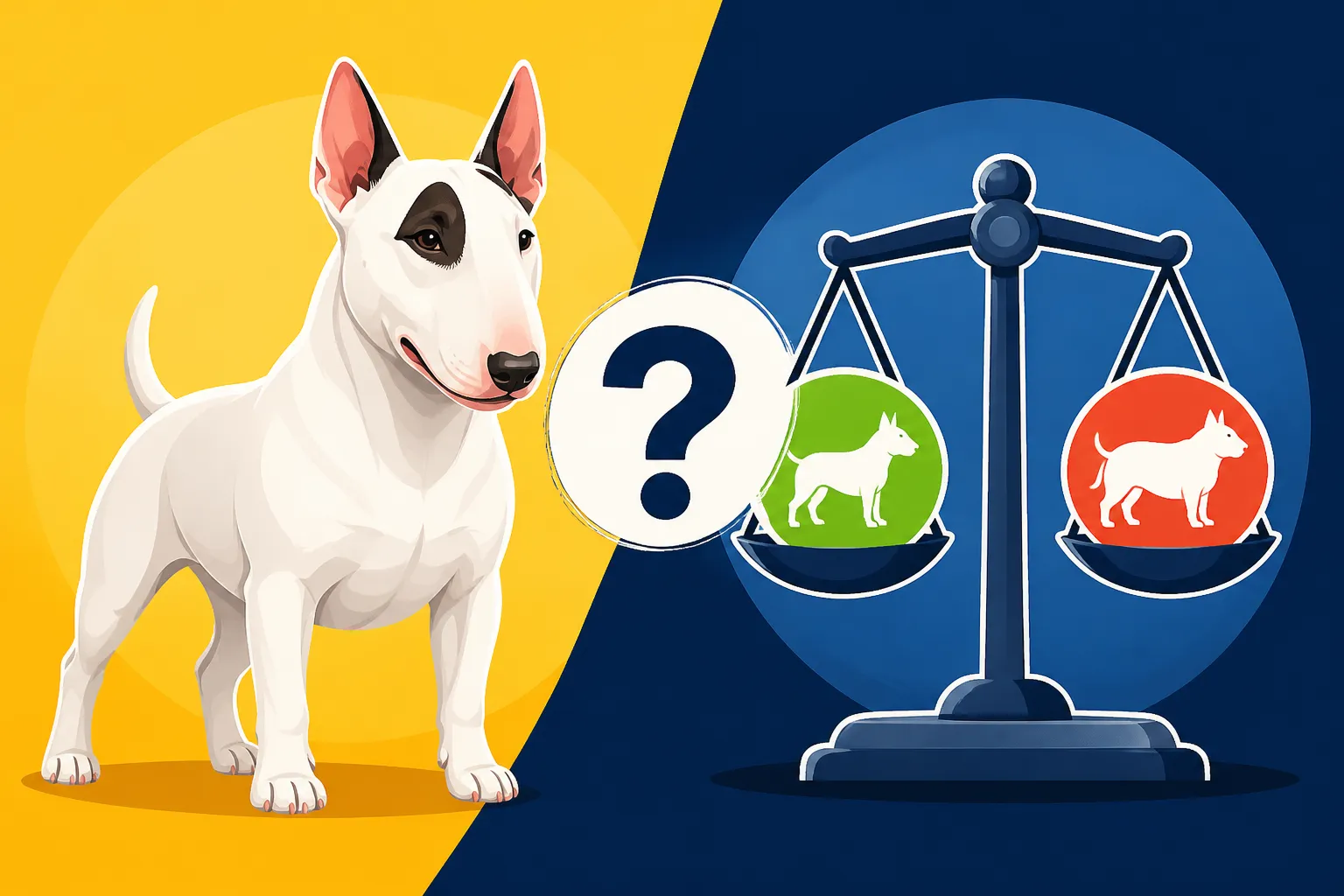
A Bull Terrier can look surprisingly heavy for its height, so it is understandable to wonder whether the breed standard sets a maximum weight. The short answer is that the standard does not prescribe a weight limit for the standard Bull Terrier. This guide explains what judges assess instead, how that differs from healthy body weight, and why the Miniature Bull Terrier has a separate size rule.
Does the Bull Terrier standard set a weight limit
What the standard says about weight and height
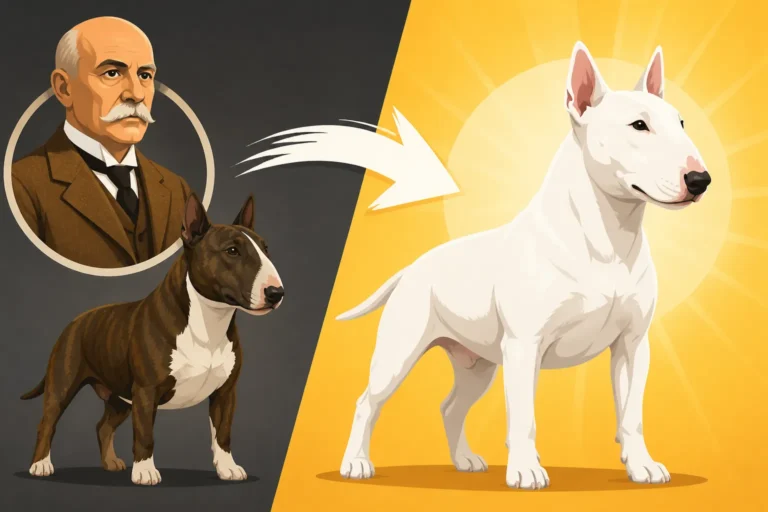
For the standard Bull Terrier, the breed standard does not set a specific maximum weight or height. Instead, it describes the dog’s overall appearance and asks for substance and balance in keeping with the dog’s quality and sex. In everyday terms, that means a judge is not meant to disqualify a standard Bull Terrier simply because it weighs more than a particular number.
This can be confusing if you are used to breeds with a stated height range or weight bracket. A Bull Terrier may be compact, broad through the chest, and visibly muscular, so a number on a scale does not tell the whole story. Two dogs of similar height can have different frames and body composition, and their weights may differ without either being automatically outside the standard.
The standard’s emphasis is on proportion and type, not on reaching a target number. For more background on the breed’s general measurements, see What a Bull Terrier Weighs and How Tall It Stands and How Much a Bull Terrier Weighs.
How judges assess substance rather than a number
In the show ring, judges assess the dog as a whole. They look at features such as structure, movement, condition, and whether the dog’s build fits the breed’s characteristic appearance. A substantial dog is not necessarily an overweight dog; likewise, a lighter dog is not automatically better if its overall structure and condition do not meet the standard.
Picture two adult Bull Terriers standing side by side. One is heavier, but carries that weight in a sound, muscular frame and moves comfortably. The other weighs less, but appears out of proportion or lacks the breed’s expected substance. The number on the scale alone cannot settle which dog is closer to the standard.
Judging is also not the same as a veterinary health assessment. A dog might be fit for the show ring but still need routine health monitoring, and a judge’s opinion about conformation is not a diagnosis. If you are concerned about your dog’s body condition, focus on its health and function rather than trying to make it fit a show-ring ideal.
| Question | Standard Bull Terrier | What it means |
|---|---|---|
| Is there a maximum weight in the standard? | No fixed maximum weight is specified | Weight alone does not determine whether the dog meets the standard |
| Is there a maximum height in the standard? | No fixed height limit is specified | Overall balance and type matter more than a single measurement |
| What is assessed instead? | Build, proportion, condition, movement, and breed characteristics | The dog is evaluated as a whole |
| Does the show standard define a healthy weight? | No | A veterinarian can help assess body condition and health |
Why a dog’s healthy weight is a different question
The show standard is not a weight chart
A breed standard describes the desired type of a breed. It does not give owners a feeding plan or a universal healthy-weight range for every individual dog. A Bull Terrier’s appropriate weight depends on factors such as age, sex, frame, muscle, and body condition. That is why a single number can be a poor guide to whether your dog is carrying too much weight.
A sturdy, well-muscled dog may weigh more than a narrower dog of similar height. On the other hand, a dog can be overweight even if its weight seems plausible for the breed. The useful question is not just “How many pounds does my dog weigh?” but “Can I feel the ribs without pressing hard, and does my dog have a visible waist when viewed from above?”
For a practical way to assess your dog at home, explore How to Feel a Bull Terrier's Ribs and Signs a Bull Terrier Is Overweight. These checks are not a substitute for veterinary advice, but they can help you notice a gradual change that might otherwise be easy to miss.
When weight deserves a closer look
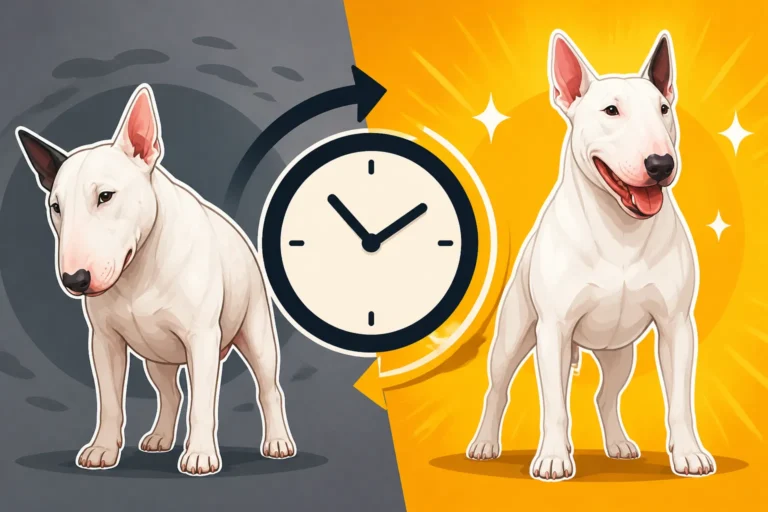
A sudden increase or decrease in weight deserves attention, particularly if it comes with changes in appetite, thirst, energy, or mobility. For example, a dog that is gaining weight despite eating its usual meals may need a review of portions, treats, activity, or health. A dog losing weight without an obvious reason should also be discussed with a veterinarian rather than simply given extra food.
Changes can be gradual. A dog who used to bound up the stairs but now hesitates, tires earlier on walks, or seems less comfortable getting up may be carrying extra weight—or may have another health issue. Keeping a simple record of weight and noting changes in appetite and activity can give your veterinarian helpful context.
Avoid trying to bring a Bull Terrier to a particular weight just because another dog, website, or show listing gives that number. Ask your veterinarian to assess body condition and recommend a suitable plan for your individual dog. If weight management is needed, steady adjustments to food and activity are generally more sensible than abrupt restriction or intense exercise.
The standard Bull Terrier and the Miniature Bull Terrier
Why the Miniature has a height limit
The Miniature Bull Terrier is a separate breed variety with its own standard. Unlike the standard Bull Terrier, the Miniature has a stated height limit: it should not exceed 14 inches at the shoulder. Its standard does not establish a corresponding maximum weight, so proportion and substance still matter rather than one required number on the scale.
This is an important distinction when comparing dogs. A Miniature Bull Terrier is not simply a standard Bull Terrier that falls below a particular weight. The height rule and breed-variety standards are different from a weight limit, and the two types should not be judged as though they share every measurement requirement. For a fuller explanation, see The Miniature Bull Terrier Is a Different Breed and How a Bull Terrier Differs From a Miniature Bull Terrier.
Why size comparisons can be misleading
People sometimes compare an individual dog with photos or measurements they have seen online and assume that a heavier dog must be oversized. But photographs can distort scale, and a dog’s appearance changes with posture, coat condition, age, and muscle. Even a measured height does not explain the dog’s full proportions or condition.
If your question is about show eligibility, check the standard and rules used by the kennel club or show organization where the dog will be entered. A dog may be judged under a particular organization’s rules, and a breeder or experienced breed-club member can help clarify how those rules apply. Avoid relying on informal claims that every Bull Terrier must stay below a certain weight.
For more on the standard Bull Terrier’s proportions, How Tall a Bull Terrier Stands offers useful context. If your concern is whether a dog is unusually large for its variety, Whether an Oversized Bull Terrier Can Be Shown addresses the show-related question more directly.
How to use the standard as an owner
Keep show goals separate from everyday care
You do not need to weigh your Bull Terrier against a show standard to care for it well. A dog that is not shown can still benefit from regular weight checks, a suitable diet, and activity that matches its age and fitness. The goal is comfortable movement and good health, not a particular silhouette chosen for the ring.
A practical routine is to weigh your dog periodically under similar conditions and keep a note of the result. You might use the same scale, choose a consistent time of day, and record the number alongside observations such as appetite and exercise tolerance. A single reading can fluctuate, but a pattern over time is more informative.
If the scale is hard to use at home, your veterinary clinic can help monitor weight during appointments. Ask the team to explain your dog’s body condition as well as its weight, so you have a clear reference point. If your dog needs to lose or gain weight, agree on a plan with them instead of making a major change based only on breed averages.
Avoid setting an arbitrary maximum
A number presented as “the maximum weight for a Bull Terrier” may be someone’s personal rule of thumb, a figure taken from a particular dog, or a guideline that does not apply to your dog. It is not the same as a limit in the standard. Repeating an unsupported threshold can lead owners to worry unnecessarily or to restrict food when the dog is already in healthy condition.
The standard’s lack of a weight cap does not mean that every weight is healthy. It means that the breed description does not use one number to define the standard Bull Terrier. Use the standard to understand breed type, and use your veterinarian’s assessment to judge your dog’s individual health.
If your Bull Terrier is comfortable, energetic for its age, and maintaining a healthy body condition, there may be no reason to chase a number simply because it appears in a forum or casual breed guide. If weight or shape has changed, arrange a veterinary check and ask for advice tailored to your dog.
Disclaimer
This article is for general informational purposes only and does not constitute professional advice. Laws, prices and regulations vary by location and change over time. Consult a qualified professional for guidance on your specific situation.