How Much Dalmatian a Modern Bull Terrier Carries
Many Bull Terrier enthusiasts and potential owners often look at this remarkable breed and wonder about its unique heritage, especially the persistent rumors about Dalmatian ancestry. It's a fair question, given the distinctive traits, but it's not a straightforward answer of "how much" in terms of a quantifiable percentage. This guide will delve into the historical tapestry that created the Bull Terrier, exploring the role the Dalmatian played in shaping the breed we know and love today, and explaining why its influence is more ancestral than arithmetic.
The Early Days: Breeding the White Cavalier
The Bull Terrier, in its earliest form, wasn't just a random creation; it was the result of a deliberate and ambitious breeding program. James Hinks, a true visionary from Birmingham in the 1860s, set out to refine the rough-and-tumble "Bull and Terrier" types of his era. He envisioned a dog that combined strength, courage, and elegance—a gentleman's companion, rather than a mere fighting dog.
James Hinks' Vision for the Bull Terrier
Hinks' primary goal was to create a distinctly white dog, often referred to as the "White Cavalier." This wasn't just an aesthetic preference; it was a statement. In an age where dog fighting, though declining, still cast a shadow, a pristine white dog was less likely to be associated with the blood and grime of the pit. Hinks wanted a dog that looked noble, stood out in the show ring, and embodied a refined spirit. He aimed for a dog with a clean, unblemished coat, and a powerful yet graceful physique.
To achieve this, Hinks started with crosses primarily between the Old English Bulldog, for its tenacity and robust build, and the now-extinct English White Terrier, which contributed refinement and a keen terrier spirit. The offspring of these initial pairings had the drive and courage Hinks sought, but they often lacked the consistent "finish" he desired, both in terms of coat color and conformation. This is where the story gets a bit more complex, and where other breeds, including the Dalmatian, entered the picture. Hinks was meticulously crafting a new breed, and that involved careful selection and the occasional introduction of "new blood" to cement desired traits. You can learn more about the origins of the breed in James Hinks Built the Bull Terrier in Birmingham in the 1860s.
The Need for Refinement and the Introduction of New Blood
While the Old English Bulldog and English White Terrier provided the foundational courage and some of the physical traits, Hinks felt the breed needed further refinement. The original dogs were often coarse, with less uniform heads and coats than he envisioned for his "White Cavalier." He was looking for a more elegant silhouette, better movement, and a truly striking white coat that would mesmerize onlookers. This pursuit of perfection led him to experiment with other breeds to enhance specific characteristics, especially the clean lines and aristocratic look he wanted.
It's widely believed that Hinks introduced other breeds into his lines, selectively breeding for the specific traits he desired while working to minimize any undesirable ones. The goal wasn't just to make a dog look a certain way, but to also influence its temperament to be a loyal, if strong-willed, companion. This blending of different canine heritages was crucial in moving from the rough-and-ready bull and terrier types to the distinctive Bull Terrier. The question of Which Breeds Went Into the Bull Terrier is a fascinating dive into the intricate lineage.
Unpacking the Dalmatian Connection
The Dalmatian's inclusion in the Bull Terrier's ancestral mix is one of the more frequently discussed aspects of its history. While not the sole contributor, it certainly played a notable role in helping Hinks achieve his specific vision for the breed.
Why the Dalmatian Was a Logical Choice
When Hinks was refining the Bull Terrier, the Dalmatian offered several characteristics that would have been highly valuable. Firstly, Dalmatians were known for their striking white coats, albeit with distinct spots. For Hinks, who was striving for an all-white dog, the Dalmatian provided a strong genetic influence for extreme white pigmentation. Even if early crosses brought in spots, the underlying genetics for a pure white base were there to be selected for in subsequent generations. Why Hinks Wanted an All White Dog sheds more light on this specific ambition.
Beyond color, Dalmatians possessed a sleek, athletic build and graceful movement that Hinks likely found appealing. They are active, intelligent dogs with a strong presence, traits that could add refinement and stamina to the developing Bull Terrier. While the overall head shape of the Dalmatian is quite different from the iconic "egg head" of the modern Bull Terrier, their clean bone structure and muscular bodies contributed to the active and sturdy yet elegant dog Hinks envisioned. The influence wasn't just about appearance; it was about creating a robust, capable animal.
How Dalmatian Traits Manifested (and Were Managed)
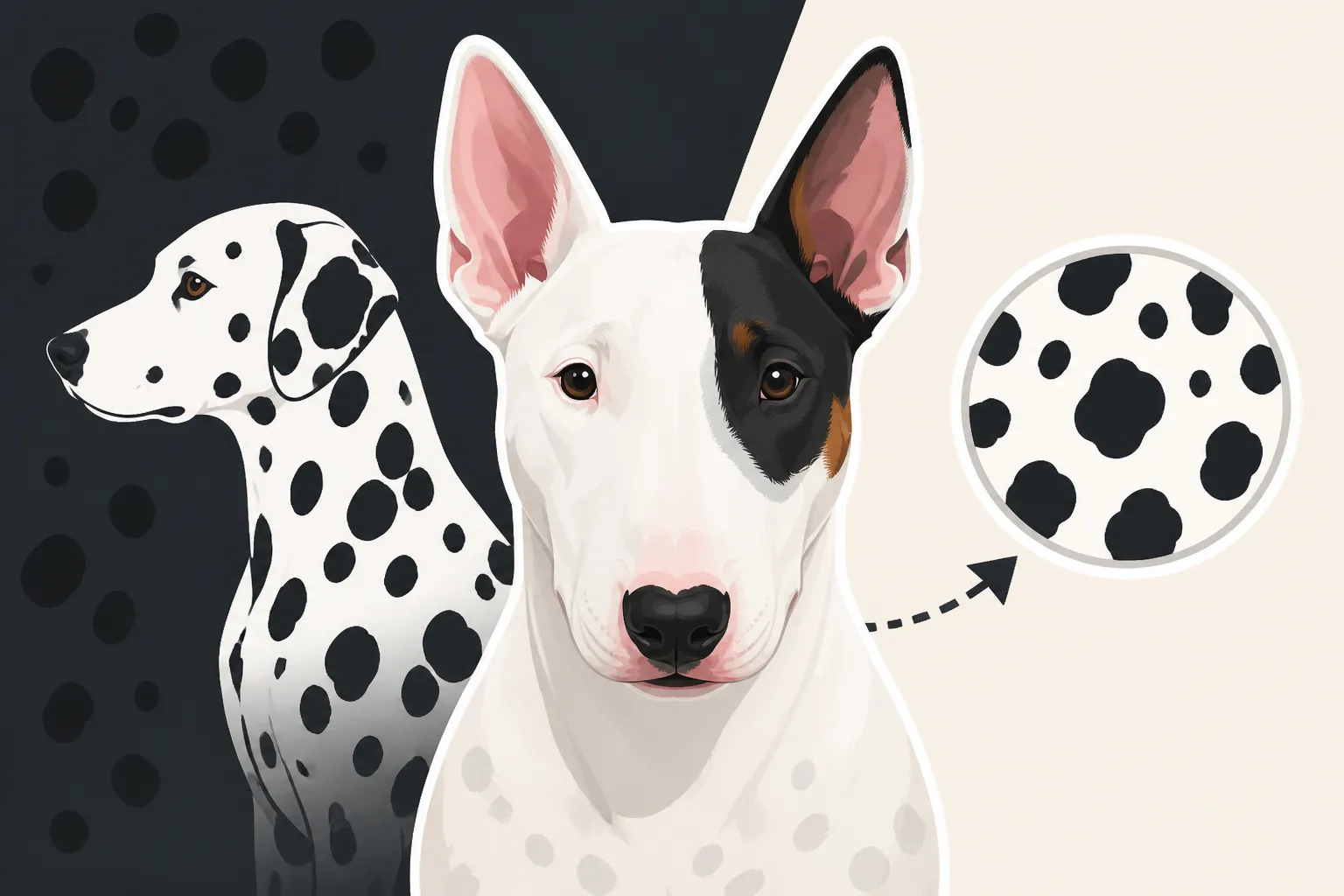
The introduction of Dalmatian blood certainly helped Hinks achieve a whiter, more refined coat. However, it also likely brought with it the challenge of spots. Early Bull Terriers, even those designated "white," occasionally showed slight spotting, sometimes referred to as "patches" or "ticking," which breeders worked diligently to eliminate to achieve the desired pure white standard. This selective breeding over generations gradually diluted the visible spotted pattern, pushing for uniform white.
Another significant consideration stemming from breeds with extreme white coats, such as the Dalmatian and the English White Terrier, is congenital deafness. This is a well-documented issue in white-coated dogs, often linked to the absence of pigment-producing cells in the inner ear. The Dalmatian's genetic contribution likely amplified this predisposition in the emerging Bull Terrier breed. Modern breeders are very aware of this, and comprehensive health testing, such as the BAER test, is crucial. This is why Why a White Bull Terrier Should Be BAER Tested is such a critical read for any owner or prospective owner. The challenges presented by these early genetic contributions were gradually addressed through meticulous breeding practices focused on health and breed standard.
The "How Much" Question: Genetic Contribution Today
It's common for people to ask "how much" of a particular breed is in another, as if it were a simple recipe. However, when you're talking about breeds that were established over 150 years ago, the concept of a precise "percentage" becomes less meaningful in a modern genetic sense.
The Blending of Genes Over Generations
The Bull Terrier breed has been meticulously developed through countless generations of selective breeding since Hinks' time. While Dalmatians (and other breeds like the Spanish Pointer and Greyhound) were certainly part of the original genetic cocktail that contributed to the Bull Terrier's foundation, their genetic material has been thoroughly integrated, diluted, and refined over more than a century and a half.
Think of it like mixing paints: if you start with red and yellow, then add a touch of blue, and then keep stirring and adding more of the foundational red and yellow over time, the "touch of blue" becomes an inseparable part of the overall color, rather than a distinct stripe. The Bull Terrier is now a distinct, established purebred dog, recognized by all major kennel clubs worldwide. Its genetic makeup is uniquely "Bull Terrier," even if its ancestral roots draw from several different historical breeds. The initial contributions from breeds like the Dalmatian were absorbed into the genetic pool, helping to establish certain traits that were then fixed and perpetuated through breeding specifically within the Bull Terrier lineage. It's a testament to the dedication of breeders that the unique "egg head" and powerful physique have been solidified over time. How the Bull Terrier's Head Changed Over Time explains this evolutionary process.
Looking at Modern Bull Terrier Genetics
If you were to take a DNA test on a modern purebred Bull Terrier today, you would primarily see "Bull Terrier." While these tests can sometimes trace back to broad ancestral groups or "landraces," they aren't designed to give you a precise percentage of long-ago foundational breeds like Dalmatian, English White Terrier, or Old English Bulldog. That's because the Bull Terrier is the breed. Its genetic identity is now complete and distinct.
What modern genetic science can tell us more definitively are specific genetic markers related to health conditions common in certain breeds or ancestral lines. For instance, the predisposition to deafness in white Bull Terriers is a legacy of its white-coated ancestors, including the English White Terrier and potentially the Dalmatian. Instead of focusing on a percentage of Dalmatian, the scientific community looks at the specific genes and their expression that cause certain traits or predispositions. So, while the "whether the Dalmatian is in the Bull Terrier" is a resounding historical "yes," the "how much" is better understood as a foundational influence rather than a current, measurable quantity.
Beyond the Dalmatian: Other Influential Breeds
While the Dalmatian gets a lot of attention, it's important to remember that the Bull Terrier is a true mosaic, built from several carefully selected breeds. Each contributed something vital to the creation of this iconic "gladiator."
The Role of the English White Terrier and Old English Bulldog
These two breeds were the absolute bedrock of James Hinks' breeding program. The Old English Bulldog, a formidable and tenacious dog, contributed immense power, courage, and a sturdy, muscular physique. It's from this ancestor that the Bull Terrier inherited its incredible strength and famously robust build. The term "bull" in Bull Terrier is a direct nod to this powerful heritage. What the Old English Bulldog Gave the Bull Terrier explores this contribution in fascinating detail.
The English White Terrier, on the other hand, was a sleek, elegant, and agile breed, known for its pristine white coat and keen terrier instincts. It brought refinement, grace, and an intense prey drive to the mix. It helped to lighten the heavier Bulldog frame and contributed significantly to the desired white coloration that Hinks was so passionate about. Without these two foundational breeds, the Bull Terrier as we know it simply wouldn't exist. They provided the essential raw materials for Hinks to sculpt his vision.
Hints of Other Breeds: Spanish Pointer, Greyhound
Beyond the core foundational breeds and the recognized Dalmatian influence, some historical accounts and theories suggest the inclusion of other breeds to achieve specific refinements. The Spanish Pointer, for instance, is sometimes mentioned as potentially contributing to the Bull Terrier's distinctive head shape, particularly the "downface" or "Roman finish," and perhaps further refining its athletic build. Pointers are known for their elegant lines and athletic prowess, which would have been desirable traits for Hinks.
Similarly, the Greyhound, renowned for its speed, grace, and slender yet powerful build, is also speculated to have played a minor role in the breed's development. Its genes could have helped in elongating the head, cleaning up the lines, and further enhancing the Bull Terrier's overall athleticism and elegance. Whether a Greyhound Went Into the Bull Terrier offers more insight into this possibility. The cumulative effect of these various breeds, carefully selected and blended over time, is what ultimately gave us the Bull Terrier's utterly unique appearance, including its characteristic triangular eye, which is singular among dog breeds. The Bull Terrier Is the Only Breed With a Triangular Eye. Each thread in this genetic tapestry contributed to the strength, character, and unmistakable style of the Bull Terrier.
To give you a clearer picture of some of the shared traits between Dalmatians and early Bull Terriers, here's a brief comparison:
| Trait | Dalmatian | Early Bull Terrier (Hinks' Era) | Purpose in Bull Terrier Breeding |
|---|---|---|---|
| Coat Color | Predominantly white with distinct spots | Aimed for pure white, but often had patches/ticking | Source of extreme white genetics, foundation for "White Cavalier" |
| Build & Structure | Athletic, lean, muscular, elegant | Powerful, sturdy, but Hinks sought more refinement/elegance | Refinement of body lines, improved athleticism, stamina |
| Temperament | Energetic, intelligent, sometimes stubborn | Courageous, tenacious, Hinks sought more companionable traits | Added intelligence, vivacity, and spirited nature |
| Head Shape | Distinct stop, moderate muzzle | Varied, Hinks sought more distinctive, powerful head | Less direct influence on head shape, more on overall refinement |
| Health Concerns | Known predisposition to deafness | High incidence of deafness in white coats | Shared genetic predisposition to deafness due to white pigmentation |
The legacy of these diverse foundational breeds is evident in every Bull Terrier today. It's a breed born from a desire for strength, elegance, and distinctiveness, a combination that makes them truly one-of-a-kind. Understanding their history helps us appreciate just how much intentional effort went into creating these wonderful dogs. It’s a breed that, despite its complex origins, has maintained its recognizable form and character for generations, a testament to its unique breeding journey. Knowing this heritage helps us understand Whether the Bull Terrier Will Stay Recognizable for future generations.
Disclaimer
This article is for general informational purposes only and does not constitute professional advice. Laws, prices and regulations vary by location and change over time. Consult a qualified professional for guidance on your specific situation.