Whether Woodrow Wilson Kept a Bull Terrier
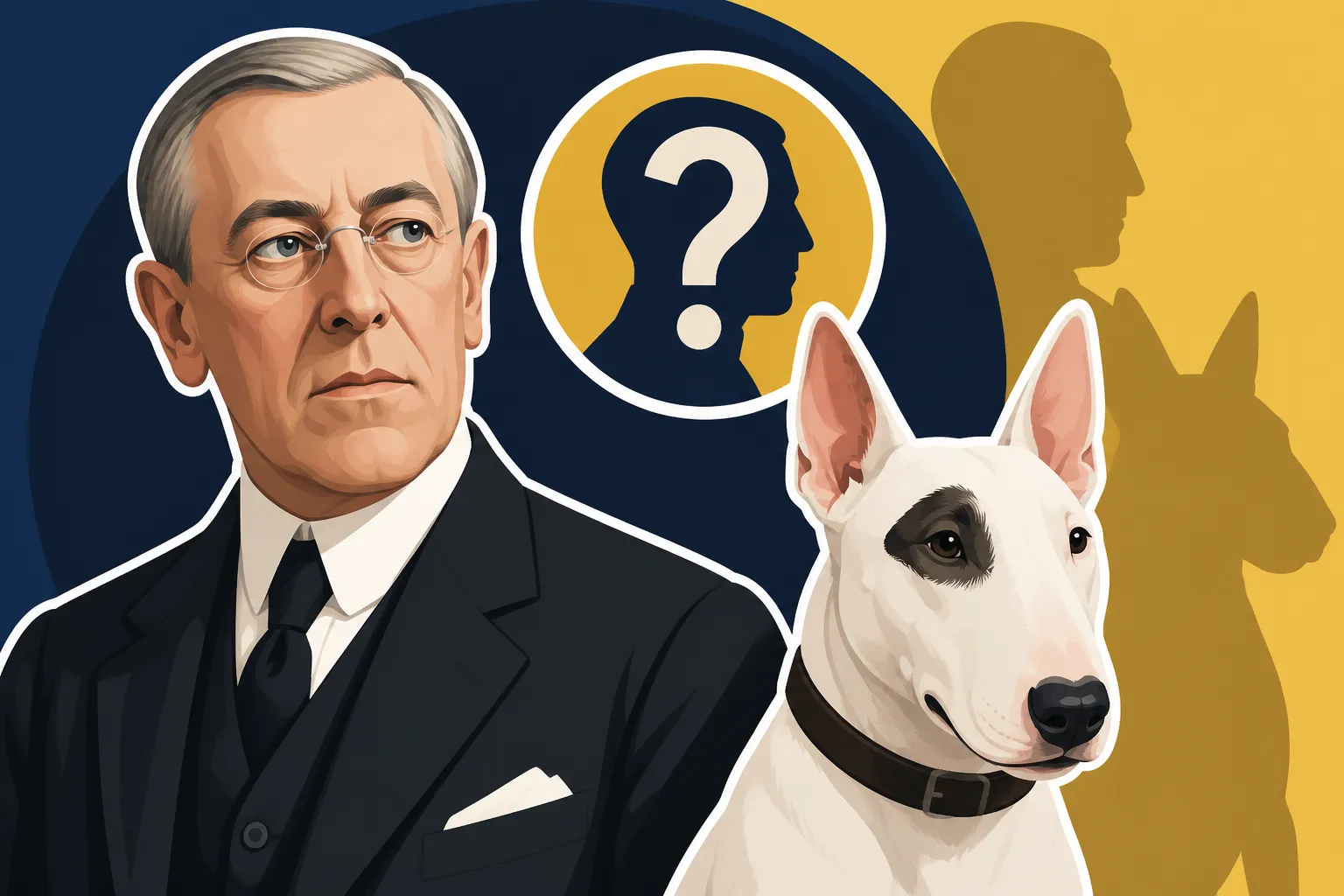
Woodrow Wilson did keep a Bull Terrier. The dog was named Bruce and lived at the White House during Wilson’s presidency. The basic answer is clear, but the surviving story is brief: Bruce is remembered mainly in lists of presidential pets, rather than through a detailed account of his daily life or personality.
Did Woodrow Wilson Have a Bull Terrier
Bruce was Wilson’s Bull Terrier
Yes. Presidential pet accounts identify Bruce as a Bull Terrier kept by Woodrow Wilson and his family at the White House. Wilson served as president from 1913 to 1921, so Bruce belongs to the story of the White House during that period.
It is worth separating what is commonly recorded from what is not. Bruce’s name and breed are the key details associated with him. More elaborate stories about his habits, favorite people, or adventures should be treated cautiously unless they are supported by specific historical documentation. The fact that Bruce appears in presidential pet histories does not, by itself, provide a full biography.
The word “kept” can also mean more than one thing in a presidential household. A dog might be especially associated with the president, but daily care and companionship could involve other members of the family and household. The safest description is that Bruce was a Wilson family dog at the White House, not that every aspect of his care or ownership is known.
Bruce lived among a varied group of White House animals
Bruce was not the only animal associated with the Wilson White House. Accounts also mention an Airedale named Davie and the White House sheep flock. The sheep were kept on the grounds during the First World War, when they helped maintain the lawn while staff resources were under pressure.
That setting is a useful reminder that a presidential pet list is not necessarily a record of one person’s private collection of animals. The White House was a family home as well as a workplace and a national landmark. Dogs and other animals could be part of family life while also attracting public interest because of where they lived.
Bruce’s place in that household is usually stated in a straightforward way: he was Wilson’s Bull Terrier. The historical record does not need to be embellished for the answer to be meaningful. A Bull Terrier was, in fact, part of life at the White House during Wilson’s presidency.
What Is Known About Bruce and What Is Not
The name and breed are the strongest details
When people ask whether Woodrow Wilson kept a Bull Terrier, they are often looking for a simple fact they can repeat. The reliable core is that Wilson’s Bull Terrier was named Bruce. That is the detail most commonly preserved in summaries of presidential pets.
By contrast, Bruce’s individual story is not as widely developed as the stories of some later presidential dogs. There is less commonly repeated detail about his exact age, where he came from, what he looked like, or the particular events he took part in. When an online account adds colorful anecdotes without explaining their basis, it is sensible to distinguish the entertaining detail from the well-established identification.
This is a common problem with historical pets. A name and breed may survive in reference lists, while letters, photographs, or contemporary news accounts that would fill in the everyday story are harder to find or are not often discussed. A short record does not mean Bruce was unimportant to the family; it simply means the details we can confidently repeat are limited.
Be cautious about mixing up presidential dogs
Presidential pet stories are easy to muddle because many administrations had several dogs, and popular accounts sometimes emphasize a dog’s breed or name without much context. Bruce should not be confused with Davie, the Airedale also associated with Wilson. They were different dogs of different breeds.
It is also easy to blend Bruce’s story with the better-known Bull Terriers that became public figures in later periods. Spuds MacKenzie and Bullseye, for example, are familiar names in American popular culture, but they were not Wilson’s dog. For a broader look at notable examples, see Which Famous Bull Terriers Everyone Remembers and Spuds, Bullseye and the Bull Terriers America Remembers.
A helpful way to check a claim is to ask what exactly it says: does it identify Bruce as Wilson’s dog, or does it add a specific story about his life? The first is the central historical point. The second may be true, but it deserves more careful checking before it is repeated as fact.
| Claim about Bruce | What can be stated carefully |
|---|---|
| Woodrow Wilson kept a Bull Terrier | Yes |
| The dog’s name was Bruce | This is the name commonly associated with Wilson’s Bull Terrier |
| Bruce lived in the White House | He is remembered as a Wilson family dog during Wilson’s presidency |
| Bruce’s full life story is widely documented | Detailed biographical information is limited in commonly repeated accounts |
| Bruce was the same dog as Davie | No; Davie was an Airedale |
Why a Bull Terrier Fits the Broader History
Bull Terriers were companions as well as working dogs
The Bull Terrier’s history is more complicated than a single label. The breed developed in nineteenth-century Britain, and its background reflects a period when dogs were bred for a range of purposes and valued for different traits. For more on the breed’s development, see James Hinks Built the Bull Terrier in Birmingham in the 1860s and Where the Bull Terrier Comes From.
By Wilson’s time, the Bull Terrier was not simply a dog defined by its earliest working history. Like other breeds, it could be a household companion. Bruce’s presence in the White House is one small example of the breed living as part of a prominent family’s daily life. It does not tell us exactly how Bruce behaved, but it does show that Bull Terriers were kept as pets in an ordinary domestic sense, even in a very unusual home.
This distinction matters because breed histories can be reduced to stereotypes. A dog’s origins do not determine its individual personality, and a breed’s reputation does not tell us how a particular dog behaved with its family. The wider history is discussed in Whether a Bull Terrier Was a Gentleman's Companion and The White Cavalier: Why the Bull Terrier Never Started Fights.
One presidential dog cannot represent every Bull Terrier
Bruce’s story is interesting, but it should not be used to make sweeping claims about Bull Terriers as a whole. We do not have enough detail about his temperament, training, or daily routine to say that he behaved in a particular way because of his breed. Nor can one dog’s presence in a presidential household prove that every Bull Terrier is suited to every home.
A realistic picture of a breed comes from combining history with an understanding of individual needs. A Bull Terrier today may be energetic, strong, affectionate, or exuberant, but those traits vary by dog and are shaped by upbringing, health, and environment. Historical anecdotes are a starting point for curiosity, not a substitute for learning about modern care and behavior.
That is especially important when a breed’s reputation is shaped by dramatic stories. If you encounter claims that reduce Bull Terriers to fighting or aggression, look for context rather than accepting a label at face value. Whether a Bull Terrier Was Bred to Start Fights and What People Get Wrong About the Bull Terrier explore why those broad assumptions can be misleading.
How to Talk About Wilson’s Bull Terrier Accurately
Keep the answer direct and separate fact from folklore
A clear response is: “Yes. Woodrow Wilson’s family kept a Bull Terrier named Bruce at the White House.” That sentence answers the question without adding details that may be difficult to verify.
If you want to say more, make the boundary between the known fact and the historical context clear. You can mention that Wilson’s household also included an Airedale named Davie and that the White House had a flock of sheep. Avoid presenting an unverified anecdote about Bruce as established history simply because it appears in a retelling.
This approach is useful for any presidential pet. A brief identification can be well established even when the animal’s full story is not. Keeping the language measured makes the answer more trustworthy, not less interesting.
Treat modern breed information as a separate subject
Interest in Bruce may lead to questions about living with a Bull Terrier today, but modern ownership is a separate topic from Wilson-era history. A retailer’s product descriptions, including listings on Chewy, can show what supplies are marketed to contemporary dog owners; they do not establish what Bruce ate or how he was cared for. Chewy is a modern shopping resource, not evidence about a White House dog from the early twentieth century. If you are considering a Bull Terrier now, use current veterinary guidance for health and care questions rather than drawing conclusions from Bruce’s brief historical record or a product page on Chewy.
The same separation applies to breed stories more generally. A famous dog can make a breed memorable, but it cannot answer practical questions about exercise, training, health screening, or fit with a particular household. Historical curiosity and responsible modern ownership can sit side by side, as long as the two are not confused.
Woodrow Wilson did keep a Bull Terrier named Bruce. The most useful way to remember him is as a Wilson family dog at the White House, while recognizing that the commonly repeated record gives us only a few firm details about his individual life.
Disclaimer
This article is for general informational purposes only and does not constitute professional advice. Laws, prices and regulations vary by location and change over time. Consult a qualified professional for guidance on your specific situation.