Whether the Miniature Is Just a Small Bull Terrier
A Miniature Bull Terrier may look like a Bull Terrier scaled down, but size is only part of the story. They are recognized as a distinct breed, with their own size standard and some health concerns that deserve special attention. This guide explains what the two breeds share, where they differ, and what to consider before choosing one.
Is a Miniature Bull Terrier just a smaller Bull Terrier
They are closely related but recognized as separate breeds
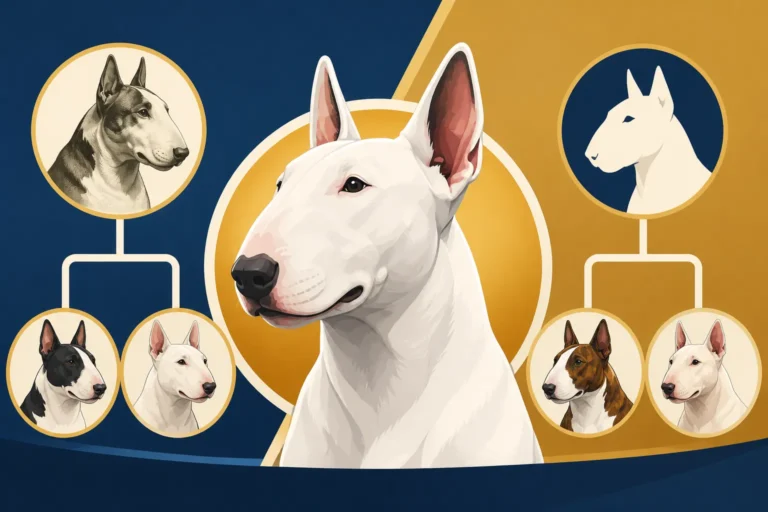
Miniature Bull Terriers and standard Bull Terriers share a common history and many recognizable traits: the egg-shaped head, muscular build, alert expression, and lively, people-focused character. Miniatures were developed from smaller Bull Terriers, with breeders selecting for a more compact dog while retaining the breed’s essential type.
That shared ancestry does not make a Miniature Bull Terrier simply a young standard Bull Terrier or a standard Bull Terrier that stopped growing early. Breed registries treat them as separate breeds, with separate standards and registrations. The Miniature Bull Terrier is expected to fit its own standard as an adult, not to match a smaller version of every standard Bull Terrier’s proportions.
That distinction matters if you are choosing a puppy. A small standard Bull Terrier puppy will grow, while an adult Miniature Bull Terrier stays within the miniature breed’s size range. For a broader explanation of the relationship, see How a Bull Terrier Differs From a Miniature Bull Terrier and The Miniature Bull Terrier Is a Different Breed.
Their size is a defining difference, not a promise of an easier dog
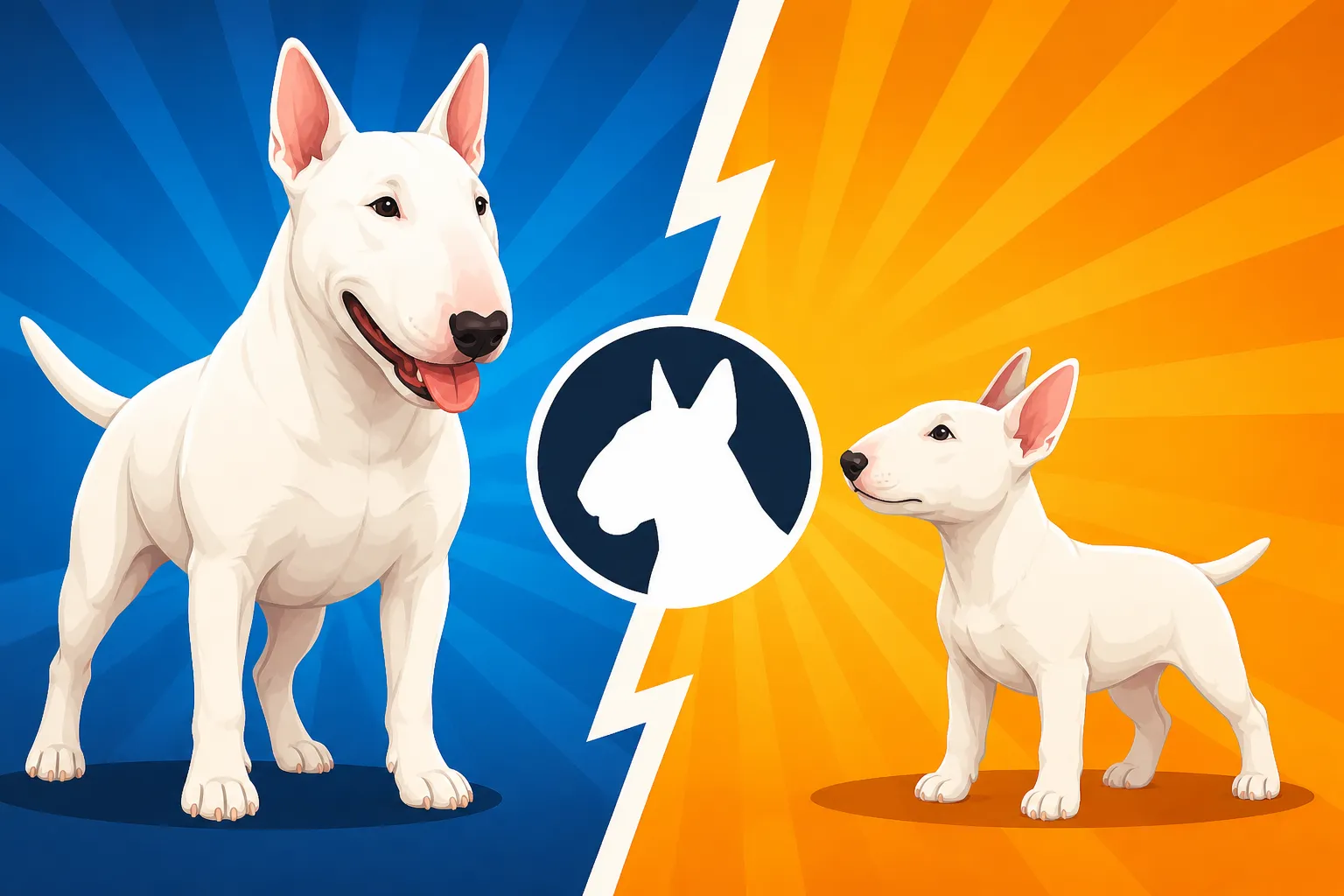
A Miniature Bull Terrier is generally less than 14 inches tall at the shoulder. Its weight should be proportionate to its height and build rather than treated as a single target number. A standard Bull Terrier has no comparable upper height or weight limit in its breed standard, so individuals can vary considerably in size.
Being smaller can make a Miniature easier to lift, transport, or accommodate in a compact home. It does not automatically make the dog calmer, less strong, or less demanding. A compact, muscular dog can still pull hard on a leash, barrel through a doorway, or turn a quiet evening into a burst of zoomies. Owners who expect a miniature dog to need only miniature effort can be surprised by the breed’s energy and determination.
If size is the deciding factor, meet adult dogs where possible and ask breeders about the size of their mature dogs. Breed standards describe the ideal, not a guarantee that every individual will be identical. How Small a Miniature Bull Terrier Is and What a Bull Terrier Weighs and How Tall It Stands offer more detail on size.
What the two breeds have in common
Expect a lively, people-oriented companion
Both Miniature and standard Bull Terriers are often playful, physically affectionate, and full of personality. They can be funny companions, but their enthusiasm may take up a lot of room. A dog that leans its full weight against your legs or greets you by bouncing can be a lot to manage, especially in a busy household or around small children.
They also tend to do best with regular engagement rather than being left to invent their own activities for hours. Walks, training, supervised play, and food-based enrichment can help provide structure. A smaller body does not remove the need for training: polite greetings, loose-leash walking, recall practice, and a reliable settle cue are useful for either breed.
Early, thoughtful social experiences matter, too. That does not mean pushing a puppy to meet every dog or person. It means teaching it to stay composed around everyday sights and sounds, and helping it learn what to do when something exciting appears. If you are comparing the breeds partly because you want an easygoing dog, spend time with adult dogs and ask owners about their daily routines—not just their dogs’ size.
Both need consistent handling and sensible supervision
Bull Terriers are strong, active dogs, and both types benefit from rewards-based training with short, engaging sessions. Repeating a cue long after a dog has lost interest can turn practice into a contest. Clear routines, useful rewards, and practice in gradually more distracting settings tend to be more effective than harsh corrections.
Household management matters as much as formal training. Use gates or separate spaces when dogs need a break, supervise interactions with children, and keep tempting objects out of reach. This is especially important for any dog that likes to chew or pick up things it should not swallow. A smaller dog may be easier to handle physically, but that does not make unsupervised rough play or access to hazardous objects safe.
Before adopting or buying either type, think beyond your floor plan. Consider whether you can provide daily activity, training, companionship, and care over the dog’s lifetime. What People Get Wrong About the Bull Terrier is a useful related read if you are weighing the breed’s reputation against the reality of living with one.
Health and breeder questions to consider
The miniature has some health concerns of its own
Miniature Bull Terriers have health risks that overlap with those of standard Bull Terriers, but the details are not identical. One condition of particular concern in Miniatures is primary lens luxation, an inherited eye disorder in which the lens can move out of its normal position. The condition can be painful and may threaten vision, so ask breeders what screening they do and what documented results they can share.
Patellar luxation, in which the kneecap moves out of its normal position, is another concern to discuss. Heart and kidney health may also come up when reviewing a dog’s family history. A breeder should be willing to explain the health tests relevant to their lines, show results where available, and describe how they make breeding decisions.
Do not assume that a small dog is automatically healthier, or that the miniature’s risks are simply a scaled-down version of the standard’s. Health depends on the individual dog, its family history, and responsible breeding and veterinary care. For more context, read Which Problems the Miniature Bull Terrier Has Instead and Whether a Bull Terrier Is a Healthy Breed.
Ask for records, not just reassuring descriptions
When speaking with a breeder, ask which health conditions they screen for and request records for the puppy’s parents. A confident answer such as “our dogs are healthy” is not a substitute for specific documentation. Ask what each test covers, whether the results apply to the individual parents, and whether the breeder will explain any findings you do not understand.
You can also ask how the breeder matches temperament and structure, what support is available after the puppy goes home, and what the contract says about returning a dog if circumstances change. Responsible breeders should be comfortable discussing both the strengths and the limitations of their lines. The same careful approach applies when considering a rescue: ask what is known about the dog’s medical history and arrange a veterinary examination.
Health testing recommendations can vary with the breed, family line, and location. A veterinarian can help you understand what screening is appropriate for a particular dog. Which Health Tests a Bull Terrier Breeder Should Run provides a starting point for questions to take into a breeder conversation.
Choosing between a Miniature and a standard Bull Terrier
Compare the individual dog and your daily life
The Miniature may suit someone who wants a more compact Bull Terrier, but a smaller frame does not guarantee less exercise, less training, or a quieter temperament. A standard Bull Terrier may be physically larger, yet individual dogs vary in energy, confidence, sociability, and ability to settle. The right match depends on the particular dog and the home you can offer.
Make a practical list before choosing. Can you manage a strong dog on leash? How long will the dog be alone on a typical workday? Is there room for play and rest? Do you have children, cats, or other dogs, and what boundaries will help everyone stay safe? These questions are more useful than relying on breed size alone.
If you are comparing equipment, measure the dog rather than guessing from its breed name. A retailer’s catalog can help you compare options, but fit still matters. For example, Chewy listings may show a range of harness sizes; check the manufacturer’s measuring instructions and make sure the harness allows free movement without rubbing. The same principle applies to crates and beds: use the dog’s measurements and behavior, not the label “miniature,” as your guide.
Clarify breeding and registration details
If a breeder says a puppy is a Miniature Bull Terrier, ask how the puppy will be registered and what breed standard applies. The two types are recognized separately, but breeding practices and registration rules can depend on the organization and country. If you have questions about how Miniatures and standards are bred, ask the breeder to explain the pedigree and registration in plain language. Whether Miniature and Standard Bull Terriers Are Bred Together explores that question in more detail.
When preparing for a new dog, look for equipment that is suited to the individual’s build and chewing habits. You might use Chewy’s catalog to compare crate dimensions or toy styles, then verify that a chosen item is appropriate for your dog’s size and play style. No toy should be treated as indestructible, and dogs should be supervised with new items until you know how they use them.
Food choice is another individual decision rather than a simple miniature-versus-standard rule. Ask the breeder what the puppy currently eats, then discuss any planned change with your veterinarian, especially if the dog has a medical condition or a sensitive stomach. Chewy can be one place to compare available food formats and ingredient information, but your veterinarian can help you decide what suits your dog’s age, health, and needs.
Make the decision on fit, not appearance alone
If what you want is a Bull Terrier in a smaller package, the Miniature may be the breed to explore. Just go in expecting a distinct breed with its own health considerations—not a low-effort substitute for the standard. Spend time with adult Miniatures, talk with knowledgeable breeders or rescue groups, and ask questions about temperament, health, training, and the everyday realities of ownership.
A good match is less about finding the smallest dog or the most striking head shape and more about finding a dog whose needs you can meet. The Miniature Bull Terrier can be compact and still be a powerful, energetic, demanding companion. Understanding that difference before bringing one home makes it easier to choose with clear expectations.
Disclaimer
This article is for general informational purposes only and does not constitute professional advice. Laws, prices and regulations vary by location and change over time. Consult a qualified professional for guidance on your specific situation.