Teaching a Bull Terrier Not to Shoulder Through a Door
It’s a scenario many Bull Terrier owners know all too well: you approach a doorway, leash in hand, or hear a knock, and suddenly your otherwise charming companion transforms into a battering ram, shoulder-checking you out of the way to get to the other side. This guide is here to tackle that exact frustration, offering practical, empathetic strategies to teach your exuberant Bull Terrier polite door manners, ensuring safety and a calmer home for everyone.
Understanding the "Why" Behind the Shoulder Charge
Before we can even begin to address the behavior, it’s crucial to understand why your Bull Terrier might be trying to shoulder their way through every doorway. It’s rarely out of malice, but rather a combination of breed characteristics, learned behaviors, and a lack of clear guidance. They aren't trying to be rude; they're simply being Bull Terriers, which comes with its own unique set of joys and challenges!
The Bull Terrier's Enthusiasm and Impulsivity
Bull Terriers are renowned for their incredible enthusiasm for life. They approach everything with gusto, whether it's a new toy, a walk in the park, or greeting a favorite person. This boundless energy, while endearing, can easily translate into an impulsive rush when a doorway presents an exciting possibility. Imagine their thought process: door opening = adventure/visitor/treats! Must get there now!
This isn't just about walks either. Think about the simple act of you moving from the kitchen to the living room. For many Bull Terriers, that transition through a doorway is an event. If they're particularly attached to you – and let's be honest, most Bull Terriers are "velcro dogs" – they want to be right there, next to you, through every threshold. Their sheer physical presence and muscular build make a gentle nudge feel like a full-blown body check. They just don't always understand their own strength, which is a common complaint among owners. It’s part of why they are often called Why a Bull Terrier Is Called a Three Year Old in a Dog Suit.
Lack of Defined Boundaries and Leadership
Dogs thrive on clear structure and understanding their place within the "pack," which in a domestic setting is your family. If the rules around doorways aren't explicitly taught and consistently enforced, your Bull Terrier might perceive that the "leader" (them) dictates who goes first. Without firm, kind boundaries, they naturally fill the vacuum.
This isn't about being harsh or dominating your dog, but rather about providing clear, consistent leadership that they can understand and trust. When you consistently allow them to barge ahead, you're inadvertently telling them, "Yes, this is how we do things." It becomes the established routine, making it much harder to change later on. This can sometimes contribute to other behavioral challenges too, such as Why a Bull Terrier Decides a Cue Is Optional if they perceive you as inconsistent.
Learned Behavior: Reinforcing the Charge (Accidentally!)
One of the biggest culprits behind the door-charging behavior is accidental reinforcement. Every time your Bull Terrier shoves past you and successfully gets through the door, they've been rewarded. The reward is getting to the desired location or person. It doesn't matter if you grumble or sigh; if the door still opens for them, they've "won."
Consider this common scenario: you're holding a bag of groceries, and your Bull Terrier nudges the door open further with their nose and shoulders, slipping past you. You're busy, so you let it go. To your Bull Terrier, that was a successful maneuver. They learn that pushing works. Over time, this behavior becomes deeply ingrained, and it can be a frustrating cycle to break, especially when you're in a hurry. Understanding this accidental reinforcement is the first step toward correcting it.
Laying the Groundwork for Polite Door Manners
Addressing the shoulder-charge isn't about a quick fix; it's about building a foundation of respect and clear communication. Your Bull Terrier is smart, but they need you to be consistent and patient.
Consistency is Key: Every Door, Every Time
This point cannot be stressed enough. If you only enforce polite door manners sometimes, your Bull Terrier learns that it's a gamble. Sometimes they win, sometimes they lose. This inconsistency makes the behavior harder to extinguish because it keeps hope alive! Every single person in the household must be on board and apply the same rules, whether it's the front door, the back door, the crate door, or even just moving between rooms.
Imagine you're trying to teach a child to say "please." If they only have to say it for some things, but not others, or only with one parent but not the other, the lesson won't stick. The same applies to your Bull Terrier. Make a family pact to enforce the "door rule" universally. This might feel tedious at first, but it will pay off immensely in the long run. Even a quick trip to the backyard requires the same calm approach.
Establishing "Nothing in Life is Free" (NILIF) Principles
The "Nothing In Life Is Free" (NILIF) program is a wonderful framework for any dog owner, but especially for an enthusiastic breed like the Bull Terrier. It's a philosophy where your dog learns that they must "work" for everything they want – a sit for a meal, a down for a petting session, and a calm wait for going through a doorway. This isn't about withholding love or necessities; it's about teaching impulse control and reinforcing your leadership in a positive way.
Implementing NILIF helps your Bull Terrier see you as the benevolent provider and decision-maker. It builds a foundation of good manners across the board, making specific training tasks like polite door behavior much easier. For instance, before you put their food bowl down, ask for a sit and wait. Before throwing a ball, ask for a down. This constant practice in "earning" rewards spills over into all interactions, including doorways. Many reputable online training platforms, such as BAXTER & Bella, advocate similar positive reinforcement and structured learning approaches that can be invaluable.
Mastering Basic Obedience Cues: Sit and Stay
Before you even tackle the doorway directly, ensure your Bull Terrier has a solid grasp of "sit" and "stay." These are not just party tricks; they are fundamental building blocks for impulse control and critical for polite door manners. A strong "stay" command, in particular, will be your best friend.
Practice these cues in various environments, starting in low-distraction areas and gradually increasing the challenge. Make it fun and rewarding with high-value treats or their favorite toy. If your Bull Terrier struggles with holding a stay, go back to basics and build up duration and distance gradually. A reliable "sit" and "stay" mean you have a way to ask for calm, stationary behavior at the door. If you're struggling to get them to hold a stay, you might find some good tips in Teaching a Bull Terrier to Sit and Stay.
Step-by-Step Training for the Doorway Dynamo
Now that we've set the stage, let's get into the nitty-gritty of teaching your Bull Terrier to respect the threshold. Remember, patience is paramount. Bull Terriers are smart but also incredibly strong-willed, meaning you might need to try a few approaches before finding what clicks best for your particular dog.
The "Closed Door" Method: Setting the Stage Indoors
This method focuses on teaching your Bull Terrier to wait calmly before the door even begins to open.
- Start with an internal door: Choose a low-stakes door, like one leading to a quiet room or even just an open archway where you can pretend there's a door. No actual exciting outdoor access yet.
- Approach the door: With your Bull Terrier on a leash (even inside, this provides an extra layer of control) or nearby, approach the door.
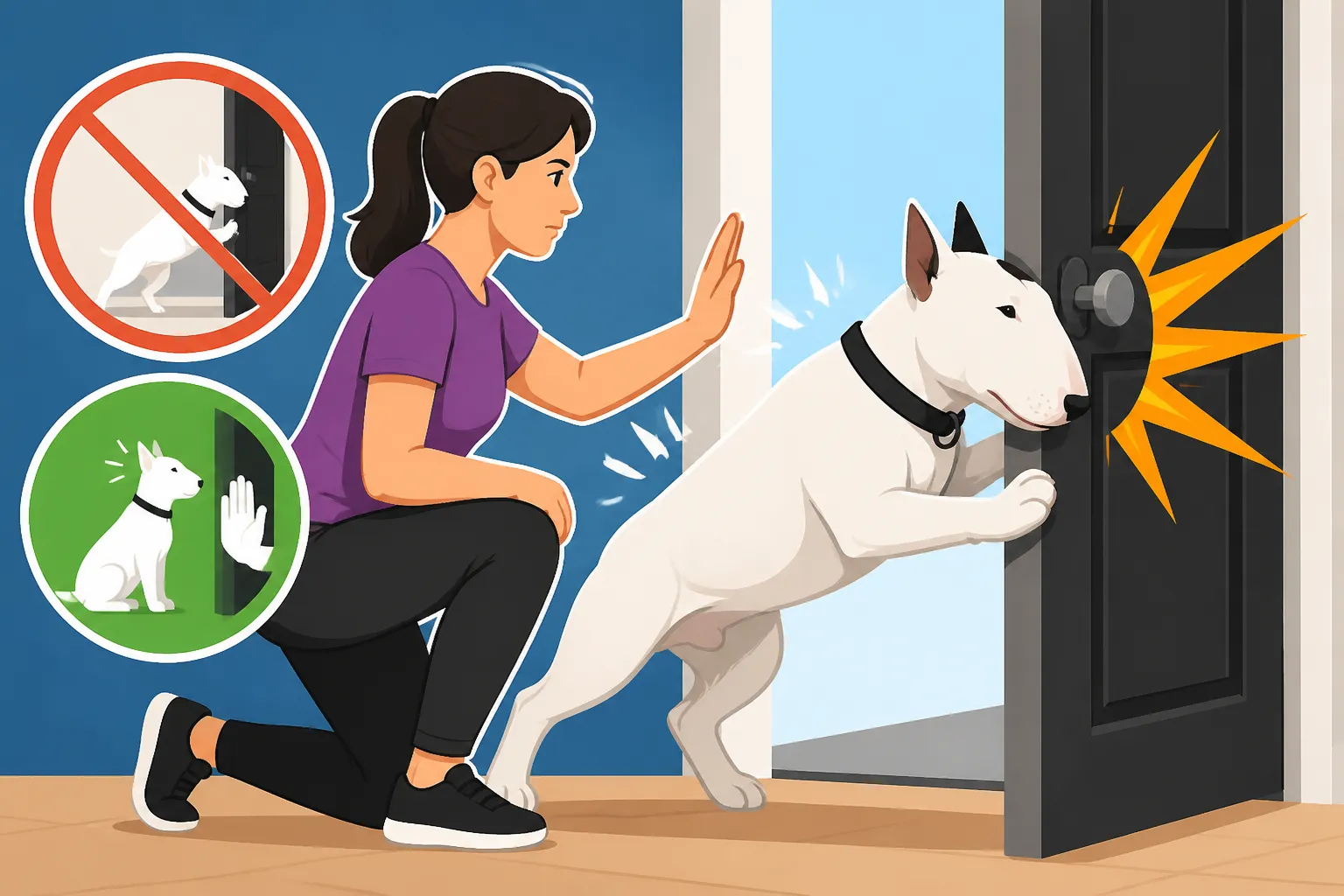
- Wait for calm: If your dog lunges, pushes, or even subtly tries to get ahead, immediately stop moving. Do not open the door. Stand still, like a statue.
- Reward stillness: The moment your Bull Terrier settles, even for a split second – a slight lean back, a glance at you, or a sit – offer praise and a treat. Then, take one tiny step towards the door. If they lunge again, stop. Repeat.
- Add the door opening: Once they reliably wait for you to approach the closed door calmly, start to reach for the doorknob. If they get excited, your hand freezes. Only when they are calm do you continue.
- Crack the door: With your dog calm, slowly crack the door open an inch or two. If they lunge, immediately shut the door, but not with a slam that scares them. Just firmly close it. Wait for calm again.
- Progress slowly: Repeat this process, gradually opening the door wider. Only when they are completely calm and waiting (perhaps in a sit or down position that you've cued) should you fully open the door.
- The "pass through" cue: Once the door is fully open and they are still calmly waiting, give them a clear release cue like "Okay!" or "Go!" and allow them to pass through. Reward them after they've passed politely.
This method teaches them that the door only opens and they only get to pass when they are calm. Their pushing makes the door close, not open. It may take many repetitions, but it’s incredibly effective for shaping their behavior.
The "Leash Control" Technique: Managing Excitement
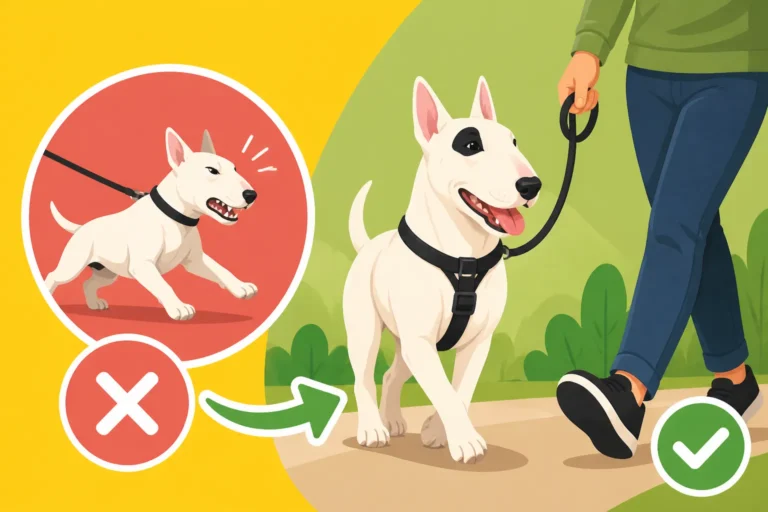
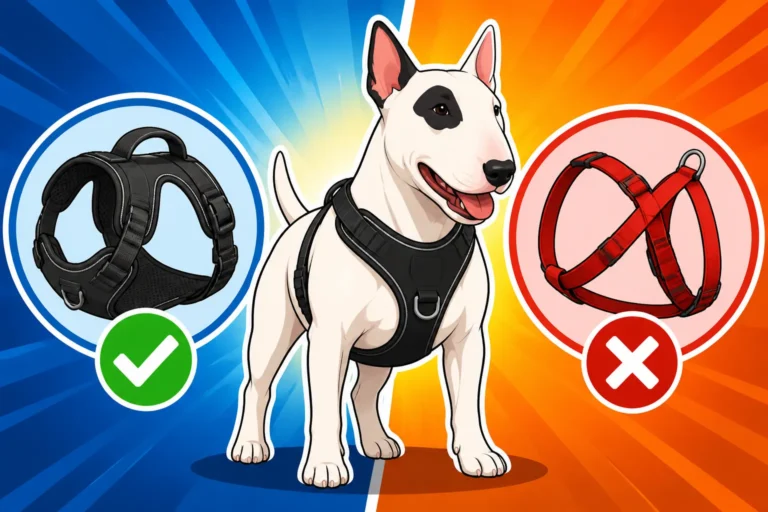
When starting this training, especially with a strong and excited Bull Terrier, using a leash is invaluable, even indoors. A flat collar or a well-fitting front-clip harness works best for this.
- Attach the leash: Before approaching any door (internal or external), attach your Bull Terrier's leash. This gives you a physical means of preventing them from barging.
- Hold the leash short: Keep the leash relatively short, but not taut, allowing just enough slack for them to sit comfortably beside you.
- Approach the door, stop, and cue: Walk towards the door, stop a few feet away, and ask your Bull Terrier to "sit." If they anticipate and try to forge ahead, use the leash to gently guide them back to your side and into a sit. Don't pull harshly; simply stop their forward momentum.
- Wait for eye contact: Once they are sitting, wait for them to offer you eye contact, even for a brief moment. This shows they are disengaging from the door and checking in with you. Reward this with praise and a high-value treat.
- Open the door slowly: With your dog in a sit and the leash providing control, slowly open the door. If they try to break their sit or lunge, immediately close the door. This isn't a punishment, just a consequence: excitement closes the door, calmness opens it.
- Release cue: When the door is fully open, and they are still sitting calmly and looking at you, give your release cue ("Okay," "Free," etc.) and allow them to pass through. Reward them with enthusiasm and a treat once they're through politely.
- Practice on walks: Extend this to walks. Don't let them drag you out the door. The instant they pull, stop dead. Wait for slack in the leash and a moment of calm, then proceed. This reinforces that calm behavior gets them what they want. You can find many durable leashes and harnesses on Amazon that are great for Bull Terriers. A good fitting harness, particularly a front-clip design, can give you more control during these training sessions for Teaching a Bull Terrier to Walk Without Pulling.
Incorporating a Release Word and Rewarding Calmness
A clear release word is essential. It tells your Bull Terrier exactly when it’s okay to move through the doorway. Without it, they're left guessing, which can lead to anticipation and frustration.
- Choose a specific word: Pick a word that you don't use casually, like "Okay," "Free," or "Break."
- Practice in low-distraction environments: Start by having them sit or lie down. After a few seconds, say your release word and immediately offer a treat and praise as they stand up. This connects the word with permission to move.
- Apply to the door: When your Bull Terrier is calmly waiting at the open door, instead of letting them just walk through, say your release word. As they step through, reward them generously.
- Reward before the door: Crucially, don't just reward after they pass through. Also reward moments of calm before the door even opens, or when it's slightly ajar. This reinforces the waiting aspect. Toss a treat on the floor beside them, praise them for staying, then continue the door sequence. This breaks down the behavior into smaller, achievable steps.
- Vary the waiting time: Once they understand the concept, vary how long you ask them to wait. Sometimes it might be two seconds, sometimes ten. This builds duration and prevents them from expecting an immediate release. This practice will also help with other impulse control behaviors, such as when A Bull Terrier Trains When It Sees the Point.
Advanced Scenarios and Troubleshooting
Even with the best training, Bull Terriers can be quirky and challenging. Let's look at how to handle more intense situations and what to do when things don't go perfectly.
Dealing with High-Excitement Situations (Visitors, Walk Time)
The real test comes when distractions are high. The doorbell rings, or you pick up the leash for a walk. These are triggers for many Bull Terriers to go from zero to sixty in a blink, and their door manners often go out the window.
- Practice without the trigger: Before adding visitors or the leash, practice the door routine without these high-value triggers. Get it perfect in a calm environment.
- Simulate the trigger: Have a friend ring the doorbell (or even just knock gently) while you practice the door routine. Keep your Bull Terrier on a leash. The moment they react, stop, reset, and wait for calm. Your friend waits patiently on the other side.
- Manage the greeting: When a visitor arrives, ideally your Bull Terrier is already on a leash. Ask for a sit-stay away from the door. You answer the door, step outside to greet the person, then bring them in. Only when your Bull Terrier is calm can they approach for a polite greeting, still on a leash. This helps your dog understand that you handle the greeting, not them.
- Leash as a predictor: Make the leash a predictor of good things only if they are calm. If they get overexcited when you pick up the leash, put it down and walk away. Come back in a few minutes and try again. They need to associate the leash with calmness, not frenetic energy. This helps to establish better Teaching a Bull Terrier to Walk Without Pulling.
- Utilize a crate: For extremely excitable dogs, consider crating them calmly before the doorbell rings or you need to exit. Once the visitors are settled or you're ready to leave, let them out on a leash to practice the polite door routine. This gives you valuable control in overwhelming situations. Many robust crates, suitable for strong breeds, are available on Amazon.
When Your Bull Terrier Still Tries to Barge Through
Even after consistent training, your Bull Terrier might have moments where they try to revert to old habits. It's not a failure; it's an opportunity to reinforce the lesson.
- The "door slam" (gentle version): If your Bull Terrier pushes their nose or shoulder into the door as you're opening it, immediately and calmly close the door. No yelling, no fuss. Just a firm, quiet closing. Wait a few seconds for them to reset, then try again. They need to understand that pushing means the door doesn't open.
- Step back and reset: If they lunge from a sit-stay, don't try to physically restrain them (unless necessary for safety). Instead, back away from the door, move them to a different spot, and restart the entire process from the beginning: sit, stay, wait for eye contact, approach the door.
- Short time-outs: If the excitement is overwhelming and they just can't calm down, a brief time-out might be necessary. Lead them to a quiet space (a designated mat, their crate, or another room) for a minute or two until they can settle. Then, bring them back and try the door exercise again. The key is that the time-out is not a punishment, but a chance to de-escalate.
- Re-evaluate the rewards: Are your rewards high-value enough? For some Bull Terriers, a squeaky toy or a piece of cheese is far more motivating than a standard kibble. Experiment to find what truly excites them for good behavior. Remember, a Bull Terrier needs consistent motivation, which is why A Bull Terrier Trains When It Sees the Point is so true.
The Importance of Continued Practice and Patience
Teaching a Bull Terrier polite door manners is not a one-and-done task. It's an ongoing process, a continuous reinforcement of good habits. Your Bull Terrier thrives on routine and consistency, but they can also be creatures of habit when it comes to less desirable behaviors.
Expect setbacks, especially during growth spurts, changes in routine, or increased stress. Don't get discouraged. Every time you patiently reset and guide them, you're building a stronger foundation for their behavior. It's a marathon, not a sprint. Celebrate the small victories – the first time they wait patiently without a single nudge, or the moment they offer eye contact at the threshold.
Remember, your Bull Terrier wants to please you, but their natural exuberance and strength need gentle, firm guidance. With consistent training, plenty of positive reinforcement, and a whole lot of patience, you'll soon have a Bull Terrier who understands that good things come to those who wait politely at the door. And if you ever feel overwhelmed, remember resources like BAXTER & Bella offer ongoing support and community for committed owners.
Polite Door Manners vs. The Shoulder Charge: A Comparison
To help you visualize the transformation, here's a quick comparison of the behaviors you're working to change versus the polite manners you're aiming to instill.
| Behavior Aspect | Shoulder Charge (Undesired) | Polite Door Manners (Desired) |
|---|---|---|
| Approach to Door | Rushes, pushes, leans into the door, gets ahead of owner. | Walks calmly beside or slightly behind owner, maintains personal space. |
| At Closed Door | Whines, scratches, jumps, paws, shoves nose under the door. | Sits or stands calmly at a distance, awaits instruction. |
| Door Opening | Attempts to lunge through gap, ignores owner's presence. | Stays in position, watches owner for cue, maintains calm. |
| Greeting Trigger | Over-excitement, body slams guests, barks uncontrollably. | Waits for permission to greet calmly, takes treats gently. |
| Leash Handling | Pulls immediately when leash is attached, drags owner. | Remains calm when leash is attached, walks nicely to the door. |
| Owner's Role | Perceived as an obstacle to get around. | Perceived as leader, source of permission and guidance. |
| Consequence | Door opens despite pushing, reinforcing the behavior. | Door only opens for calm behavior, reinforcing patience. |
Disclaimer:
This article is for general informational purposes only and does not constitute professional advice. Laws, prices and regulations vary by location and change over time. Consult a qualified professional for guidance on your specific situation.