How Quickly a Bull Terrier Puppy Learns the Door
One of the most common frustrations for Bull Terrier owners, especially those navigating puppyhood, is the sheer chaotic energy that erupts around a doorway. That little egghead on four paws quickly learns that the door means excitement, and suddenly, all sense of calm, politeness, and even basic obedience flies right out the window – sometimes, literally, as they try to dart through! This guide will tackle the unique challenge of teaching your Bull Terrier puppy impeccable door manners, diving into their quirky learning style and providing actionable strategies to make every exit and entrance a breeze, not a wrestling match.
Understanding the Bull Terrier's Unique Learning Curve
Bull Terriers are truly one-of-a-kind, and their approach to learning reflects that vibrant personality. They're smart, yes, often alarmingly so, but they're also incredibly independent and have a singular focus on what they find rewarding. This combination can make traditional training methods feel like you're trying to herd cats with a spaghetti noodle. When it comes to the door, their inherent drive to investigate, play, and be with their people can easily override any polite request to "wait."
The Bull Terrier Mindset: Independent and Clever
Your Bull Terrier puppy isn't trying to be defiant; they're simply weighing the options and making a decision based on what benefits them most. If bolting through an open door leads to a thrilling adventure or a chance to greet someone, that's a huge payoff in their book. They're quick to grasp patterns, so if sometimes rushing out is tolerated, they'll learn that it's worth a try every single time. Their cleverness means they can figure out how to exploit any inconsistency in your routine, so what might seem like stubbornness is often just a highly intelligent dog acting on learned associations. You might even find them testing boundaries, pushing their luck to see what they can get away with, which is why a strong, clear, and consistent message is paramount when teaching door etiquette.
The key to unlocking their cooperation lies in making the desired behavior far more appealing than their own spontaneous ideas. They won't just "do it because you said so"; they'll do it because it leads to something amazing for them. Understanding What a Bull Terrier's Temperament Is Really Like is fundamental here, as it helps you anticipate their natural inclinations and channel them into positive behaviors, rather than constantly battling against their nature.
Puppyhood Energy and Impulse Control
Bull Terrier puppies are bundles of boundless energy, and frankly, they're not born with an innate understanding of impulse control. The world is a giant playground, and every doorway represents a new frontier to explore. This natural exuberance means that asking a young Bull Terrier to calmly sit while the door opens is asking them to fight against their very instincts. They want to greet, they want to run, they want to explore – and they want to do it now.
This lack of impulse control manifests as jumping, pushing, whining, or even nipping at the leash in their excitement. It’s not malicious; it's simply an overflow of pent-up energy and anticipation. Trying to physically restrain them without teaching them self-control can often backfire, leading to more frustration for both you and your puppy. Instead, we need to guide them into making better choices, giving them the tools to manage their own excitement around the thrilling gateway that is your front door. Learning to manage this early exuberance is critical for developing a well-behaved adult Bull Terrier.
The "Zoomie" Factor and Doorways
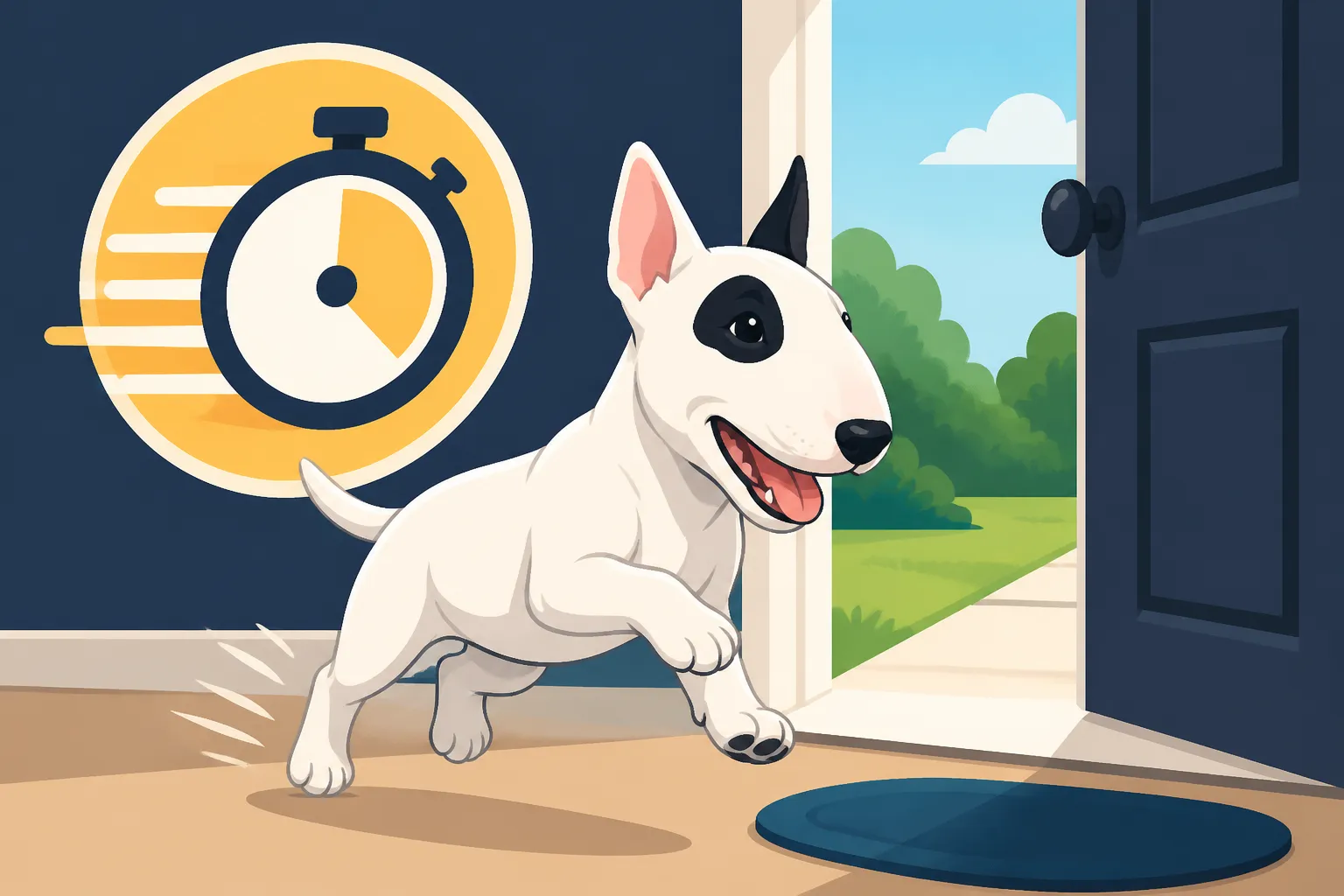
Ah, the infamous Bull Terrier zoomies! Those sudden, explosive bursts of energy where your puppy transforms into a furry torpedo, careening around the house with reckless abandon. Doorways, unfortunately, can often become epicenters for these wild sprints. The sight of an opening door can act as a direct trigger, signaling the ultimate liberation for a quick dash, a roll in the grass, or an enthusiastic greeting of whatever lies beyond. It’s like a launchpad to their version of doggy nirvana.
This isn't just about door manners; it's about channeling that intense energy safely. If a Bull Terrier puppy habitually uses the door as a launchpad for a full-speed exit, it poses a significant safety risk, not just for them but for anyone in their path. Teaching them to pause and collect themselves at the threshold isn't about stifling their joy; it's about teaching them when and where to express it. A secure, fenced yard is often where they can safely unleash their zoomies after demonstrating calm at the door. You might be surprised at How far a Bull Terrier Should Walk Before It Gets Silly but even after a good walk, that residual energy can still spark a door dash if not managed properly.
Laying the Foundation: Early Training Principles
Successful door training for a Bull Terrier puppy isn't about quick fixes; it's about building a solid foundation of understanding and trust. Because of their unique personalities, you'll need a different approach than you might use with other breeds. It’s all about consistency, motivation, and making the right choice the easiest and most rewarding one for your energetic companion.
The Importance of Consistency and Clear Cues
If there's one golden rule for training a Bull Terrier, it's consistency. Seriously, engrave it on your soul. These dogs are incredibly smart, and they will pick up on any loopholes in your system. If "wait" at the door means sometimes you let them rush out, and sometimes you don't, they'll always try their luck. This isn't them being difficult; it's them being intelligent and opportunistic. Every single person in your household needs to be on the same page, using the exact same verbal cues and hand signals, and enforcing the same expectations, every single time a door is approached.
Imagine trying to teach a child to always use a fork, but then sometimes you give them a spoon, and sometimes you just let them eat with their hands. They'd be confused and probably just grab whatever's easiest! It's the same principle for your Bull Terrier. Clear, concise cues, always followed by the same expected behavior and consequence (reward for compliance, redirection for non-compliance), will build a strong understanding. Without this unwavering consistency, your Bull Terrier puppy will learn that the door is a negotiable space, and you'll find yourself constantly battling their instincts to bolt. This firm but fair approach prevents them from developing a habit of thinking a cue is merely Why a Bull Terrier Decides a Cue Is Optional.
Positive Reinforcement and High-Value Rewards
When training a Bull Terrier, positive reinforcement isn't just a suggestion; it's the most effective strategy. These dogs thrive on praise, attention, and tangible rewards for a job well done. Harsh corrections or punishment for trying to go through the door will likely just make them wary of you or the door itself, rather than teaching them the desired behavior. They might become sneaky, or even shut down entirely under pressure. Instead, focus on rewarding the behaviors you want to see.
What constitutes a "high-value" reward for a Bull Terrier? It's typically something incredibly enticing – tiny pieces of cooked chicken, cheese, or their absolute favorite squeaky toy. A bland kibble might work for a quiet "sit" in the living room, but at the thrilling doorway, you need to pull out the big guns. Ensure your rewards are small enough to be eaten quickly so as not to interrupt the flow of the training session. You can find a huge variety of high-value training treats and engaging puzzle toys on Amazon that can be rotated to keep your Bull Terrier interested. Discovering Which Reward Outranks a Bull Terrier's Own Idea will be your secret weapon in almost all training scenarios.
Short, Frequent Training Sessions
Bull Terriers, especially puppies, aren't built for long, drawn-out training sessions. Their attention spans are notoriously short, particularly when faced with repetitive tasks. Trying to force a 30-minute door manners drill will likely result in a bored, frustrated puppy who decides to find their own entertainment (perhaps by chewing the doormat!). Instead, aim for multiple, very short sessions throughout the day – think 3-5 minutes, maybe even less, but repeated many times.
These brief bursts of focus keep training engaging and prevent your puppy from becoming mentally fatigued. End each session on a high note, with success and a big reward, even if you only managed one perfect "wait" at the door. This leaves your puppy wanting more and excited for the next training opportunity. Incorporating these mini-sessions into your daily routine, like before mealtimes or before going out for a potty break, will make them a natural part of your Bull Terrier's day without feeling like a chore. Understanding How Short a Bull Terrier's Training Session Has to Be is crucial for effective learning and preventing burnout in both you and your puppy.
Step-by-Step Door Etiquette Training
Now that we understand the Bull Terrier's unique mind, let's get down to the nitty-gritty of actual door training. This isn't about force; it's about teaching your puppy the specific sequence of actions you want them to take, making it clear what is expected and what leads to a reward. Patience, as always with a Bull Terrier, will be your greatest virtue.
"Wait" and "Stay" at the Threshold
The "wait" cue is your absolute best friend when it comes to doors. It teaches your Bull Terrier puppy to pause and hold position until you release them, even with an open door. Start this training far away from any actual doors, perhaps just using a designated mat or even a piece of tape on the floor as a "threshold." Ask your puppy to sit or lie down, give the "wait" cue, take one step away, then immediately return and reward if they stayed. Gradually increase the distance and duration.
Once they understand "wait" away from the door, move to the actual doorway. Have your puppy on a leash, ask for a sit a few feet from the door, then give your "wait" cue. Put your hand on the doorknob. If they get up or lunge, immediately remove your hand from the knob, wait for them to settle, and ask for the sit again. Only when they remain calm with your hand on the knob do you slowly turn it. Repeat this process for opening the door a crack, then wider, then fully, always rewarding calm behavior and closing the door if they break their "wait." The goal is to make the door opening a consequence of their calm behavior, not a trigger for excitement. This sequential process is key to Teaching a Bull Terrier Not to Shoulder Through a Door.
Preventing Jumping and Leash Pulling at the Door
Jumping and pulling at the door are instinctual behaviors fueled by excitement, but they can quickly become dangerous. To prevent jumping, never reward it with attention. When your Bull Terrier puppy jumps, turn your back, cross your arms, and completely ignore them. The moment all four paws are on the floor, turn back and quietly praise and reward. Repeat, repeat, repeat. If they jump again, turn away again. Consistency is key here; everyone who interacts with your dog must follow this rule.
For leash pulling, especially as you approach or leave the door, a sturdy, well-fitting harness can be invaluable. Look for no-pull harnesses that clip at the front, redirecting their momentum when they pull. You can find excellent options for strong breeds on Amazon. Practice loose leash walking in quiet areas near the door, rewarding every step they take without tension on the leash. If they pull, simply stop walking. The moment the leash slackens, continue. This teaches them that pulling gets them nowhere, while a loose leash gets them where they want to go. This groundwork is vital for Teaching a Bull Terrier to Walk Without Pulling in any context, but especially around the stimulating environment of a door.
Greeting Guests Politely
Guest arrival can be a huge trigger for Bull Terrier puppies, often leading to a chaotic flurry of jumps, barks, and enthusiastic (but often overwhelming) greetings. The key here is proactive management and controlled introductions. Before a guest arrives, have your puppy on a leash. Practice a "sit-stay" a short distance from the front door. When the doorbell rings, give them a high-value treat for remaining calm. If they start to get overexcited, simply walk them to a quiet space or another room until they settle, then bring them back to try again.
When your guest enters, keep your puppy on the leash. Ask the guest to ignore your puppy completely until they are calm and have all four paws on the floor. Only then, with a clear release cue from you, can your puppy approach for a calm sniff and greet. Short, positive interactions are best. If the puppy gets too boisterous, calmly redirect them or take them for a short "time out" until they can compose themselves. Programs like BAXTER & Bella often have specific modules on polite greetings and impulse control, which can be a huge asset for Bull Terrier owners tackling this very common challenge.
Common Challenges and Troubleshooting
Even with the best intentions and consistent training, you're bound to hit a few bumps in the road when teaching door manners to a Bull Terrier puppy. They are, after all, still puppies with big personalities! Knowing how to anticipate and troubleshoot these common challenges will save you a lot of frustration and keep you both on the path to success.
The Bolting Bull Terrier: Safety First
A bolting Bull Terrier is not just a nuisance; it's a serious safety hazard. Their instinct to chase, combined with their incredible speed and surprising endurance, means that a swift escape can quickly lead to a dangerous situation, whether it's running into traffic, getting lost, or encountering another dog on their terms. For this reason, you should never fully trust a Bull Terrier puppy (or even many adult Bull Terriers) off-leash near an open door or gate. It's simply not worth the risk.
Prevention is paramount. Consider using a double leash system if you're concerned about them slipping their collar – one lead attached to a collar and another to a harness. Always have them on a leash before opening the door, even if it's just to step outside to grab the mail. If you have a yard, ensure your fencing is truly secure; Bull Terriers are surprisingly capable diggers and climbers. How a Bull Terrier Gets Out of a Fence can offer additional insights into securing your perimeter. For puppies, a sturdy crate near the door can be a lifesaver, allowing you to manage the entry/exit while they wait safely inside.
Door Destruction and Chewing
If your Bull Terrier puppy starts turning your door frame, doormat, or even the door itself into a chew toy, it's a clear signal that something isn't quite right. This behavior is often rooted in boredom, anxiety, or simply a lack of appropriate outlets for their powerful jaws. A Bull Terrier puppy with unmet physical or mental needs will find its own (often destructive) ways to entertain itself.
The solution typically involves a multi-pronged approach. First, increase their mental and physical stimulation throughout the day. Are they getting enough walks, playtime, and engaging activities? Puzzle toys, readily available on Amazon, filled with their meal or high-value treats can keep their minds busy. Provide a variety of tough, appropriate chew toys – redirect them to these every time they attempt to chew the door. Crate training can also be incredibly useful, providing a safe, dog-proof space for them when you can't supervise directly. Addressing What a Bull Terrier Does When It Is Bored will be key to stopping destructive behaviors at the door and elsewhere.
Regression and Consistency Slip-Ups
No matter how diligent you are, there will be days when your Bull Terrier puppy seems to forget everything you've taught them about door manners. They'll lunge, they'll jump, they'll whine, and you'll wonder if all your hard work was for nothing. This is what we call "regression," and it's a completely normal part of puppy development and learning, especially with a breed as spirited as the Bull Terrier. It's easy to get discouraged, but the worst thing you can do is give up or become inconsistent.
Regression often happens during growth spurts, adolescence, or when there's a change in routine or environment. The key is not to panic, but to go back to basics. Dial back your expectations, simplify the training steps, and reinforce heavily. If they're struggling with the open door, go back to practicing with the door closed, then just cracked, rewarding every small success. Re-evaluate your consistency: has anyone in the household been lax with the rules? Are your rewards still high-value enough? Remember, every "slip-up" is an opportunity to reinforce the correct behavior, and with a Bull Terrier, that often means repeating, repeating, and repeating again.
Advanced Door Manners and Real-World Scenarios
Once your Bull Terrier puppy has a solid grasp of basic door etiquette at your main entrance, it's time to generalize those skills and tackle more complex, real-world situations. Life isn't always a perfectly controlled training environment, and a well-trained Bull Terrier needs to be able to maintain their composure no matter the distraction or the doorway.
Managing Multiple Doors and Gates
Your home likely has more than just a front door. There are back doors, garage doors, gates leading to the yard, and even internal doors that your Bull Terrier puppy might try to "shoulder through." The challenge here is ensuring that the rules you've established for one door apply equally to all exits and entrances. Bull Terriers are masters of context; they might understand "wait" at the front door but think the back door is fair game for a sprint.
The solution is to systematically practice the same door manners at every doorway and gate in your home. Start simple, just as you did with the main door, and gradually work your way up to full exits. Consistency is still your guiding star. If you allow them to bolt out the back door "just this once," you're undermining all the hard work you've put into the front door. Every family member needs to enforce the same rules at every single threshold. This generalization is crucial for a truly well-mannered Bull Terrier.
The "Doorbell" Dilemma
The sound of a doorbell can transform an otherwise calm Bull Terrier puppy into a barking, jumping, excited mess. This is often because the doorbell has become associated with the arrival of exciting visitors or the anticipation of a walk. The goal is to change that association from "excitement" to "calm."
Start by desensitizing your puppy to the doorbell. Have someone ring the doorbell (or use a recording) while you're not expecting guests. The moment the sound occurs, immediately reward your puppy for any calm behavior – looking at you, sitting, or even just pausing their activity. Don't reward the bark or the jump. Practice this many times a day, gradually increasing the distractions around them. You can also teach a "go to mat" or "place" command, so that when the doorbell rings, your puppy's conditioned response is to calmly go to their designated spot. Reward them heavily for staying on their mat until the "all clear" is given. This structured response gives them a job to do instead of letting their excitement spiral.
Door Manners in Public Spaces
Taking your Bull Terrier puppy out into the world means encountering a whole new set of doors: vet office doors, pet store entrances, friend's houses, and even car doors. These environments come with novel smells, sounds, and distractions that can make maintaining door manners incredibly challenging. What works perfectly at home might fall apart in a stimulating public setting.
The key to success in public is to manage the environment and set your puppy up for success. Always have them on a leash, and if necessary, use a front-clip harness for better control. Practice your "wait" cue outside the door before entering. If they're too excited, walk them away from the entrance, let them calm down, and try again. Don't be afraid to take a few steps back in your training if needed. Start with less stimulating public doors (e.g., a quiet pet store during off-peak hours) and gradually introduce more challenging ones. Remember, every successful entry and exit in a new place builds confidence and reinforces their training. Even if your Bull Terrier is typically a good traveler, understanding How a Bull Terrier Rides in a Car can also contribute to a calmer demeanor upon arrival at public doors.
Door Manners Training Troubleshooting Table
Here's a quick reference for common door manners problems and how to approach them with your Bull Terrier puppy:
| Problem | Why it Happens (Bull Terrier Perspective) | Troubleshooting Strategy |
|---|---|---|
| Bolting through an open door | High prey drive, curiosity, excitement of the unknown, inconsistent rules. | Safety first: Always leash before opening. Practice "wait" at the threshold. Consider a double leash. Secure your yard. Never trust off-leash at doors. |
| Jumping on people at the door | Over-excitement, seeking attention, lack of impulse control. | Ignore the jump: Turn your back, cross arms. Reward only when four paws are on the floor. Use a leash for control. Practice "sit-stay" away from the door when guests arrive. |
| Pulling on the leash near the door | Eagerness to go, strong breed, lack of loose-leash training. | Stop and go: Stop walking the moment the leash tightens. Resume when slackens. Use a front-clip harness (like those found on Amazon) for better control. Practice loose leash walking away from the door first. |
| Chewing/scratching the door frame | Boredom, separation anxiety, pent-up energy, lack of appropriate chew toys. | Enrichment: Provide puzzle toys, rotate chew toys. Increase exercise. Address separation anxiety if present. Crate training. Redirect to appropriate chews whenever caught in the act. |
| Barking excessively at the doorbell | Excitement, warning, learned association with visitors. | Desensitization: Practice ringing the bell and rewarding calm behavior. Teach "go to mat" or "place" command. Manage expectations: don't let them "guard" the door. |
| Forgetting manners in new places | New distractions, lack of generalization, over-stimulation. | Practice in new places: Start with quiet, low-distraction environments. Gradually increase difficulty. Manage expectations, go back to basics if needed. Use a leash and harness for control. |
Disclaimer
This article is for general informational purposes only and does not constitute professional advice. Laws, prices and regulations vary by location and change over time. Consult a qualified professional for guidance on your specific situation.