Which Crosses Bull Terriers Appear In
Bull Terrier crosses can look and behave very differently, even when two dogs share the same mix label. That makes names like “Bull Terrier Lab mix” a starting point, not a reliable description of adult size, temperament, or care needs. This guide explains common crosses, what their names mean, and how to assess an individual dog before bringing one home.
What people mean by a Bull Terrier cross
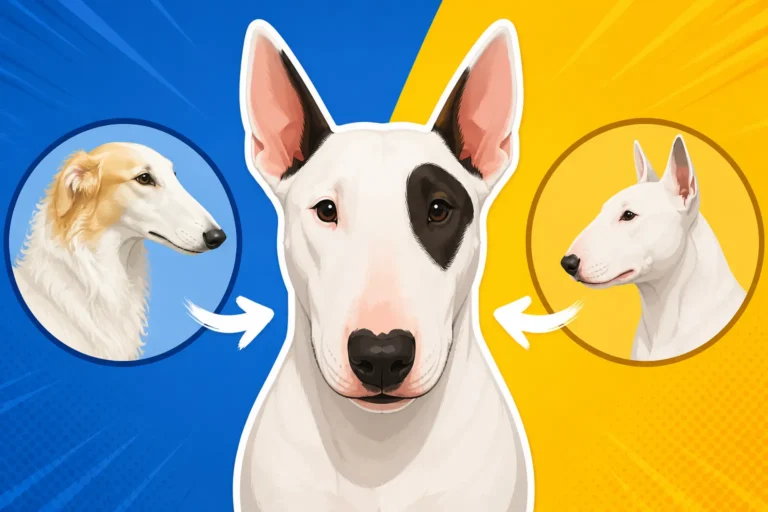
A Bull Terrier cross is a dog with at least one Bull Terrier parent and a parent from another breed or mixed background. The other parent might be known, as in a Bull Terrier crossed with a Labrador Retriever, or uncertain, as often happens with dogs entering rescue without a complete history.
There is no single, predictable “Bull Terrier mix” type. Puppies in one litter can inherit different combinations of their parents’ features, and a dog’s appearance does not reveal its whole ancestry. Even siblings may differ in build, coat, energy, sociability, and how much training they need.
Crossbreed names are informal
Many Bull Terrier crosses do not have an established breed name. People may describe a dog as a Bull Terrier–Staffordshire Bull Terrier mix, a Bull Terrier–Boxer cross, or simply a Bull Terrier mix. These labels are usually practical shorthand rather than names for recognized breeds with a consistent standard.
Some cross names are especially ambiguous. For example, “Bullador” is sometimes used for a Bull Terrier–Labrador cross, but it can also refer to other combinations. When you see a nickname, ask which breeds it is meant to describe rather than assuming it identifies a specific mix.
This matters when you are researching expected size, health, or behavior. Advice written for a dog with one particular combination may not apply to another dog carrying the same nickname. If a seller or rescue knows the parents, ask for their breeds and, where possible, details about their health and temperament.
A mix label cannot predict the whole dog
People often hope that crossing breeds will reliably combine the best of each. In reality, a puppy may inherit a trait from either parent, a blend of both, or a combination that is hard to anticipate. A Bull Terrier–Labrador cross might be sociable and energetic, for instance, but the label alone cannot promise that temperament.
Physical features are variable too. One puppy may have a broad head and compact frame, while another from the same litter may be leggier or have a different coat. Weight estimates based on breed averages can be rough guides, not guarantees—especially when the dog’s ancestry is unknown.
If you are considering a particular dog, focus on that dog’s behavior and needs rather than trying to predict everything from its name. Find out how it responds to handling, unfamiliar people, other dogs, and being left alone. For background on the purebred parent, Where the Bull Terrier Sits in America Today offers a wider breed overview, while What a Bull Terrier's Temperament Is Really Like describes the Bull Terrier’s characteristic personality without implying every cross will share it.
Bull Terrier crosses you may encounter
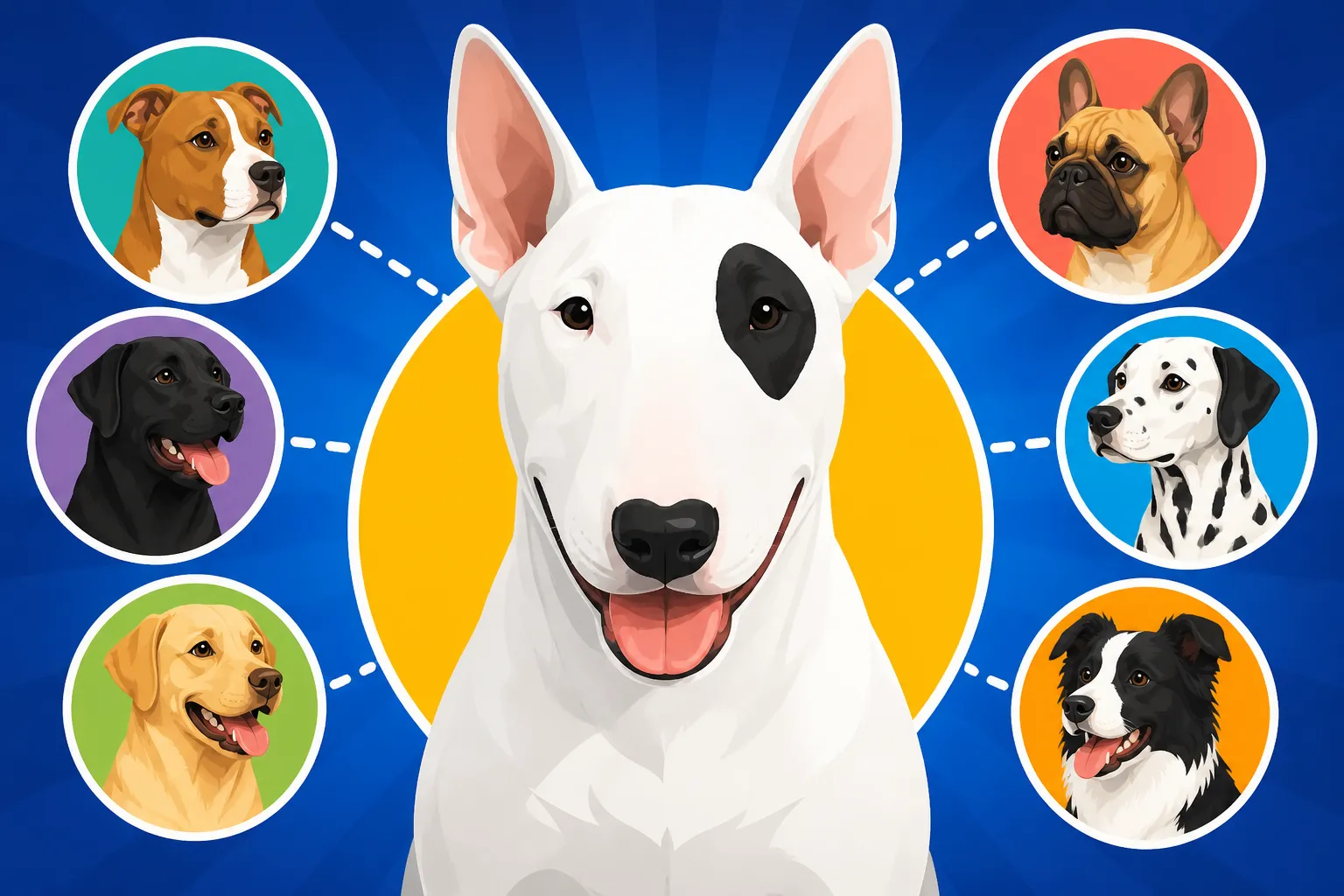
Bull Terriers can be crossed with many breeds, deliberately or by chance. The following examples describe combinations people may encounter, not standardized types. A dog’s actual characteristics depend on its ancestry, early experiences, health, and individual temperament.
| Possible cross | What the label tells you | What it cannot tell you |
|---|---|---|
| Bull Terrier and Staffordshire Bull Terrier | Both parents are bull-type terriers | How dog-tolerant, sociable, or physically powerful the individual will be |
| Bull Terrier and Labrador Retriever | One parent is a Bull Terrier and one is a Labrador | Adult size, retrieving interest, coat, or friendliness |
| Bull Terrier and Boxer | The dog has ancestry from two strong, active breeds | Whether it will be bouncy, calm, easy to manage, or suited to a particular home |
| Bull Terrier and American Pit Bull Terrier | The dog has ancestry from two distinct breeds often grouped under broad “bully breed” labels | Exact breed ancestry, legal classification, or behavior |
| Bull Terrier and Dalmatian | The dog has ancestry from both breeds | Whether it will have spots, a particular activity level, or any specific health outcome |
| Bull Terrier and an unknown breed or mix | A Bull Terrier-like appearance or reported ancestry | The dog’s full genetic background or likely adult traits |
Bull Terrier and Staffordshire Bull Terrier crosses
A Bull Terrier–Staffordshire Bull Terrier mix may be muscular and strong, but appearance and body shape vary. Both parent breeds can be energetic and people-oriented, yet that does not mean every dog will be comfortable with every other dog or easy to handle in all situations.
A prospective owner should pay close attention to leash skills, play style, and how the dog behaves around other animals. A dog that enjoys people may still need careful introductions to unfamiliar dogs, and a playful dog may be too forceful for a small companion. Read How a Bull Terrier Gets On With Other Dogs for useful context, but evaluate the individual rather than assuming a cross will match a breed description.
Bull Terrier and Labrador Retriever crosses
A Bull Terrier–Labrador cross can vary in size, coat, and energy. Some dogs may enjoy retrieving games or swimming; others may show little interest. A Labrador parent does not guarantee an easygoing temperament, just as a Bull Terrier parent does not guarantee stubbornness or any other single trait.
Think about the daily routine you can offer. A strong, active dog needs safe outlets for movement and problem-solving, alongside time to rest and learn household rules. Ask how the dog behaves when excited and how quickly it can settle afterward. How Much Exercise a Bull Terrier Actually Needs can help you think through activity needs, but a cross may require a different routine from either parent.
Bull Terrier crosses with other breeds
Bull Terrier crosses with Boxers, American Pit Bull Terriers, American Bulldogs, Dalmatians, or other breeds may turn up in shelters, rescue groups, and private homes. Some may be intentional litters; others may have an unknown or partly known background. A name such as “Bull Terrier Boxer mix” does not establish that the dog will inherit a predictable combination of traits.
It is also easy to overinterpret looks. A broad head, short coat, or muscular body does not prove a particular mix. Breed ancestry can sometimes be investigated with a DNA test, but results are estimates and do not replace learning how the dog behaves in everyday situations.
When a dog’s background is uncertain, rely on practical information: medical records, observed behavior, foster-home reports, and the organization’s adoption process. For people deciding whether rescue is the right route, Adopting a Bull Terrier From Rescue explains considerations that are relevant to bringing home a dog with a known or unknown history.
How to assess a Bull Terrier cross before adopting
Choosing a cross is less about finding the perfect label and more about deciding whether a particular dog fits your home. A thoughtful assessment can help you avoid surprises—not because it makes the future certain, but because it gives you a clearer picture of the dog in front of you.
Ask about the individual dog’s history
If the dog is from a breeder, ask what they know about both parents. Request clear information about the parents’ health and temperament, and ask whether you can meet them. If the dog is from a rescue or shelter, ask what has been observed in foster care or at the facility and what is unknown.
Useful questions include:
- How does the dog respond to unfamiliar people and handling?
- What has the dog’s experience been with other dogs, cats, and children?
- Can the dog relax at home, or does it remain highly active?
- How does it behave when left alone for short periods?
- Has it shown guarding, fear, or sensitivity to particular situations?
- What medical records, vaccination details, or prior assessments are available?
Answers should be specific. “Good with dogs,” for example, is less useful than knowing whether the dog has calmly lived with another dog, met dogs only on walks, or has not yet been assessed around them. If you are preparing breeder questions, Which Questions to Ask a Bull Terrier Breeder offers a practical framework for discussing health and background.
Match the dog to your household
Consider your home, schedule, and experience honestly. A sturdy, enthusiastic dog may need patient leash training, supervision around children, and controlled introductions to other animals. This is not a judgment about a mix; it is a reminder that size and strength affect how manageable everyday moments can be.
Think about ordinary situations: greeting visitors at the door, walking past dogs on a narrow sidewalk, settling while you work, and being handled for grooming or veterinary care. If a dog becomes overexcited in those moments, you will need a plan for teaching calmer behavior. Training should be reward-based, consistent, and paced to the dog, rather than built around assumptions about its breed label.
It can help to meet the dog more than once, when possible, and observe it in different settings. Ask whether a foster-to-adopt arrangement or post-adoption support is available. No introduction can guarantee how a dog will settle in, but thoughtful preparation gives both the dog and household a better chance to succeed.
Plan for health and ongoing care
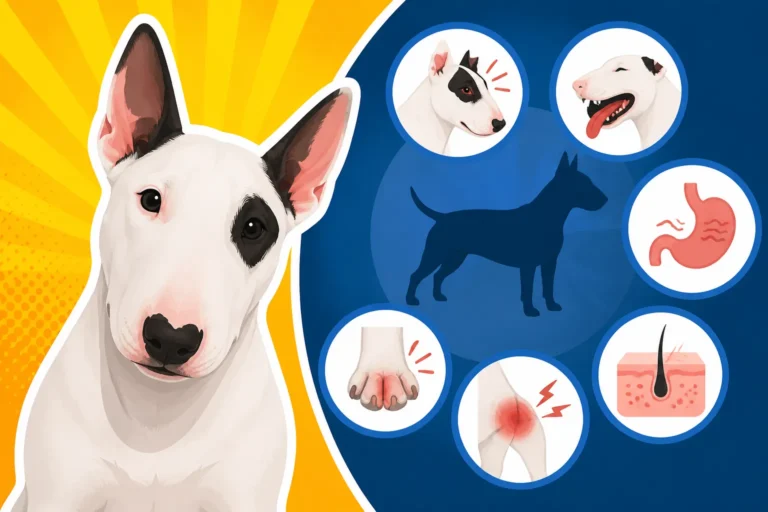
Mixed ancestry does not mean a dog is automatically healthier or free from inherited conditions. Health risks depend on the dog’s actual ancestry and individual medical history, and routine veterinary care remains important. Ask for available records and schedule a veterinary examination after adoption so you can discuss appropriate preventive care and any concerns.
For a Bull Terrier-parent dog, owners may want to understand the health issues that can occur in the breed, while avoiding the assumption that every cross will develop them. What a Bull Terrier Breeder Should Have Tested explains health screening considerations for purebred Bull Terriers; with a cross, available screening will depend on the parents, the dog’s background, and the veterinarian’s advice.
Budget and housing also deserve attention. Food, training, routine veterinary care, and unexpected treatment all add up, while rental rules and insurance policies may treat dogs differently. Check your own lease, local requirements, and policy terms rather than relying on a general statement about a breed or mix. What a Bull Terrier Costs Over Its Lifetime can help you think about the broader responsibilities of long-term ownership.
Common misconceptions about Bull Terrier mixes
A few persistent assumptions can make it harder to choose a dog fairly and realistically. Keeping these distinctions in mind helps shift the focus from a label to the individual dog.
A cross is not automatically calmer or healthier
Crossing two breeds does not guarantee a calmer, healthier, or easier dog. A puppy can inherit health risks from either side of its ancestry, and temperament is shaped by more than breed alone. Early care, social experiences, training, and individual variation all matter.
It is reasonable to ask about health screening and medical history, but be cautious of broad promises. A seller’s claim that a cross is “healthier by design” is not a substitute for documentation or veterinary guidance. The same applies to claims that a mix is naturally good with children, dogs, or first-time owners.
A dog’s appearance does not settle its identity
A dog can resemble a Bull Terrier without having a confirmed Bull Terrier parent, and a genuine cross may not look strongly like one. Visual guesses are unreliable, especially when several breeds share similar features. If ancestry matters for medical planning or another practical reason, ask what evidence is available and discuss useful next steps with a veterinarian.
Do not let an uncertain label distract from the more immediate questions: Is the dog comfortable in your home? Can you meet its exercise and training needs? Are there known health or behavior concerns that you can manage? Those answers are more useful than a confident-sounding mix name.
Every cross still needs individual training
A Bull Terrier cross may be clever, playful, strong, sensitive, or some combination of those traits, but no mix arrives knowing household rules. Teach the skills that make daily life safer and easier: walking on a loose leash, settling on a mat, greeting people without jumping, and responding to a recall cue in controlled settings.
Keep sessions short enough to hold the dog’s attention and reward the behavior you want to see again. If you are struggling with pulling, overexcitement, or interactions with other dogs, ask a qualified trainer for help early. A Bull Terrier Trains When It Sees the Point provides additional insight into making training engaging and consistent.
The most useful way to think about Bull Terrier crosses is simple: the mix name offers a clue, not a forecast. Learn what you can about the dog’s parents and history, observe the individual, and make a realistic plan for training, care, and daily life. That approach is more dependable than choosing—or ruling out—a dog based on a label alone.
Disclaimer
This article is for general informational purposes only and does not constitute professional advice. Laws, prices and regulations vary by location and change over time. Consult a qualified professional for guidance on your specific situation.