Whether a Bull Terrier’s Tail Is Docked
A Bull Terrier’s tail is not normally docked. It is naturally long, low-set, thick at the base, and tapered to a fine tip, so seeing one with a short tail can raise questions about injury, surgery, or its background. This guide explains the breed’s natural tail, why docking is uncommon, and what to do if your dog’s tail looks unusual or becomes sore.
What a Bull Terrier’s tail naturally looks like
The breed’s tail is meant to be long
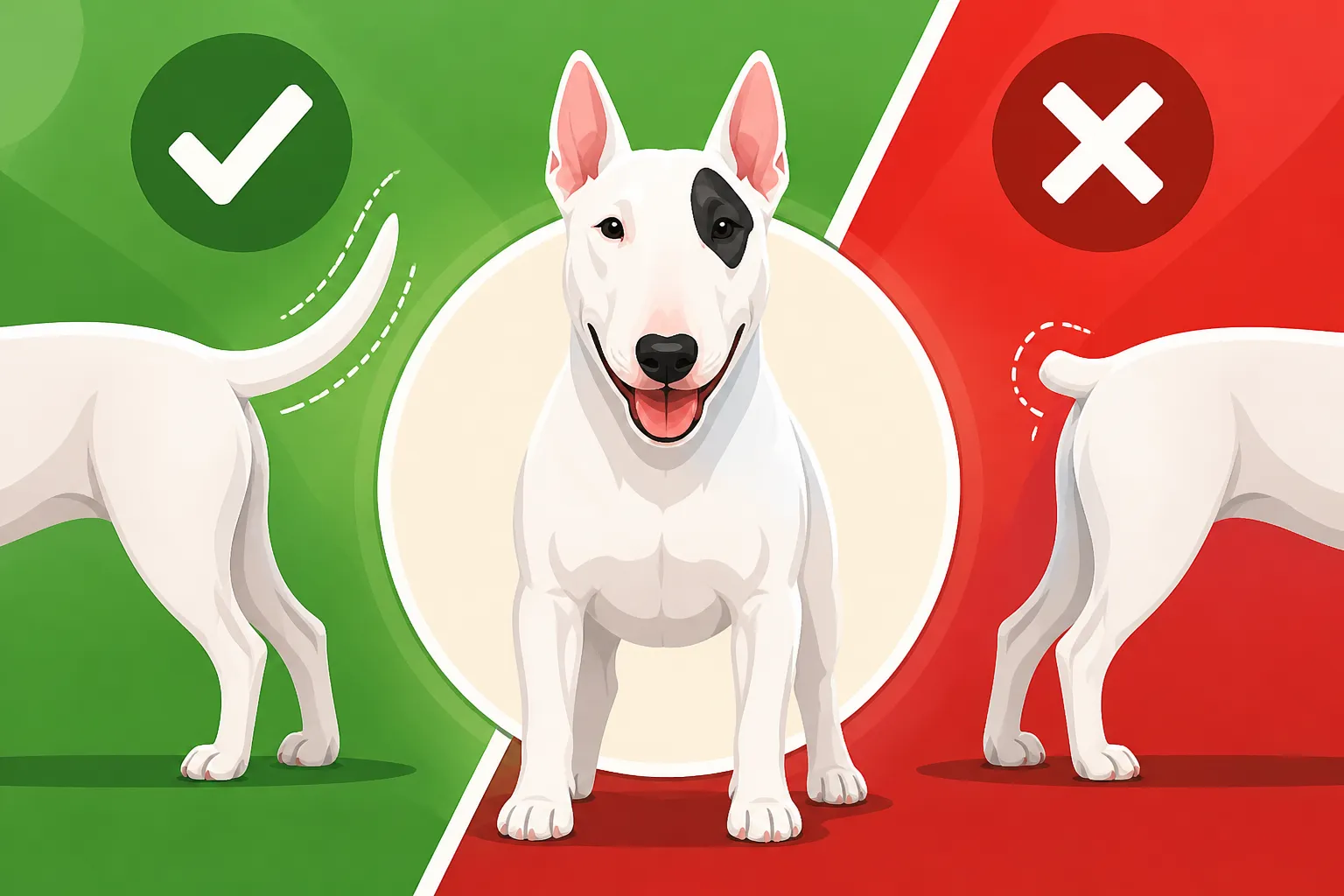
A Bull Terrier’s tail is naturally full length. Breed standards describe a tail carried low or horizontally, with a thick root that tapers toward the tip. It usually reaches approximately to the hocks. The tail is not meant to curl tightly over the back or end in a short stump.
That shape can look different from the tails people expect on some other breeds. A Bull Terrier’s tail may hang quietly when the dog is relaxed, extend behind the body when it is alert, or wag with considerable force when it is excited. Its appearance and movement are normal parts of the dog’s anatomy, not signs that the tail needs to be shortened.
A short coat makes the tail easy to see, and the broad base can make it look unusually substantial. If you want to check whether your dog’s tail looks typical, look at its length, taper, and how it is carried rather than comparing it with a photo taken at an odd angle. You can also ask your breeder or veterinarian to explain how your dog’s tail fits the breed’s general outline.
Why the tail can look shorter in a photo
A tail tucked close to the body may seem much shorter than it is. Dogs often hold their tails low when they are resting, feeling unsure, or focused on something nearby. A curled posture, a camera angle, or a tail partly hidden behind a leg can also create the impression of a docked tail.
Coat color and lighting can add to the confusion. On a white Bull Terrier, a pale tail against a light background may be difficult to see clearly; on a colored dog, shadows can make the tip appear to disappear. If the tail looks short only in certain pictures, compare them with a clear view of your dog standing naturally.
A genuinely short tail deserves a little more investigation, but it does not prove that someone docked it. The dog may have had a prior injury or medically necessary surgery, or its tail may have a naturally unusual shape. If you are considering a puppy, ask the breeder directly and request any relevant veterinary history rather than guessing from appearance.
A short tail does not change what the breed standard expects
The Bull Terrier’s outline includes a tapered tail, not a docked one. Breed descriptions are useful for understanding the expected appearance, but they do not tell you everything about an individual dog’s health or history. A dog with a shorter tail can still be a Bull Terrier, and a tail that looks different from the standard is not, by itself, proof of poor care.
If you are choosing a puppy, ask to see the puppy and its mother in person when possible. Ask whether every puppy was born with a full-length tail and whether any tail has been injured or treated. A responsible breeder should be comfortable discussing health and handling questions, including the information covered in Which Questions to Ask a Bull Terrier Breeder.
Are Bull Terriers’ tails docked?
Routine docking is not typical for the breed
Bull Terriers are not generally a breed whose tails are routinely docked. A puppy is normally born with its full tail, and shortening it for appearance is not part of the breed’s expected look. If you see a Bull Terrier with a short tail, it is reasonable to ask why, but the answer should come from the dog’s history rather than an assumption.
People sometimes use “docking” to describe any shortened tail. In practice, a short tail may have several explanations: it could have been shortened surgically after a serious injury, affected by a birth variation, or inherited from another breed in a mixed-breed dog. A veterinarian can assess what is present, but the owner, breeder, rescue, or medical records may be needed to clarify the history.
Tail-docking rules vary by location. Some places restrict or prohibit docking, while others allow it only under specific circumstances. Check the rules that apply where the dog lives and where any procedure took place. If you are buying or adopting, ask for records rather than relying on a casual explanation.
Medical tail amputation is different from cosmetic docking
A veterinarian may recommend removing part or all of a tail when disease or serious damage makes it necessary. For example, a severe injury that cannot heal properly may require surgery. That is a medical decision made for an individual dog, not routine cosmetic shortening.
If a Bull Terrier has had surgery, ask for the reason, the date, and any follow-up instructions. The dog may need pain management, protection of the surgical site, or checks for infection while healing. A rescue organization or previous owner may have records that explain what happened; when records are missing, your veterinarian can examine the area and advise on the dog’s current needs.
For future reference, keep surgery notes with your dog’s other veterinary documents. If you use an online pet-supply retailer such as Chewy to order routine care items, make sure any wound-care products or protective equipment are ones your veterinarian has recommended. A store-bought product is not a substitute for an examination when the tail is injured or painful.
Questions to ask about a short-tailed puppy or rescue
A short tail is a good reason to ask calm, specific questions. You do not need to accuse anyone of wrongdoing; you do need enough information to understand the dog’s health and care needs. Ask whether the tail was shortened, whether the procedure was performed by a veterinarian, and whether records are available.
For a rescue dog, the full history may not be known. Focus on what can be established: whether the skin is healed, whether the dog reacts when the area is touched, whether it moves comfortably, and whether a veterinarian has assessed it. A missing history does not automatically mean the dog has a current problem, but it is worth mentioning at the first health visit.
For a puppy from a breeder, ask to see written veterinary documentation for any procedure. Also ask why the procedure was performed and whether the litter had any related injuries or medical issues. If the answer is vague or the breeder discourages reasonable questions, take time to seek independent advice before making a decision.
| What you notice | Possible explanation | Sensible next step |
|---|---|---|
| Full-length tail that tapers to a fine tip | Typical Bull Terrier tail | Keep an eye on it during routine grooming and handling |
| Tail held low or tucked in a photo | Posture, mood, or camera angle | Observe the dog standing and moving naturally |
| Short tail with a healed end | Previous surgery, injury, or natural variation | Ask for the dog’s history and have a vet assess it if needed |
| Fresh wound, swelling, bleeding, or marked sensitivity | Possible injury or infection | Contact a veterinarian promptly |
| Repeatedly damaged tail tip | Tail striking hard surfaces or another cause | Discuss the pattern with your veterinarian |
How to care for a Bull Terrier’s tail
Check the tail during ordinary handling
A brief tail check can be part of the same routine as looking at your dog’s ears, paws, and skin. Run your eyes along the tail from its base to the tip. Look for cuts, scabs, swelling, hair loss, redness, or a change in the way your dog holds it. If your dog is comfortable, gently feel along the tail without squeezing or bending it.
Some Bull Terriers are enthusiastic waggers. In a small room, near a wall, or inside a crate, a moving tail can hit hard surfaces repeatedly. Watch for a pattern: a tiny mark that keeps reopening, blood on the wall, or a dog that suddenly guards its tail may mean the tail is being injured. Whether a Bull Terrier's Tail Needs Watching offers a useful starting point for making tail checks part of routine care.
Keep notes or take a clear photo if you notice a recurring issue. That can help your veterinarian see whether a wound is improving or returning. Avoid applying human creams or wrapping the tail tightly without veterinary guidance; a bandage that slips or becomes constrictive can create another problem. If you need basic supplies for ordinary grooming, Chewy may be one place to find them, but treatment for a wound should follow your vet’s advice.
Take tail-tip injuries seriously
The tail tip can be vulnerable because it is exposed and may strike furniture, door frames, or crate bars. A small cut can bleed more than expected, and repeated impacts can stop it from healing. If you notice fresh bleeding, gently prevent further banging and contact your veterinarian for advice, especially if the wound is deep, painful, or keeps reopening.
Do not assume that a split or scabbed tip will resolve on its own. A vet can check for infection, determine whether the injury needs treatment, and suggest practical ways to reduce further impact. The article Why a Bull Terrier's Tail Tip Splits discusses this particular problem, while How a Bull Terrier Injures Its Tail can help you think through common ways a tail gets hurt.
A dog that is suddenly reluctant to wag, flinches when the tail is approached, or holds it in an unusual position may be in pain. Tail injuries can be easy to miss when the dog is otherwise cheerful and active. If your Bull Terrier has a known injury or recent surgery, follow the veterinarian’s instructions about activity, cleaning, and follow-up rather than trying a home remedy.
Make the home safer without restricting normal movement
You do not need to prevent a Bull Terrier from wagging its tail. Instead, notice where repeated impacts happen. A dog that wags against a narrow hallway wall or a rigid crate may benefit from a different resting spot, more room to turn, or a softer barrier in the area where the tail repeatedly strikes.
If crate use is part of your dog’s routine, check that the dog can turn around comfortably and that the tail is not being pressed against the sides or caught near a door. A crate should be a safe resting place, not a space where a wagging tail is repeatedly knocked. See Whether a Bull Terrier's Tail Should Be Protected in a Crate for more on reducing that risk.
Soft bedding or a washable cover can make a resting area more comfortable, but it will not solve every tail injury. For example, padding a crate may help with a minor bump, while a dog whose tail is actively bleeding still needs veterinary guidance. Chewy carries general pet supplies such as bedding and crate accessories; choose items that fit securely and do not create loose material your dog might chew or swallow.
When a Bull Terrier’s tail needs a veterinarian
Look for signs that go beyond appearance
A tail that is naturally low-set or held still while a dog is resting is not automatically a medical concern. A sudden change is more important. Contact your veterinarian if your dog has a painful or swollen tail, an open wound, unexplained bleeding, discharge, a bad smell, or trouble moving the tail as usual.
Also mention changes in behavior. A dog may lick or chew the tail repeatedly, avoid sitting comfortably, resist being touched, or become unusually quiet. These signs do not identify a specific cause, but they are good reasons to arrange an examination instead of waiting for the problem to become obvious.
If the tail is bleeding heavily, the wound is severe, or your dog appears very distressed, seek urgent veterinary help. Do not pull at the tail, try to straighten it, or give medication intended for people. A veterinarian can decide whether the problem is a cut, a fracture, infection, skin condition, or something else.
Repeated tail damage may need a broader plan
Some dogs injure their tails over and over, particularly when they wag forcefully in a confined space. The solution may involve changing the environment, treating an underlying wound, or managing an injury while it heals. Your veterinarian can help determine which changes make sense for your dog and whether further investigation is needed.
If the injury keeps returning, bring details to the appointment: when it happens, where your dog is, what surfaces are nearby, and whether the dog seems uncomfortable between episodes. A short video can also show how the tail moves in the home. That information is often more useful than a single clinic snapshot.
In some cases, a veterinarian may discuss surgery when a tail is severely or repeatedly damaged and other measures have not worked. That decision is specific to the dog’s condition and should not be confused with routine cosmetic docking. For tips on preventing and responding to repeated impacts, see How to Treat a Bull Terrier's Happy Tail.
Protect the dog while you arrange care
If there is a minor injury, keep your dog calm and prevent the tail from striking the same spot again while you contact your veterinarian. Do not wrap it tightly, use adhesive directly on the hair or skin, or let the dog chew at the area. If your dog keeps licking, ask the clinic whether a protective collar or another temporary measure is appropriate.
Avoid delaying a check because the wound looks small. Tail tips can reopen, and a dog may mask discomfort until the area is touched or bumped. If your Bull Terrier has had tail surgery, follow the discharge instructions and attend any recommended rechecks even if the dog seems comfortable.
For ordinary supplies such as washable bedding or a properly sized crate accessory, Chewy may be convenient, but let your veterinarian guide choices that affect an injury or surgical site. The goal is not to shorten a healthy tail; it is to protect the dog’s comfort and help any real problem heal.
Disclaimer
This article is for general informational purposes only and does not constitute professional advice. Laws, prices and regulations vary by location and change over time. Consult a qualified professional for guidance on your specific situation.