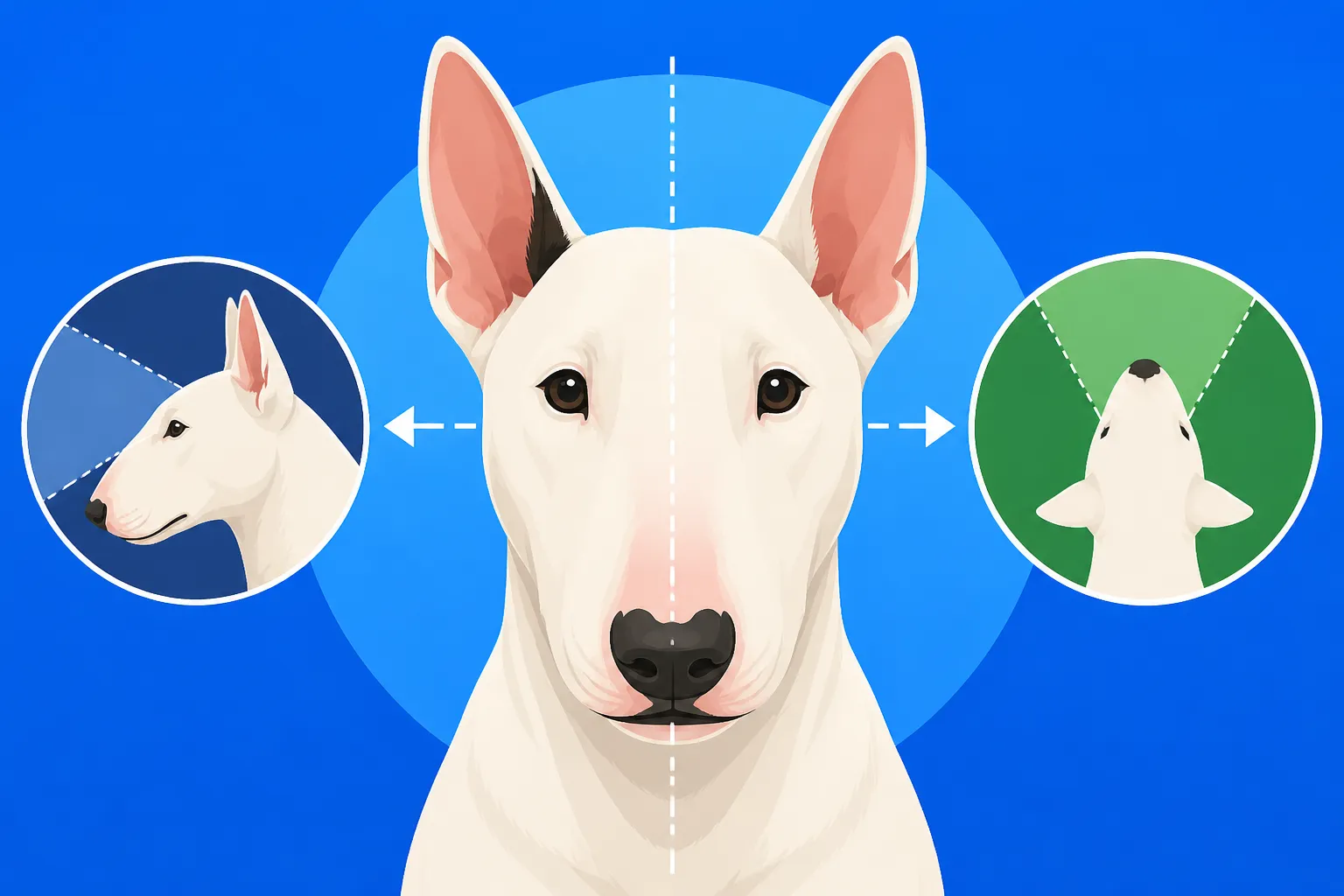
Whether a Bull Terrier Can See Straight Ahead
A Bull Terrier’s small, triangular eyes and distinctive egg-shaped head can make it look as though its view must be unusual. In most cases, though, the breed can see straight ahead. This guide explains how eye placement affects vision, what the head shape does and does not mean, and which changes should prompt a veterinary check.
Can a Bull Terrier See Straight Ahead
How its eyes are positioned
Yes. A Bull Terrier can look forward and focus on objects in front of it. Its eyes are set toward the front of the head, though their placement and shape differ from a person’s. Like other dogs, it uses both eyes together for some forward-looking tasks and relies on each eye’s wider field of view to notice activity around it.
The breed’s eyes are commonly described as small, dark, triangular, and set obliquely. Those features are part of its recognizable appearance; they do not, by themselves, mean the dog cannot see ahead. The triangular look can seem especially striking in photos, where shadows and a close-up view exaggerate the shape. For more on that feature, see The Bull Terrier Is the Only Breed With a Triangular Eye.
A dog’s forward view is not identical to a person’s. Its eyes, muzzle, and head shape influence what it can see from different angles. If something is close to its nose, low to the ground, or directly beneath its face, it may need to lower or turn its head to get a better look. That is normal visual behavior, not proof that it cannot see straight ahead.
How dogs use forward vision
When a Bull Terrier watches you walk across a room, tracks a moving toy, or focuses on a treat held in front of its face, it is using its forward vision. Dogs also use movement, scent, sound, and their memory of familiar spaces to make sense of what is around them. Vision is important, but it is only one part of how a dog navigates everyday life.
A dog may briefly miss something that a person notices immediately, especially if the object is small, still, or positioned near the dog’s muzzle. It may then turn its head, sniff, or look again. That kind of adjustment is not necessarily concerning. What matters more is a persistent change from the dog’s usual behavior, such as repeatedly bumping into furniture or hesitating in places it knows well.
| What you notice | What it may mean | What to do |
|---|---|---|
| Your dog turns its head to inspect something near its nose | It may be adjusting its view or using scent | Usually observe if its behavior is otherwise normal |
| It tracks a toy or person in front of it | Its forward vision is being used normally in that moment | Keep watching for any change from its usual pattern |
| It bumps into familiar objects repeatedly | Vision, balance, or another health issue may need assessment | Arrange a veterinary check |
| One eye is suddenly cloudy, red, painful, or held closed | A painful or urgent eye problem is possible | Contact a veterinarian promptly |
What the Bull Terrier Head Shape Means for Vision
The egg-shaped head and downface
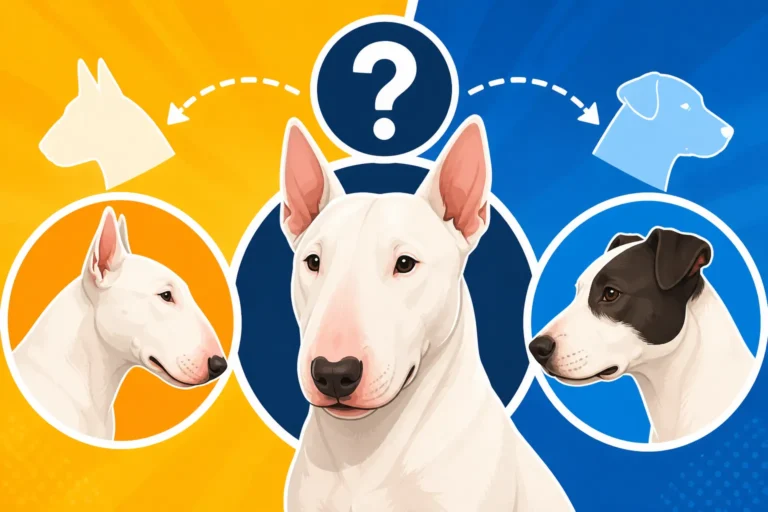
The Bull Terrier’s long, gently curved profile is often called an egg-shaped head. Its face also has a distinctive downcurve from the top of the head toward the nose, rather than the pronounced stop seen in many other breeds. These structural traits affect the breed’s appearance, but they do not automatically block its forward view. Read more about the profile in What a Bull Terrier's Downface Is and Why a Bull Terrier Has No Stop.
It can be tempting to assume that a prominent muzzle or unusual head shape must create a major visual obstruction. In practice, a dog’s ability to see depends on the structure and function of its eyes and surrounding tissues, not simply on whether its head looks different from a human’s. A Bull Terrier may move its head to inspect a close object, but that is common canine behavior.
The look of the breed has changed over time, and different dogs may vary in head shape and eye appearance. A striking profile is not a diagnosis. If you are comparing a dog’s appearance with breed history, How the Bull Terrier's Head Changed Over Time gives more background.
Why small eyes do not automatically mean poor sight
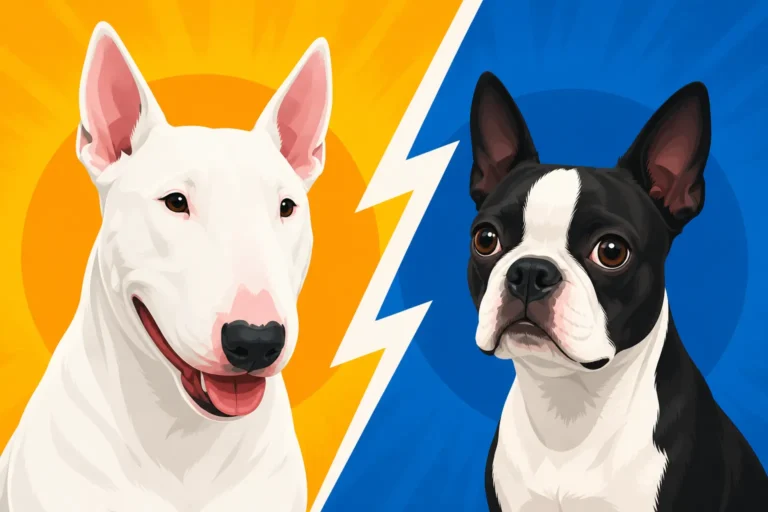
The Bull Terrier’s eyes can look unusually small beside its broad, curved head. Their size and triangular outline are characteristic, but appearance alone cannot tell you how well an individual dog sees. A healthy-looking eye may still need an examination if the dog shows a change in behavior, while a naturally small eye is not necessarily a problem if the dog is comfortable and functioning normally.
Owners sometimes compare their dog’s eyes with those of breeds that have larger, rounder eyes. That comparison can make normal Bull Terrier features look concerning. The more useful question is whether the dog’s eyes are comfortable and whether its sight seems consistent with its own usual behavior. The breed’s eye appearance is discussed further in Why a Bull Terrier's Eye Is the Smallest of Any Breed.
The word “small” also should not be confused with “unable to see.” A dog can have eyes that appear compact while still responding to movement, finding familiar people, and moving around its home confidently. A sudden change in any of those abilities deserves attention, regardless of the dog’s breed or eye shape.
How to Tell Whether Your Bull Terrier Is Seeing Normally
Everyday signs to observe
At home, notice how your Bull Terrier moves through familiar rooms, follows a person or toy, and responds when someone approaches from different directions. These observations are not a substitute for an eye examination, but they can help you recognize a change. A dog that has always paused before jumping onto a sofa may simply be cautious; a dog that suddenly starts misjudging familiar steps is different.
Try not to test vision by waving a hand close to the eye or startling the dog. A quick movement near the face can trigger a blink or flinch even when sight is normal, and a nervous response can be hard to interpret. Instead, note behavior during ordinary routines: walking through a doorway, following you in a well-lit room, or finding a familiar resting spot.
Write down what you see, when it began, and whether it affects one eye or both. For example, “hesitates at the back step in dim light” is more useful to a veterinarian than “seems blind.” If the change is sudden, worsening, or paired with discomfort, call the clinic rather than waiting for a routine appointment.
Signs that need a veterinary check
Contact a veterinarian if your dog begins bumping into objects, misses steps, becomes reluctant to enter a familiar room, or has trouble locating food or toys. These signs can have several explanations, including changes in vision, pain, or balance. They are not enough to identify the cause at home, which is why an examination matters.
Eye symptoms deserve particular attention. Redness, discharge, cloudiness, swelling, squinting, pawing at the face, or holding an eye closed can indicate irritation or pain. A sudden change, visible injury, or eye that appears markedly different from the other should be treated as a reason to seek prompt veterinary advice.
Some changes may be more noticeable in dim light or at night. If your Bull Terrier moves confidently in daylight but becomes hesitant after dark, mention that pattern to the veterinarian. Bring notes about when the behavior began and whether it is getting worse. If you are also wondering about eye color and breed appearance, Whether a Bull Terrier's Eye Should Be Dark covers that separate question; eye color alone cannot confirm normal vision.
Supporting Your Bull Terrier’s Eye Health
Make observation part of routine care
A quick, calm look at your dog’s eyes can be part of normal grooming and handling. Check for a new difference between the eyes, unusual redness, discharge, or a change in how comfortably your dog opens them. Avoid pressing on the eyeball or trying to remove anything that appears stuck to the surface.
If your dog has mild debris near the eye, ask your veterinarian what cleaning method is appropriate. Do not put human eye drops, medicated products, or home remedies into a dog’s eye unless a veterinarian has specifically advised it. Even products marketed for pets may not suit every problem, and using the wrong product can delay proper treatment.
If your veterinarian recommends a particular non-medicated cleaning product, you can ask whether ordering through a retailer such as Chewy is appropriate. Check that the product is the exact one the clinic advised, and follow the clinic’s directions rather than relying on a product description.
Prepare for an appointment
Before a visit, note what changed and when. Include whether the issue appears to affect one eye or both, whether it happens in bright or dim conditions, and whether your dog seems painful. A short video of an unusual behavior—such as hesitating at a step—may help the veterinarian understand what you are seeing, provided recording it does not delay care.
Bring any eye products you have already used, or write down their names. If your veterinarian prescribes treatment, confirm how and when to use it, what side effects to watch for, and when the dog should be rechecked. If an item needs replacing, ask the clinic to confirm the product name before ordering; Chewy may be one place to look, but the match to the veterinarian’s instructions is what matters.
For a dog that is rubbing or pawing at an irritated eye, ask the clinic how to prevent further injury while you arrange care. A veterinarian may recommend a protective measure or specific supplies. If you are buying an item for that purpose, Chewy is one possible retailer to check, but follow the clinic’s guidance on what is suitable and how it should fit.
Most Bull Terriers can see straight ahead. Their small, triangular eyes and distinctive head shape are breed features, not evidence of poor vision on their own. Pay attention to changes in your individual dog’s comfort and behavior, and ask a veterinarian about new or persistent signs rather than trying to diagnose an eye problem by appearance alone.
Disclaimer
This article is for general informational purposes only and does not constitute professional advice. Laws, prices and regulations vary by location and change over time. Consult a qualified professional for guidance on your specific situation.