What an 1870s Bull Terrier Looked Like
An 1870s Bull Terrier would look familiar in some ways, but not like the polished, egg-headed dog many people picture today. Early dogs varied in shape and type, and surviving photographs and descriptions offer only a partial view. This guide explains what those Bull Terriers likely looked like, what had already changed, and why old images can be easy to misread.
The Bull Terrier Was Still Taking Shape
From bull-and-terrier crosses to a named breed
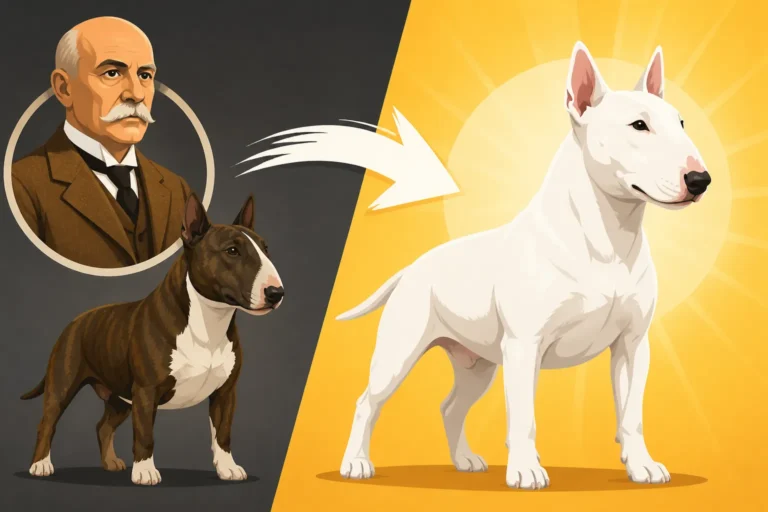
The Bull Terrier of the 1870s was a relatively young breed. Its ancestors were bull-and-terrier dogs, a broad type rather than one uniform, formally established breed. They combined traits of bulldogs and terriers, and their appearance could differ considerably from dog to dog. James Hinks, a Birmingham breeder associated with the breed’s early development, helped move that mixed type toward a more consistent, recognizable dog.
That transition was not instant. A dog called a Bull Terrier in the 1870s might still look more like an athletic, lean-headed bull-and-terrier than a modern show-ring Bull Terrier. Breed identity was growing, but the features we now associate with the breed had not all been fixed into a familiar standard. The breed’s early history is explored in Where the Bull Terrier Comes From and Who James Hinks Was.
The name also didn’t mean that every dog had the same proportions, coat, or temperament. Breeders were shaping a type through selection over generations, and individual dogs reflected different combinations of ancestry. When you look at an old engraving or photograph, it helps to think of the 1870s Bull Terrier as a breed in development, not a finished modern type.
What “white” meant in the early breed
Hinks became closely associated with white Bull Terriers, and the white dog became a recognizable early image of the breed. White coats could make dogs stand out in illustrations and show settings, but coat color alone does not tell you exactly what a dog looked like beneath its fur. The body, head, and overall proportions still varied.
The preference for white was part of a larger effort to create a distinctive, fashionable companion dog. It did not mean every Bull Terrier in the 1870s was white, nor that color was the only difference between the early dogs and those seen today. The story of that ideal is covered in Why Hinks Wanted an All White Dog and What the White Cavalier Name Meant.
It’s also worth separating the historical label from modern assumptions. Calling a dog a “White Cavalier” reflected the image and reputation people wanted to associate with the breed; it wasn’t a precise description of one fixed body shape. The dogs were still changing as breeders chose which traits to carry forward.
The Likely Look of an 1870s Bull Terrier
A lighter, less exaggerated outline
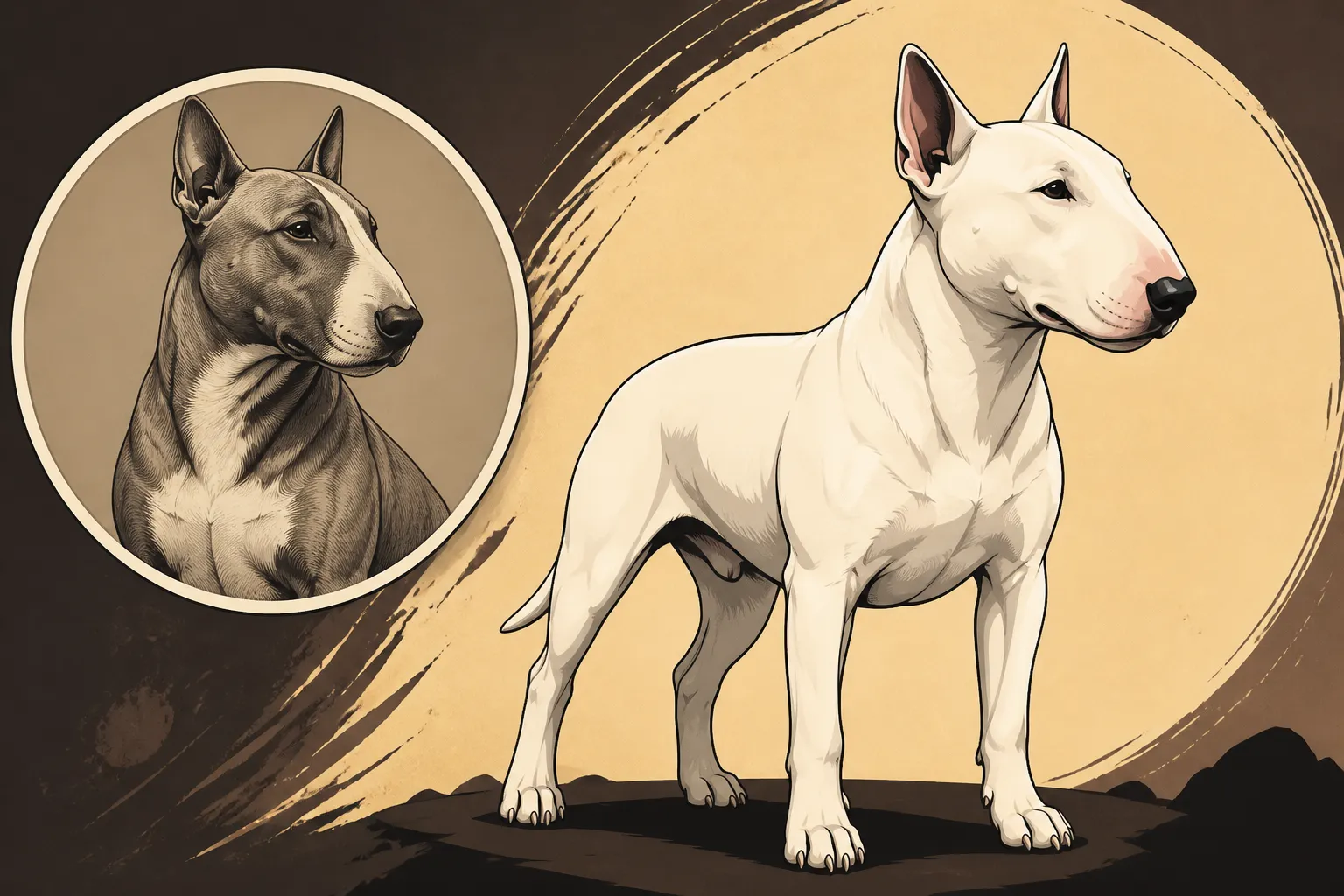
Compared with many modern Bull Terriers, an 1870s dog would likely appear more lightly built and less exaggerated in the head. Early dogs generally had a more conventional profile, with a visible transition between forehead and muzzle rather than the smooth, continuous downward curve often called a “downface.” Their heads could still be strong and distinctive, but they did not all have the modern breed’s familiar profile.
The body, too, could seem more athletic and less uniformly substantial. An old illustration may show a dog with a narrower chest, longer-looking legs, or a leaner outline than a contemporary Bull Terrier. Those impressions need caution: drawings can stylize proportions, while photographs may be affected by pose, lens, and the quality of the image. The gradual development of the breed’s outline is discussed in How the Bull Terrier's Head Changed Over Time.
| Feature | Many Bull Terriers in the 1870s | Modern Bull Terrier appearance |
|---|---|---|
| Head profile | More conventional outline, often with a visible stop | Often a smoother, more pronounced downface |
| Build | Variable, with many dogs appearing lean or athletic | More consistent overall type, often substantial and muscular |
| Coat | White dogs were prominent, but variation remained | White and colored dogs are both established |
| Uniformity | Less consistent from dog to dog | More recognizable shared breed characteristics |
| Historical evidence | Limited photographs, illustrations, and written descriptions | Many contemporary photographs and formal breed descriptions |
This is a broad comparison, not a claim that every early dog was lean or every modern dog has the same head. The point is that a visitor from the 1870s probably would not have mistaken every dog of that era for the modern show type.
A head with less of the modern “egg” shape
The egg-shaped head is one of the Bull Terrier’s best-known features today. In the 1870s, that shape was not yet established in its modern form. Early heads were generally less filled out and less smoothly curved from the skull down to the nose. A profile could look more terrier-like or more like a bull-and-terrier cross, depending on the dog.
The modern downface developed over time through selective breeding. It is therefore misleading to take a current breed feature and assume it was already fully present in the earliest dogs. For more on the anatomy and changing profile, see What a Bull Terrier's Downface Is and When the Bull Terrier's Egg Head Appeared.
A useful way to read old images is to compare the whole head rather than focusing only on the muzzle. Look at the forehead, the point where the muzzle begins, the curve of the skull, and the relationship between head and body. One unusual angle or an artist’s interpretation can make a dog seem more modern—or more primitive—than it was.
Why old pictures can give conflicting impressions
There are fewer clear, close-up photographs from the 1870s than most readers would like. Printed illustrations, paintings, and later reproductions can be valuable, but they are not interchangeable with a carefully posed photograph. An artist may emphasize a dramatic profile, and a reproduction may lose detail in the coat or facial outline.
Even photographs can be hard to interpret. A dog standing with its head turned, ears relaxed, or body partly obscured may appear to have a different shape from a dog posed squarely in profile. Without a reliable caption or provenance, it may also be difficult to know the exact date, breeder, or even whether the image shows a Bull Terrier of the decade in question.
So if two old sources seem to disagree, that does not automatically mean one is false. They may show different dogs, different stages of the breed’s development, or different ways of representing the same type. It is safer to look for recurring traits across multiple images and descriptions than to treat one picture as the definitive 1870s Bull Terrier.
Coat Color and Features That Had Not Yet Settled
White dogs were prominent, but not the whole story
White Bull Terriers played a major part in the breed’s early public image. That prominence can make it seem as if the breed was exclusively white in the 1870s. In reality, the wider bull-and-terrier background included dogs with varied coloring, and the development of colored Bull Terriers became an important part of the breed’s later history.
Modern readers should avoid projecting today’s color categories neatly onto every early dog. Old descriptions may use terms inconsistently, and an illustration may not preserve the detail needed to identify markings. A dark patch, for example, could be obvious in a written account but difficult to distinguish in a monochrome image.
The later recognition and development of colored dogs is covered in When Colored Bull Terriers Were Accepted and Who Bred the First Colored Bull Terriers. That history helps explain why modern Bull Terriers can look quite different in color while still belonging to the same breed.
Ears, expression, and overall impression
Early Bull Terriers did not necessarily present the same alert, sharply defined expression people expect from a modern dog. Ears, head shape, and facial detail can be difficult to judge in period images. A drawing may show ears in a particular position for artistic effect, while a photograph can capture a relaxed moment rather than the dog’s most attentive expression.
The entire silhouette matters. A useful comparison includes the dog’s topline, chest, leg length, tail, and the proportions of its head to its body. Early Bull Terriers could look more like a collection of related types than a row of near-identical dogs. That variety is part of the history, not evidence that an image must be misidentified.
If you’re comparing a historic picture with your own Bull Terrier, remember that today’s pet products and routines have nothing to do with the dog’s historical appearance. A modern owner might browse Chewy for everyday supplies, but a current collar, bed, or feeding setup cannot tell you how an 1870s dog was bred or presented. Chewy belongs to the present-day ownership context, not the evidence used to reconstruct the breed’s past.
How to Read an 1870s Bull Terrier Image
Separate documented features from assumptions
Start with what the image or accompanying text actually shows. Is the dog clearly dated? Is it identified by name or breeder? Does the source describe the dog as a Bull Terrier, or is that label added later? These details matter because breed names and types were still evolving, and later captions can sometimes encourage viewers to interpret an image through modern expectations.
Next, note visible traits without immediately assigning them a precise meaning. You might record that the dog appears white, has a distinct stop, or seems lean in build. Then compare those observations with other images and accounts from the same period. This prevents one dramatic feature from becoming the whole story.
A useful question is not “Does this look exactly like a Bull Terrier today?” but “Which traits are already present, and which seem to have become more pronounced later?” That framing makes room for both continuity and change. It also reflects the gradual history described in How the Bull Terrier's Head Changed Over Time.
Keep modern comparisons in perspective
Modern photographs are useful for showing how the breed looks now, but they can create a misleading before-and-after comparison if the historical evidence is sparse. Today’s dogs are photographed from many angles and in high resolution. An 1870s image may be small, damaged, reproduced in a book, or drawn from memory. The difference in visual quality alone can make the old dog seem less clearly defined.
It’s also easy to confuse a breed’s development with a simple march toward one ideal. Breeding changes do not happen in a straight line, and not every dog of a period fits the most fashionable type. Some early dogs may have had features that look surprisingly modern, while others may appear much closer to their bull-and-terrier ancestry.
For anyone interested in contemporary Bull Terrier care rather than historical appearance, a retailer such as Chewy may be part of the ordinary modern ownership routine. That has no bearing on the breed’s nineteenth-century look: historical claims should rest on dated images, descriptions, and breed history, not on present-day shopping or care habits.
The most reliable takeaway
An 1870s Bull Terrier was recognizable as part of the breed’s emerging history, but it probably would not have looked exactly like the modern dog. Expect more variation, a less consistently developed egg-shaped head, and a build that could appear lighter or more terrier-like. White dogs were especially prominent in the breed’s early image, while the full modern picture of coat colors and type came later.
The honest answer is that no single image can represent every Bull Terrier of the decade. The breed was taking shape through the choices breeders made, and those choices accumulated over generations. Looking at several sources—and keeping the limits of each one in mind—gives a more realistic sense of what these early dogs may have looked like.
Disclaimer
This article is for general informational purposes only and does not constitute professional advice. Laws, prices and regulations vary by location and change over time. Consult a qualified professional for guidance on your specific situation.