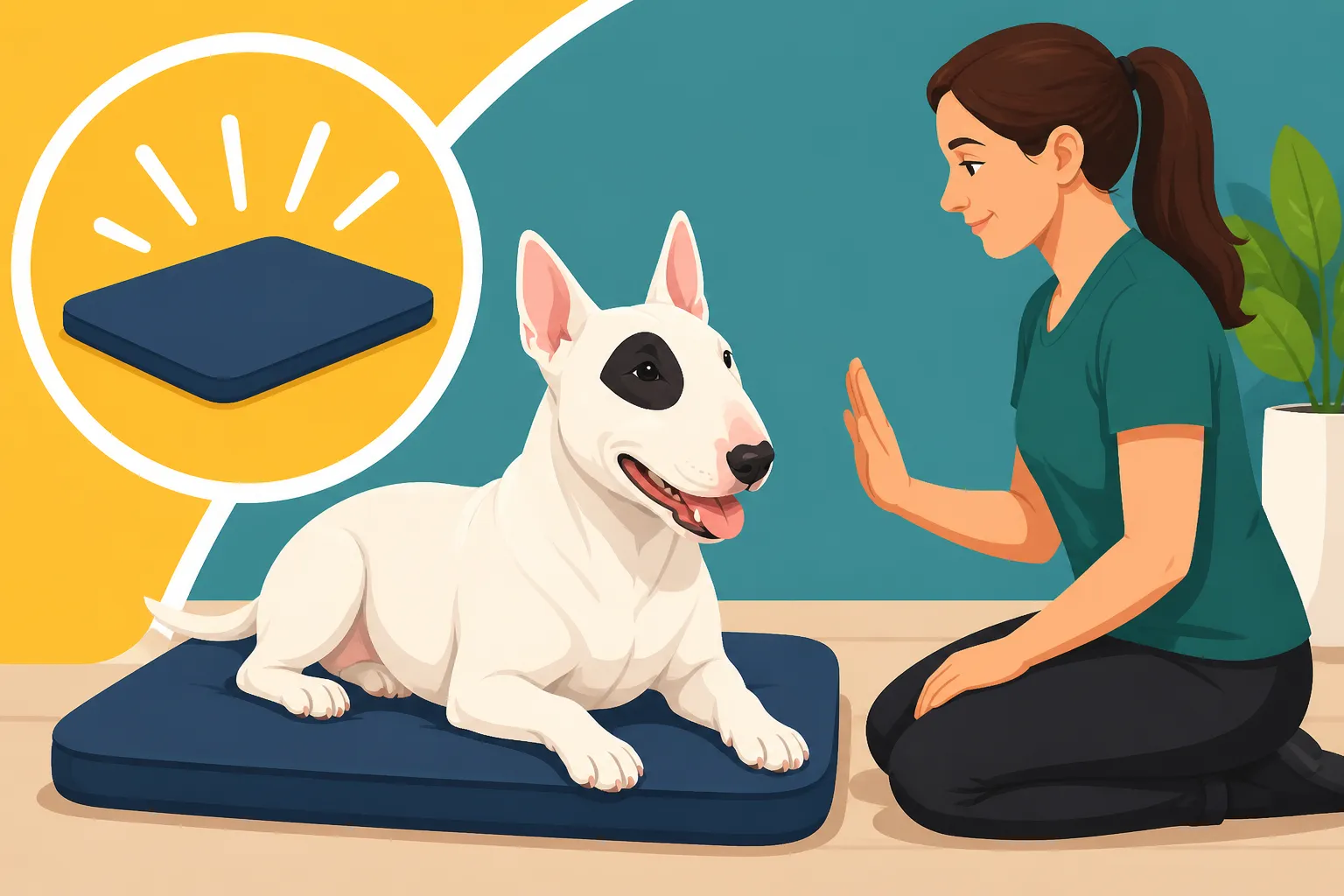
Teaching a Bull Terrier to Settle on a Mat
Oh, the dream of a Bull Terrier quietly relaxing on their mat, while you sip your coffee or read a book! If you're a Bull Terrier owner, you know this vision can often feel like a far-off fantasy. These wonderfully energetic and often hilarious dogs can struggle profoundly with the concept of "settling," making quiet moments in the house a rare commodity. This guide is here to walk you through the process of teaching your beloved Bull Terrier to settle calmly and comfortably on a mat, transforming those chaotic bursts into moments of peace.
Understanding the Bull Terrier's Busy Brain: Why "Settle" Isn't Natural
Let's be honest, asking a Bull Terrier to "just chill out" can feel like asking a toddler to sit perfectly still in a candy store. Their natural exuberance and zest for life are part of what makes them so endearing, but also what makes dedicated "settle" training so crucial. You’re not alone if you feel like your Bull Terrier has an endless battery.
The Energetic, Clownish Nature
Bull Terriers are often affectionately called "three-year-olds in a dog suit," and for good reason! Their youthful enthusiasm seems to last well into adulthood. They're naturally playful, curious, and often have a strong desire to be involved in whatever you're doing – or, failing that, to create their own entertainment. This isn't laziness or defiance on their part; it's just who they are. Their clownish antics are a huge part of their charm, but it also means their minds are constantly whirring, looking for the next exciting thing. When you're trying to teach them to settle, you're essentially asking them to override decades of breed development geared towards active engagement. It’s a big ask, but definitely not an impossible one. Their powerful personalities mean they need clear, consistent guidance. Why a Bull Terrier Is Called a Three Year Old in a Dog Suit really hits the nail on the head.
The Struggle to Switch Off
Unlike some breeds that can easily switch from active play to quiet repose, many Bull Terriers find it genuinely challenging to power down. They might zoom around the house, then crash for a short nap, only to be back at full throttle moments later. This "on-off" switch can be frustrating for owners who yearn for predictable periods of calm. Without guidance, their internal engine just keeps running, leading to restlessness, unwanted chewing, or even destructive behaviors born out of sheer boredom or overstimulation. Think about it from their perspective: the world is full of interesting smells, sounds, and potential mischief, and they don't want to miss a single second! Learning to settle on a mat gives them a designated "off-duty" zone, a mental cue that it's time to relax, even if their inner clown is still doing somersaults.
Laying the Groundwork: Defining "Settle" for Your Bull Terrier
Before you can teach your Bull Terrier to settle on a mat, you need to understand what "settle" truly means in dog language, and how to communicate that effectively to a breed known for its independent streak and discerning nature. This isn't just about putting them on a mat; it's about creating a positive association with that mat and the calm behavior you desire.
What "Settle" Really Looks Like
For a Bull Terrier, "settle" is much more than just lying down. It means resting calmly, ideally with their head down, no pacing, no whining, no incessant toy-mouthing, and certainly no impromptu zoomies. It's a state of relaxed vigilance, where they are aware of their surroundings but not actively seeking interaction or stimulation. They might be chewing a designated treat, or simply snoozing. This behavior isn't inherent; it’s a learned skill that requires patience and positive reinforcement. The mat itself becomes a powerful visual cue, signaling "this is your relaxation station." When your Bull Terrier understands this, you'll find them more readily choosing to disengage from the excitement of the room and find their calm spot.
Essential Tools and Mindset
To embark on mat training, you’ll need a few key items and, more importantly, the right mindset.
First, choose the right mat. This isn't just any old dog bed; it needs to be something easily distinguishable and comfortable that your Bull Terrier associates only with settling. A bath mat, a small rug, or a designated "place" bed works perfectly. You can find excellent, durable options on platforms like Amazon that are easy to move around your house or even take with you to different locations.
Second, gather high-value treats. These are the treats your Bull Terrier goes absolutely wild for – cheese, cooked chicken, hot dogs. Whatever makes their eyes light up!
Third, consider a clicker. For many Bull Terriers, a clicker can be an incredibly effective tool for marking the exact moment of desired behavior. If you're new to clicker training, don't worry, it's easy to learn, and can really help. How a Clicker Lands With a Bull Terrier explains why it works so well for them.
Finally, your mindset is paramount. You need patience, consistency, and a sense of humor. There will be days when your Bull Terrier acts like they've never seen the mat before. Remember, training a Bull Terrier takes a special kind of dedication because How Stubborn a Bull Terrier Is is a very real thing! Keep sessions short, positive, and end on a high note.
| Tool / Mindset Component | Description | Why it's important for Bull Terriers |
|---|---|---|
| Designated Mat | A specific, comfortable mat or bed that is clearly identifiable and portable. | Creates a clear, consistent "safe zone" for relaxation, distinct from other parts of the house. Portability allows for generalization of the skill. |
| High-Value Treats | Small, delicious, and highly motivating treats (e.g., cheese, cooked meat, soft chews). | Bull Terriers are often food motivated; high-value treats make the mat experience extremely rewarding and desirable. |
| Clicker | A small device that makes a distinct "click" sound. | Precisely marks the exact moment of desired behavior, helping your Bull Terrier understand exactly what they're being rewarded for. |
| Patience | The ability to remain calm and persistent, understanding that training takes time and repetition. | Bull Terriers can be stubborn and have short attention spans. Frustration from the owner will only hinder progress. |
| Consistency | Applying the same rules and commands every time, with every family member. | Ensures your Bull Terrier clearly understands expectations. Inconsistency will confuse them and slow down learning. |
| Positive Reinforcement | Rewarding desired behaviors to increase their likelihood. Never punishing for not settling. | Builds a positive association with the mat and the act of settling, making it a behavior your Bull Terrier wants to offer. Harsh corrections are ineffective with this breed. |
Your Step-by-Step Guide to Mat Training Success
Now for the fun part! Teaching your Bull Terrier to settle on a mat is a gradual process, broken down into manageable steps. Remember, consistency is your best friend here, and short, frequent training sessions are far more effective than long, drawn-out ones. For most Bull Terriers, How Short a Bull Terrier's Training Session Has to Be is a critical piece of advice. Aim for 5-minute sessions, several times a day.
Introducing the Mat as a "Happy Place"
The first step is to make the mat the most wonderful place in the world. Start by placing the mat on the floor. With your Bull Terrier on a leash or in a quiet area, toss a treat onto the mat. As soon as they step onto the mat to get the treat, click (if using one) and immediately toss another treat. Repeat this several times. The goal here isn't for them to lie down yet, just to associate the mat with good things.
Once they're eagerly stepping onto the mat for treats, start asking for a "down." Lure them onto the mat with a treat, then use another treat to guide their nose to the floor until they lie down. As soon as their elbows hit the mat, click and reward heavily. If they stand up, simply ignore it, reset, and try again. Don't scold them; just make the mat the source of all good things. You can find helpful videos for this foundational step on online platforms, and the BAXTER & Bella online puppy school is a fantastic resource for step-by-step video guidance and support for this kind of foundational training.
Building Duration and Distance
Once your Bull Terrier is reliably lying down on the mat, it's time to build duration. This means teaching them to stay there for longer periods. Start with just a second or two. Lure them onto the mat, ask for a down, and before they have a chance to get up, click and reward. Gradually increase the time they need to stay down. Wait two seconds, then click and reward. Then five, then ten. If they get up, no big deal; just put them back on the mat and reduce the duration a little. You want to set them up for success.
After duration, you'll tackle distance. Start by taking one tiny step away from the mat. If your Bull Terrier stays, click and return to reward them on the mat. Gradually increase your distance – two steps, then across the room, then out of sight. Always return to the mat to deliver the reward. This teaches them that staying on the mat, even when you move away, earns them those amazing treats. This is also where those engaging chew toys from Amazon can really come in handy – give them a durable chew to keep them occupied and reinforce that the mat is a place for quiet enjoyment.
Fading the Lure and Adding Cues
Once your Bull Terrier is consistently lying down on the mat for increasing durations and distances, it's time to introduce a verbal cue. Choose a word like "mat," "place," or "settle." As you guide them to the mat and lure them into a down, say your chosen word just once. As soon as they're in position, click and reward. Over time, your Bull Terrier will start to associate the word with the action.
Then, gradually start to fade the lure. Instead of physically luring them, point to the mat and give your verbal cue. When they go to the mat and lie down, click and reward. If they don't respond, go back to using the lure briefly, then try fading it again. The goal is for them to respond to the verbal cue and/or the hand signal (pointing) without needing a treat in front of their nose. This is where you really start to see the magic happen, as they actively choose to go to their mat.
Overcoming Bull Terrier Quirks on the Path to Calm
Training a Bull Terrier is an experience unlike any other. Their intelligence, paired with their unique personality, means you'll likely encounter some delightful (and occasionally frustrating) quirks during settle training. But don't despair; understanding these traits is the first step to navigating them successfully.
Dealing with Stubbornness and Short Attention Spans
Ah, the infamous Bull Terrier stubbornness! If your Bull Terrier decides they'd rather engage in a staring contest with a dust bunny than lie on their mat, you're not alone. They are notoriously good at deciding when something is "worth it" for them. This is why high-value treats are non-negotiable, and why those short training sessions are crucial. If a session isn't going well, don't push it. End on an easy win (even if it's just stepping on the mat) and try again later. Their attention spans can be surprisingly fleeting, especially for puppies. Trying to force a long session will only lead to frustration for both of you. If they seem bored, try a different type of treat or a new location. Remember, How Stubborn a Bull Terrier Is often means you need to be even more persistent and creative. You might also find that providing appropriate mental stimulation outside of training, like using puzzle toys, can help them focus better during sessions.
When Settle Turns into Chewing or Zoomies
You've got your Bull Terrier on the mat, you've rewarded them, and then suddenly the mat becomes a chew toy, or they launch into a full-speed body slam on you for fun. This is a common hurdle! If they start chewing the mat, it likely means they're under-stimulated, bored, or haven't quite grasped that the mat is for settling, not destruction. Redirect them immediately to an appropriate chew toy – something sturdy and Bull Terrier-proof you might have found on Amazon. Provide this chew only when they are on their mat, reinforcing the idea that the mat is where good, long-lasting things happen.
If they suddenly erupt into zoomies, it's a sign they might have too much pent-up energy. This tells you that perhaps they needed a longer walk or a more intense play session before settling practice. Sometimes, a Bull Terrier might even get the "zoomies" after a period of calm, almost as if they're shedding the last bit of energy. Try to anticipate this and integrate ample physical and mental exercise into their daily routine. How Much Exercise a Bull Terrier Actually Needs is often underestimated. A tired Bull Terrier is a calmer Bull Terrier, more receptive to the idea of settling. Remember, mat training isn't just about the mat; it's about helping your Bull Terrier learn an "off" switch in a busy world, and that often means addressing their fundamental needs for activity and enrichment. What a Bull Terrier Does When It Is Bored isn't pretty, so giving them an appropriate outlet is key.
Teaching your Bull Terrier to settle on a mat takes time, dedication, and a deep understanding of their unique personality. It won't happen overnight, but with patience and consistent positive reinforcement, you can transform your energetic companion into a master of relaxation, at least when they're on their mat!
Disclaimer
This article is for general informational purposes only and does not constitute professional advice. Laws, prices and regulations vary by location and change over time. Consult a qualified professional for guidance on your specific situation.