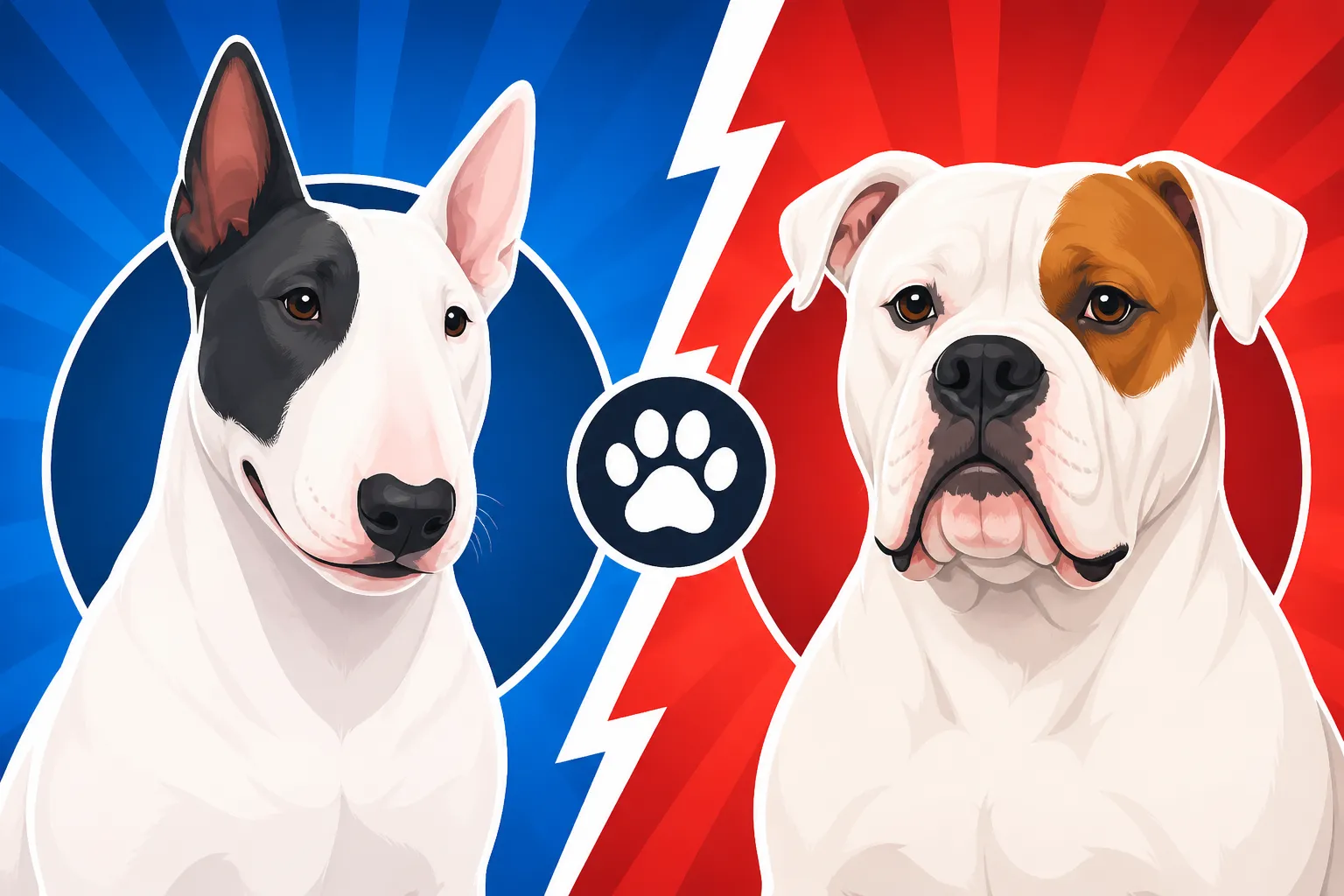
How a Bull Terrier Differs From an American Bulldog
Choosing between a Bull Terrier and an American Bulldog can be confusing: both are muscular, powerful dogs, and both may be described as energetic or stubborn. But they differ in size, appearance, exercise needs, and the kind of home that suits them. This guide explains the practical distinctions so you can compare the breeds beyond a quick glance at their broad heads.
The main differences between a Bull Terrier and an American Bulldog
Size, build, and appearance
A Bull Terrier is a solid, compact dog with a distinctive egg-shaped head, small triangular eyes, and upright ears. Its body is muscular, but the breed’s outline tends to look rounded and balanced rather than tall or heavily built. Standard Bull Terriers vary in size, and there is no single weight limit in the breed standard, so individual dogs can differ noticeably.
An American Bulldog is generally taller and heavier, with a broad chest, substantial head, and powerful frame. The breed varies too: some lines are more athletic and leggy, while others are stockier and more heavily muscled. That variation makes a particular dog’s parents and adult build more useful clues than a breed label alone.
The size gap matters in ordinary home life. A large American Bulldog may take up more room on a sofa, need sturdier equipment, and be more difficult to physically manage if it pulls. A Bull Terrier is smaller on average, but it is still strong and can knock into people or pull with surprising force. For an overview of Bull Terrier proportions, see What a Bull Terrier Weighs and How Tall It Stands.
Coat, color, and the details people notice
Both breeds have short coats, but their head shapes make them easy to tell apart once you know what to look for. The Bull Terrier’s profile curves down from the top of the skull toward the nose, with no sharp stop between forehead and muzzle. An American Bulldog’s head is broad and powerful, but it does not have the same continuous egg-shaped profile.
Bull Terriers can be white, colored, or white with markings, while American Bulldogs are often white or predominantly white with patches of other colors. Coat color is not a reliable way to judge health, temperament, or suitability for your household. If you are comparing coat patterns, Which Colors a Bull Terrier Comes In explains the Bull Terrier’s recognized range.
Both dogs have short coats that are relatively straightforward to brush, but short hair does not mean no shedding or no skin care. Seasonal shedding, irritation, and sun exposure can still be relevant, especially for dogs with light or sparsely pigmented skin. Think about routine care as part of the comparison, not just the amount of hair on the floor.
| Feature | Bull Terrier | American Bulldog |
|---|---|---|
| Typical build | Compact, muscular, rounded outline | Larger, broad and powerful; build varies by line |
| Distinctive head | Long, egg-shaped profile with a downward curve | Broad head and strong muzzle, without the Bull Terrier profile |
| Ears | Naturally upright | Usually folded or rose-shaped, depending on the dog |
| Coat | Short and close-lying | Short and close-lying |
| Size | Medium-sized, with substantial variation | Usually larger and heavier, with considerable variation |
| Exercise style | Needs daily activity and mental engagement | Needs regular activity suited to its age, health, and build |
Breed descriptions give you a starting point, not a guarantee. A young dog’s adult size, energy, and behavior depend on genetics, health, socialization, and the way it is raised.
Temperament and everyday behavior
Energy, training, and attention
Bull Terriers are often playful, people-focused dogs with a lively, sometimes clownish approach to the day. They can be clever and quick to learn, but repetition without a clear payoff may lose their interest. Short, upbeat training sessions with rewards and variety tend to be more productive than long drills or harsh corrections. For a fuller picture of the breed’s personality, read What a Bull Terrier's Temperament Is Really Like.
American Bulldogs are also strong, confident dogs, and many are closely bonded with their families. Their working background and individual lineage can influence how much activity, structure, and training they need. As with Bull Terriers, a broad breed description cannot tell you whether one particular dog will be easygoing, intense, or highly driven.
For either breed, early training should focus on practical skills: walking calmly on leash, settling indoors, greeting people without launching forward, and responding when called. This matters because strength can turn a small training gap into a tiring daily struggle. If you are looking at another commonly confused breed, How a Bull Terrier Differs From a Staffordshire Bull Terrier can help clarify how Bull Terriers compare with a related-looking but distinct breed.
Children, visitors, and other pets
Neither breed should be treated as automatically safe or unsafe with children based on its name. A dog’s temperament, past experiences, training, and ability to settle all matter. So do the child’s age and behavior. An energetic dog that greets people by bouncing or leaning may accidentally bowl over a small child even without showing aggression.
Supervise interactions and give the dog a quiet place to rest where children cannot follow. Teach children not to climb on the dog, grab its face, disturb it while eating, or approach it when it is sleeping. Adults should step in before excitement rises, rather than waiting for rough play to become uncomfortable.
Compatibility with other animals also depends on the individual dog. Some dogs can learn to live peacefully with familiar pets, while others need careful management, especially around unfamiliar dogs or smaller animals. Introductions should be gradual and controlled, with space to separate the dogs if either becomes tense. A comparison with another breed people commonly mix up with Bull Terriers is available in How a Bull Terrier Differs From a Pit Bull.
Exercise, home setup, and practical ownership
Matching activity to the dog
Both breeds need regular exercise, but there is no universal mileage target that suits every dog. Age, health, weather, fitness, and training all affect how much activity is appropriate. A young dog may need a mix of walks, play, and training, while a senior dog may do better with shorter outings and more opportunities to rest.
Mental activity counts too. A few minutes of practicing cues, searching for treats, or working through a food puzzle can give a dog something useful to do without relying on endless physical exercise. For Bull Terriers in particular, a predictable routine and engaging activities can help prevent boredom-driven mischief. See How Much Exercise a Bull Terrier Actually Needs for more on building a suitable routine.
Choose equipment based on the dog in front of you. A harness or collar should fit securely without rubbing, and the leash should be comfortable for the handler to hold when the dog changes direction suddenly. If you compare products at a retailer such as Chewy, check the measurement guide and the dog’s actual chest and neck measurements rather than choosing by breed name. A well-fitted item matters more than a label that says it is designed for a particular breed.
Space, handling, and daily routines
A larger American Bulldog may need more room to turn, stretch, and settle comfortably, but a yard alone does not meet a dog’s exercise or companionship needs. Bull Terriers can also live in a range of homes when their daily activity, training, and rest are managed well. The practical question is less “Is my home big enough?” and more “Can I safely meet this dog’s needs here?”
Think honestly about handling. If you are not comfortable managing a strong dog on leash, choose a training plan before bringing one home. Practice calm door greetings, use secure gates where appropriate, and avoid putting a powerful dog in situations where it is likely to rehearse pulling or charging. For household planning, Whether a Bull Terrier Suits an Apartment discusses the factors that matter more than square footage alone.
Daily care includes more than walks. Both breeds need routine veterinary care, nail trimming, dental attention, and coat and skin checks. When shopping for grooming supplies or food, focus on the dog’s individual needs; Chewy may be one place to compare basic products, but a veterinarian is the right person to advise on a medical diet or persistent skin problem. If a short coat makes you assume skin issues are impossible, A Bull Terrier's Skin Is Its Weakest Point offers useful context about Bull Terrier skin care.
Choosing the right breed for your household
Questions to ask before deciding
Start with the dog’s likely adult size and your ability to handle it safely. A large American Bulldog may be a poor match if every walk requires you to hold the dog back from distractions. A Bull Terrier may be a poor match if you want a quiet companion that needs little interaction or training. Neither breed is an effortless option simply because it has a short coat.
Ask about the individual dog’s history, health, behavior around other dogs, and response to handling. If you are considering a puppy, ask what the parents are like in everyday settings, not only what they look like. If you are considering an adult dog, find out what situations make it relaxed or uneasy and what routines it already knows.
Also consider how your schedule fits the dog. Both breeds benefit from companionship, exercise, and consistent rules. If the dog will spend long stretches alone, plan for appropriate support and enrichment instead of assuming a yard will keep it occupied. Compare the realities of daily care with the breed’s appealing traits before making a decision.
A simple decision framework
A Bull Terrier may suit someone drawn to a compact, muscular dog with an unmistakable profile and a playful, engaged personality, provided they are ready to train consistently and manage an exuberant companion. An American Bulldog may suit someone prepared for a generally larger, powerful dog and willing to research the particular line and individual temperament carefully.
Do not choose only by appearance or by a promise that a breed is naturally gentle, protective, easy to train, or good with every other pet. Meet adult dogs when possible, ask direct questions, and notice how the dog behaves in ordinary situations: being handled, resting, walking on leash, and meeting unfamiliar people at a sensible distance.
Finally, separate breed facts from myths. Bull Terriers and American Bulldogs are distinct breeds, even though their muscular builds can lead to casual misidentification. A thoughtful match comes from looking at the individual dog, your household, and the kind of daily routine you can sustain—not from assuming that one breed label tells the whole story.
Disclaimer
This article is for general informational purposes only and does not constitute professional advice. Laws, prices and regulations vary by location and change over time. Consult a qualified professional for guidance on your specific situation.