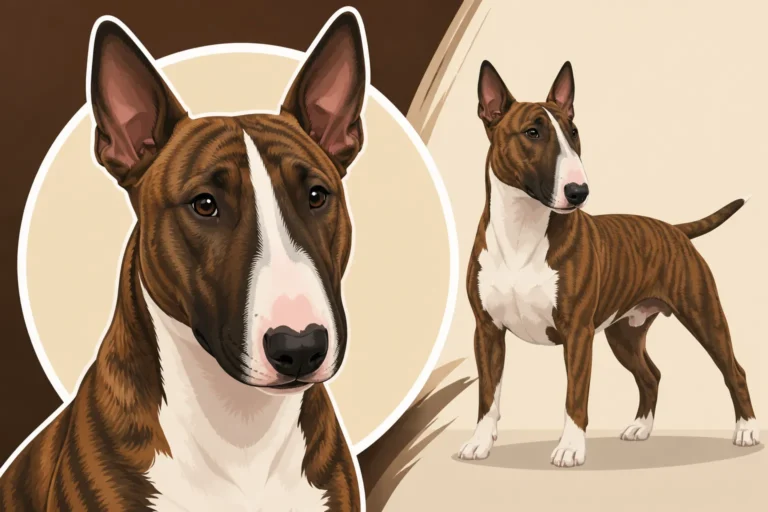
When the Miniature Bull Terrier Was Recognized
A dog described as a “miniature Bull Terrier” can sound like a recent, deliberately downsized version of the standard breed. It isn’t. The Miniature Bull Terrier has a long history of its own, and its recognition came at different times in Britain and the United States. Here’s what those milestones mean—and why recognition made the Miniature a distinct breed rather than just a smaller Bull Terrier.
When the Miniature Bull Terrier Was First Recognized
British recognition came in 1939
The Miniature Bull Terrier was recognized by Britain’s Kennel Club in 1939. That date marks an important formal milestone: the smaller Bull Terrier was accepted as a distinct breed for kennel registration and showing, rather than being treated simply as a size variation within the standard Bull Terrier.
The Miniature was not invented in the 1930s. Smaller Bull Terriers had existed much earlier, developing alongside their larger relatives. Formal recognition came after decades in which breeders worked with dogs that shared the Bull Terrier’s distinctive character and appearance, but were smaller in stature.
It helps to separate the breed’s history from its paperwork. A breed can exist for generations before a kennel organization recognizes it, and recognition does not mean that the dogs suddenly appeared in that year. For broader background on the breed’s development, see Where the Bull Terrier Comes From and Which Breeds Went Into the Bull Terrier.
Smaller Bull Terriers existed before formal recognition
Early breeders produced Bull Terriers in a range of sizes. Small examples were valued as compact companions and working dogs, including for ratting. They were not simply standard-sized puppies that had not finished growing; the aim was to establish and maintain a smaller type through breeding.
This history is one reason the Miniature Bull Terrier is often misunderstood. “Miniature” can suggest a novelty version made by shrinking a standard dog, but the Miniature has its own history as a recognized breed. Its relationship to the standard Bull Terrier is close, yet the two have separate breed standards and show classifications.
That distinction matters when you are researching a puppy or an adult dog. A small standard Bull Terrier is not automatically a Miniature Bull Terrier. Size alone does not determine a dog’s breed identity; pedigree and the applicable breed registry matter too.
How Recognition Took Different Paths in Britain and the United States
The British milestone predates American recognition
The 1939 recognition date refers to Britain’s Kennel Club. It is not the date the Miniature Bull Terrier became recognized everywhere. Breed organizations in different countries have their own procedures, and formal recognition can happen decades apart.
In the United States, the American Kennel Club recognized the Miniature Bull Terrier in 1991. That later milestone gave the breed a distinct place within the AKC system. It should not be confused with recognition of the standard Bull Terrier, which reached America and entered kennel records through a different timeline. When the Bull Terrier Reached America provides related context about the standard breed’s history in the country.
| Milestone | Organization or location | What it means |
|---|---|---|
| 1939 | Britain’s Kennel Club | Formal recognition of the Miniature Bull Terrier in Britain |
| 1991 | American Kennel Club | Recognition of the Miniature Bull Terrier as a distinct breed in the United States |
These dates answer different questions. If someone asks when the Miniature Bull Terrier was first recognized, 1939 is the key British milestone. If they mean when the AKC recognized it, the answer is 1991.
Recognition means more than a date on a timeline
Kennel-club recognition generally involves a breed being described and organized as a distinct type under that organization’s rules. It affects matters such as registration, showing, and the standard used to assess the dog. It does not mean every dog of that appearance automatically qualifies for a registry, nor does it make one organization’s process universal.
The distinction is useful for prospective owners comparing breeders. Ask which registry the breeder uses, how the puppy’s pedigree is recorded, and what the registration documents actually say. If a seller uses “miniature” loosely to describe a short or small standard Bull Terrier, that label alone does not establish that the dog is a registered Miniature Bull Terrier.
For more on the American milestone, When the AKC Recognized the Bull Terrier covers the standard breed’s AKC history. The two histories are related, but the standard and Miniature should not be treated as interchangeable entries.
What Makes the Miniature a Separate Breed
It is not just a standard Bull Terrier below a certain weight
The Miniature Bull Terrier has its own breed standard. A standard describes the qualities a breed organization expects in a show dog, including general appearance, proportions, and size. The Miniature’s standard is not simply a rule saying that any standard Bull Terrier under a certain weight belongs in the Miniature category.
That is why a very small standard Bull Terrier is not automatically a Miniature, and a Miniature Bull Terrier is not merely a standard dog that has been bred smaller in the recent past. Breed identity is tied to the dog’s recognized lineage and registry records, not only to the tape measure.
Owners sometimes focus on a puppy’s current size because they want to predict adult height. But puppies grow at different rates, and a small puppy’s measurements do not establish its eventual breed category. If size matters to your plans, request the pedigree and talk through expected adult size with a responsible breeder rather than relying on a casual label.
The Miniature keeps the Bull Terrier’s recognizable type
The Miniature Bull Terrier is known for the characteristic Bull Terrier outline and expression, but in a smaller package. It is still a powerful, active terrier—not a delicate lapdog simply because it is called miniature. Its compact build can make people underestimate how strong and energetic an individual dog may be.
The size distinction is covered in more detail in How a Bull Terrier Differs From a Miniature Bull Terrier and How Small a Miniature Bull Terrier Is. Those comparisons are helpful because they address both the breed’s physical differences and the common assumption that the Miniature is just a standard Bull Terrier scaled down without any separate identity.
Recognition also does not guarantee that every dog will match the ideal described in a standard. Dogs vary, and a breed standard is a description for judging and breeding—not a promise that every registered individual will have identical measurements, temperament, or health.
What the Recognition Dates Mean for Owners Today
Use recognition dates to understand breed history, not predict a dog’s quality
The British recognition in 1939 and AKC recognition in 1991 are useful landmarks, but neither date tells you whether an individual dog is healthy, well socialized, or a good fit for your home. Recognition establishes an official breed category within a kennel organization; responsible breeding and thoughtful care still depend on the people involved.
When speaking with a breeder, ask clear questions about the parents, health screening, temperament, and the puppy’s registration. Be wary of anyone who treats the word “Miniature” as a guarantee of a particular adult size or personality. A careful breeder should be able to explain the dog’s pedigree and the registry’s breed designation without relying on marketing language alone.
It is also reasonable to ask how the breeder distinguishes the Miniature from a small standard Bull Terrier. The answer should involve documented lineage and recognized registration, not simply “this one is tiny.” If you are comparing the breeds, How Much a Bull Terrier Weighs and How Tall a Bull Terrier Stands can help put standard Bull Terrier size into context.
Recognition does not erase the breed’s shared roots
The Miniature and standard Bull Terrier have a shared history and a close family resemblance, but each has its own place in breed records. The Miniature’s recognition in Britain in 1939 acknowledged that the smaller type had become established enough to be recognized separately. The AKC’s 1991 recognition later provided a separate American milestone.
For anyone researching the breed, the simplest way to keep the dates straight is to name the organization and country alongside the year. “Recognized in 1939” usually refers to British Kennel Club recognition; “recognized in 1991” refers to the AKC. That small clarification avoids making it sound as if the breed received one worldwide recognition date.
The Miniature Bull Terrier is therefore neither a modern novelty nor merely a small standard Bull Terrier. Its history reaches back well before formal recognition, and its official recognition developed on separate timelines in Britain and the United States. Knowing those distinctions makes it easier to understand the breed—and to ask better questions when choosing a dog.
Disclaimer
This article is for general informational purposes only and does not constitute professional advice. Laws, prices and regulations vary by location and change over time. Consult a qualified professional for guidance on your specific situation.