Whether Early Bull Terriers Had a Stop
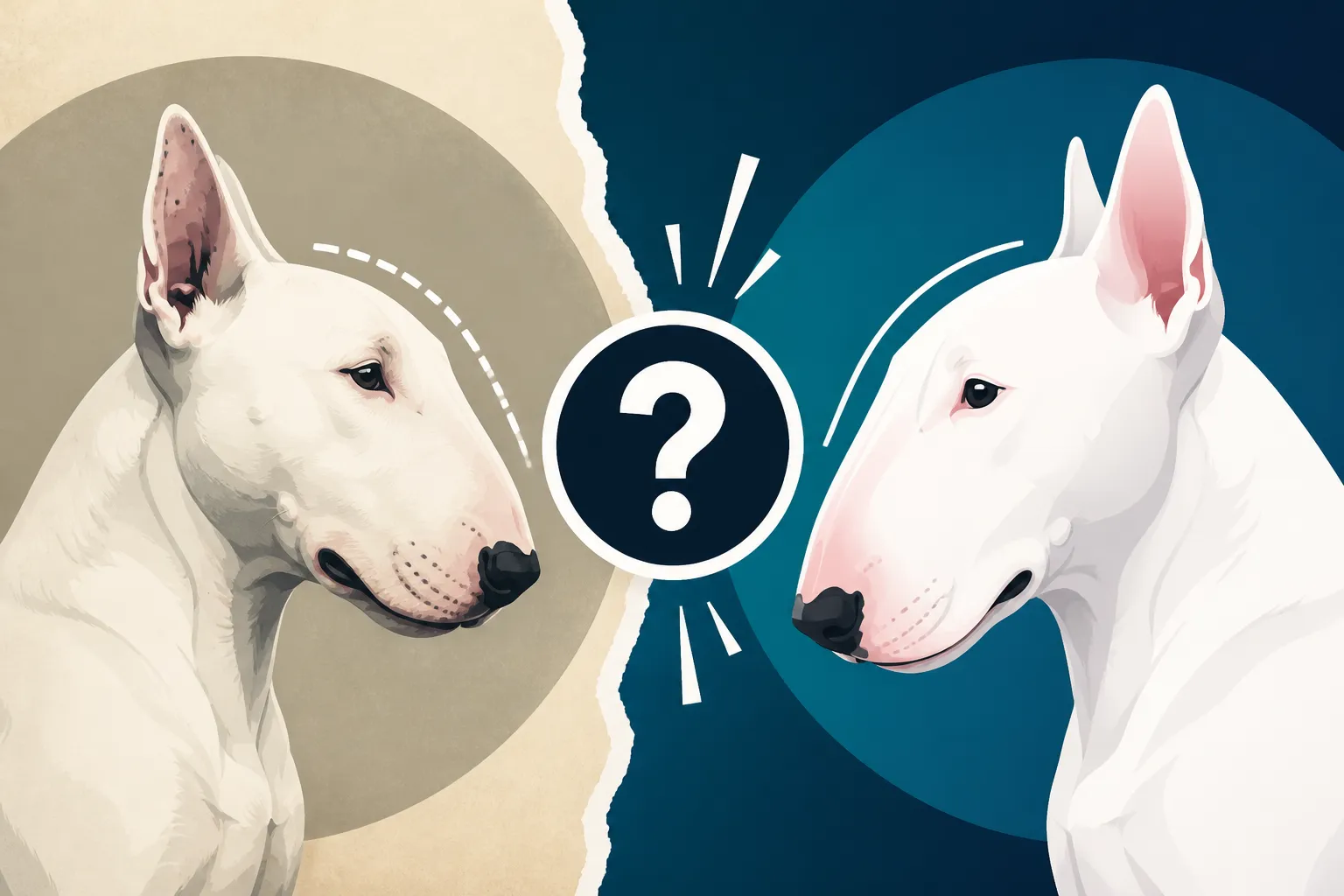
Early Bull Terriers generally had a more visible stop than the breed’s modern, smoothly curved profile. The stop is the indentation where the forehead meets the muzzle, and early dogs did not all share one identical head shape. The familiar egg-shaped head developed over time, so comparing a nineteenth-century Bull Terrier with a modern show dog can be a little misleading.
What the stop is and why it matters
The stop is the transition between forehead and muzzle
In dog anatomy, the stop is the change in direction between the skull and the muzzle, usually visible as a dip between the eyes. In some breeds, that dip is pronounced. In others, the forehead slopes more gradually toward the nose.
The Bull Terrier is now known for a profile that curves from the top of the skull down to the nose with little or no obvious indentation. That continuous line is part of the breed’s distinctive head shape. When people ask whether early Bull Terriers “had a stop,” they are usually asking whether those dogs had a more conventional forehead-to-muzzle transition than today’s dogs.
The short answer is yes, many early examples appear to have a more noticeable transition. But “early Bull Terrier” covers dogs from different decades, breeding lines, and stages in the breed’s development. There was no single frozen head type from the moment the breed emerged.
A visible stop does not mean an early dog was not a Bull Terrier
A breed’s appearance changes as breeders select for particular traits. A dog can belong to the developing Bull Terrier breed even if its head does not match the modern ideal exactly. Early Bull Terriers were not produced to a single, consistent profile that all breeders followed in the same way.
The dogs associated with the breed’s early development, including those linked to James Hinks, lived before the modern head shape was firmly established. To understand the dogs in context, it helps to read about Who James Hinks Was and What Happened at the 1862 Cremorne Show. Those histories place the early Bull Terrier in a period when breeders were establishing a recognizable type, not simply reproducing today’s appearance.
It is also worth separating an individual dog’s features from a breed-wide conclusion. A particular old photograph may show a dog with a distinct stop; another may show a more gradual line. One image cannot establish that every early Bull Terrier had the same structure.
How the Bull Terrier’s head changed over time
Early examples had more variation
The Bull Terrier did not spring into existence with the exact head shape people recognize today. In its early years, the type was still developing, and individual dogs could differ in their proportions and facial profiles. Some had heads that looked less elongated and less continuously curved than the modern show-ring ideal.
That variation is common in the history of a developing breed. Breeders may share a general idea of what they want while still producing dogs with noticeably different traits. As preferences become more consistent, selected features can become more recognizable across generations.
The evolution of the head is discussed in How the Bull Terrier's Head Changed Over Time. It is useful background when looking at old portraits, illustrations, and photographs: a more visible stop is not necessarily evidence that a dog was a different breed or a poor example of its own time.
The modern downface became a defining feature
Today’s Bull Terrier head is often described as downfaced. The profile slopes from the skull toward the nose in a continuous curve, rather than forming a clear step at the forehead. That look is a major part of the breed’s identity, but it became more pronounced through development and selection rather than appearing fully formed in the earliest dogs.
A downface can be difficult to judge from a photograph. Camera angle, lighting, the dog’s expression, and the quality of the image all affect how the brow and muzzle appear. A side view is generally more informative than a front-facing portrait, but even a side view does not tell the whole story.
For a closer explanation of the modern profile, see What a Bull Terrier's Downface Is. It helps distinguish the breed’s present-day head description from the more varied profiles visible in historical examples.
| Feature | Many early examples | Modern Bull Terrier type |
|---|---|---|
| Forehead-to-muzzle transition | Often more noticeable or less continuously curved | Usually a smooth profile with little obvious stop |
| Head shape | More varied across individual dogs and periods | More consistently associated with the characteristic downface |
| Best way to compare | Use dated, well-identified images and allow for variation | Consider the breed’s established modern description |
| Common source of confusion | Treating one early dog as representative of all early dogs | Assuming the modern head shape was present from the beginning |
Breed ideals are not the same as a timeline of every dog
When people discuss breed history, they sometimes talk as if a change happened all at once: early dogs had one shape, then later dogs suddenly had another. In reality, physical traits generally shift gradually, and different lines may retain different features for a while.
A historical portrait also records one dog, not a complete population. It may show a well-known animal selected for an illustration, a dog posed to emphasize its profile, or a specimen whose ancestry and date are not fully clear. Those limits do not make old images useless; they simply mean they should be read carefully.
The most balanced conclusion is that early Bull Terriers commonly appear less downfaced than modern examples, and a visible stop was more likely. That does not mean every early dog had a pronounced stop, nor that there was a single year when the breed’s profile changed completely.
Why old Bull Terriers can look unfamiliar
The breed was still being shaped
A modern breed standard describes a chosen type. It cannot be applied backward as though every dog from the nineteenth century was expected to meet it. Early breeders were working toward a recognizable Bull Terrier, and the look of the breed changed as that work continued.
The history of the white variety is one part of that story. Why Hinks Wanted an All White Dog gives context for the preferences that helped shape early Bull Terrier breeding. Those choices influenced more than coat color: they took place during a period when breeders were also refining the breed’s overall appearance.
This is why an older dog with a less extreme head can still be historically important. It may show a stage in the breed’s development rather than an exception to a fully settled modern pattern. Thinking in terms of gradual change makes old photographs easier to interpret and avoids judging every dog by today’s expectations.
Photographs and illustrations can distort the comparison
A photograph’s angle can make a stop appear deeper or shallower than it is. A dog photographed from slightly above may seem to have a different brow line from one photographed directly at eye level. Older images can also be soft, retouched, or reproduced at a quality that obscures small anatomical details.
Illustrations add another layer of interpretation. An artist may emphasize a dog’s head shape to make it recognizable, or simplify features that would matter in a modern conformation discussion. If the image is not dated or the dog is not identified, it is especially risky to use it as firm proof of what all Bull Terriers looked like during a particular decade.
When comparing images, look for several things together: the date, the dog’s name if known, whether the view is genuinely side-on, and whether other examples from the same period support the impression. A pattern across multiple well-identified dogs is more meaningful than one striking picture.
“Early” can mean different things
Someone using “early Bull Terrier” might mean dogs from the breed’s first years, dogs from the late nineteenth century, or simply dogs shown in old photographs. Those are not interchangeable groups. The farther apart the dates, the more likely the breed’s typical appearance had shifted.
That is why a broad question like “Did early Bull Terriers have a stop?” benefits from a qualified answer. If “early” means the first generations associated with the breed’s formation, many examples do appear to have a more visible stop than modern dogs. If the term includes later historical dogs, the range of profiles may be wider.
For a broader visual comparison, Whether Early Bull Terriers Looked Like Today's is a useful companion topic. It reinforces the key point: today’s signature head did not necessarily define every dog at every stage of the breed’s history.
How to answer the question accurately
Use a careful, evidence-based description
A clear answer is: early Bull Terriers often had a more visible stop and a less continuous downface than the modern breed, but their head shapes varied. That wording acknowledges the general historical trend without turning a complex development into an absolute rule.
Avoid statements such as “all early Bull Terriers had a stop” or “the breed had no downface until a specific year” unless you are discussing evidence that supports that exact claim. A stop is a matter of degree, and historical images do not always show the profile clearly enough to make a confident judgment.
If you are writing about a particular dog, name the dog and date the image when possible. Say that the pictured dog appears to have a more visible stop, rather than using it to make a claim about every Bull Terrier of its era. That small distinction makes breed-history writing more trustworthy.
Keep appearance separate from health claims
A head profile is a conformation feature; it is not, by itself, a diagnosis or a reliable measure of a dog’s health. Avoid assuming that a more pronounced stop means a dog was healthier, less healthy, or closer to an ideal in every respect. Historical appearance and modern veterinary assessment answer different questions.
For owners, the practical lesson is simple: breed history can explain why Bull Terriers look the way they do, but a dog’s care should be guided by its individual needs. Questions about a dog’s eyes, breathing, teeth, or general comfort are best discussed with a veterinarian rather than inferred from a photograph or a historical description.
The same care applies when using modern pet-care resources. A retailer such as Chewy may be useful for browsing ordinary supplies, but it cannot determine whether a particular facial feature is medically significant. If a Bull Terrier has a new or concerning symptom, seek veterinary guidance rather than relying on a product listing or breed-history comparison.
The takeaway on the early Bull Terrier stop
Early Bull Terriers generally did not have the uniformly smooth, strongly downfaced profile now associated with the breed. Many appear to have had a more noticeable stop, while others may have shown a subtler transition. The breed’s head developed over time, and variation among early dogs is part of that history.
So, if an old Bull Terrier looks less “egg-headed” than one you see today, that difference is not surprising. It reflects a breed whose defining features were refined over generations, rather than a modern appearance that was present in exactly the same form from the beginning.
Disclaimer
This article is for general informational purposes only and does not constitute professional advice. Laws, prices and regulations vary by location and change over time. Consult a qualified professional for guidance on your specific situation.