Which Breeds Went Into the Bull Terrier
Have you ever looked at a Bull Terrier and wondered how on earth such a distinct, egg-headed, and utterly charming dog came to be? Many owners and admirers find themselves puzzled by this breed's unique appearance and spirited personality, often hearing whispers of "bulldog" or "terrier" but lacking the full story. This guide is going to peel back the layers of history, exploring the fascinating lineage and the specific breeds that contributed to the Bull Terrier we know and love today.
The Original "Bull and Terrier" Type: A Gritty Foundation
Before the Bull Terrier, as we recognize it, ever walked the earth, there was a robust, athletic, and fiercely determined dog known simply as the "Bull and Terrier." This wasn't a formal breed with a strict standard, but rather a functional type of dog developed in England during the 18th and 19th centuries. These dogs were bred for tasks that required immense strength, courage, and tenacity, typically in the brutal arenas of bull-baiting and dog fighting. It's a dark chapter in canine history, but one that undeniably shaped the foundational traits of many modern "bully breeds."
The development of the Bull and Terrier was less about aesthetics and more about performance. Breeders at the time weren't concerned with conformity to a written standard, but rather with producing dogs that could excel in their intended, often gruesome, roles. They needed powerful jaws, unshakeable grips, and a fearless disposition. The combination of different working dogs led to a variety of physical forms within this "type," but all shared an underlying grit and athletic build. Understanding this violent beginning helps us appreciate the careful and deliberate efforts of later breeders who sought to refine these dogs into companions rather than combatants.
Defining the Ancestral Form
When we talk about the ancestral "Bull and Terrier," picture a dog that likely resembled a smaller, more agile version of the Old English Bulldog, mixed with the quickness and gameness of various local terriers. These dogs were compact, muscular, and incredibly strong for their size. Their heads were typically broader than many terriers, with powerful jaws, and their bodies were stocky and well-muscled. They were built for holding on, for grappling, and for enduring considerable stress. This physical blueprint laid the groundwork for the Bull Terrier's impressive musculature and formidable bite.
The key characteristic that unified these early "Bull and Terriers" was their unwavering drive and refusal to quit. They were often described as "game," a term referring to their courage and willingness to persevere in the face of danger or pain. This innate tenacity, while originally harnessed for brutal purposes, is a trait that still resonates in the modern Bull Terrier's spirited and sometimes stubborn personality. They possess an incredible will to do what they set their minds to, a direct echo of their distant ancestors.
The Role of the Old English Bulldog
No discussion of the Bull Terrier's ancestry can ignore the formidable Old English Bulldog. This was not the adorable, squat, breathing-challenged bulldog we see today, but a much taller, more athletic, and often more aggressive animal. The Old English Bulldog was specifically bred for bull-baiting, a "sport" where a dog would grapple with a bull. These bulldogs possessed incredible power, a tenacious grip, and a low center of gravity that made them difficult to dislodge. They were the original "bull" in "Bull and Terrier."
The Old English Bulldog brought to the mix its immense jaw strength, its determination, and a certain stoicism in the face of pain. While its extreme gameness was later tempered by breeders seeking a companion, the sheer physical power and unyielding spirit of the Bulldog remained a core component of the Bull Terrier's genetic makeup. You can still see hints of that bulldog tenacity in how a Bull Terrier sets its mind on something, whether it's getting a specific toy from a Which Toy a Bull Terrier Will Work For or trying to squeeze onto your lap despite its size.
The Contribution of Early Terriers
To balance the brute force of the Bulldog, various local terriers were introduced into the "Bull and Terrier" mix. These early terriers were far from the pampered show dogs of today; they were working dogs, bred for ratting, badger baiting, and guarding farmsteads. They contributed speed, agility, and that sharp, intelligent "terrier fire" – a quick wit and an independent nature. While specific breeds are hard to pinpoint, it's believed that a variety of small, tenacious working terriers were used.
The terriers brought a crucial element of quickness and reactivity that the heavier bulldogs lacked. They were agile, able to dart in and out, and possessed a keen predatory instinct. This infusion of terrier blood helped create a more versatile and athletic fighting dog, capable of more than just holding a grip. This terrier influence is evident in the Bull Terrier's boundless energy, its clever problem-solving abilities (especially when it comes to getting into mischief), and its sometimes-feisty attitude towards other dogs. This blend of strength and agility is what makes them such unique and sometimes challenging companions.
James Hinks and His Vision: The White Cavalier
The haphazard breeding of the original "Bull and Terrier" type eventually gave way to a more deliberate and artistic effort, spearheaded by a man named James Hinks from Birmingham, England. Hinks, a well-known dog dealer and breeder in the mid-19th century, took the existing "Bull and Terrier" stock and set out to create something new: a dog that combined the strength and courage of its ancestors with an unprecedented level of elegance and a striking, uniform appearance. He envisioned a dog that was handsome, courageous, and loyal—a true "White Cavalier."
Hinks' genius wasn't just in selecting dogs, but in seeing potential beyond the fighting pits. He wanted to produce a dog that was a gentleman's companion, a beautiful animal that could walk by a man's side with pride, commanding respect not through aggression, but through presence and grace. His work marked a pivotal shift from breeding purely for function in brutal sports to breeding for both aesthetics and a refined temperament. This dedication to form and character is why the Bull Terrier stands out so distinctly among its relatives.
Hinks' Goal: Beauty and Courage
Hinks’ primary goal was to create a dog that embodied both supreme physical beauty and unwavering courage. He wanted a dog that was aesthetically pleasing, with a clean, powerful outline, but without sacrificing the innate fearlessness that was so prized in its forebears. This was a revolutionary concept for the time, as many working dogs were bred purely for their utility, with little regard for their looks. Hinks essentially took a rugged fighter and aimed to turn it into a refined athlete and companion.
He worked tirelessly, selecting individuals that possessed the desired traits: courage, intelligence, and a tractable disposition, alongside the physical attributes he envisioned. He wasn't just breeding for "looks" or "brawn" in isolation; he was striving for a holistic ideal. This drive for a balanced dog is what makes the Bull Terrier so captivating – they are strong, yet surprisingly gentle, brave, yet devoted. The ideal Bull Terrier, as Hinks conceived it, was a dog that could face any challenge with dignity and still be a loving member of the family.
The Pursuit of Pure White
One of Hinks' most defining decisions was his pursuit of an all-white coat. While "Bull and Terriers" came in various colors, Hinks believed that a pure white dog would embody elegance and purity, setting his creation apart. Achieving this uniform white coat was no easy feat and required selective breeding over several generations. He specifically aimed for dogs with no markings, just pristine white, believing this would make them stand out in the show ring and be more appealing to the upper classes.
The drive for pure white, however, came with an unforeseen genetic cost. The gene responsible for white coats in many breeds is often linked to deafness. This is why Why a White Bull Terrier Should Be BAER Tested is such a critical health screening for white Bull Terriers to this day. Hinks, of course, couldn't have known this at the time, but his aesthetic choice had a profound and lasting impact on the breed's health. Despite this, the image of the "White Cavalier" became synonymous with the Bull Terrier, a symbol of its distinctive history and unique charm.
Breeding for a New Temperament
Beyond looks, Hinks also focused heavily on temperament. He wanted a dog that was courageous but not aggressive towards people, a far cry from the temperament of many fighting dogs. His vision was a dog that possessed a calm and gentlemanly demeanor in public, but still retained the "game" spirit and tenacity when needed. This required careful selection of breeding stock, favoring dogs that were stable, intelligent, and responsive to human interaction.
This emphasis on a companionable temperament is a crucial part of the Bull Terrier's legacy. While they are known for their strong personalities and sometimes mischievous nature, modern Bull Terriers are typically devoted family members, eager to participate in activities and spend time with their humans. The transformation from a pit dog to a loyal companion is a testament to Hinks' dedication to shaping both the physical and behavioral aspects of the breed. This is also why responsible breeders today still prioritize temperament alongside health and conformation.
The English White Terrier: A Controversial Contributor
In the lineage of the Bull Terrier, one breed often mentioned is the now-extinct English White Terrier. This breed, though short-lived and controversial, played a significant role in helping James Hinks achieve his goal of a pure white Bull Terrier. However, its contribution also introduced certain genetic predispositions that modern Bull Terrier owners must still contend with, notably concerning health.
The English White Terrier was itself a refined version of older white working terriers, bred specifically for its aesthetic purity and sleek appearance. It was championed for its elegant lines and distinctive head shape, traits that Hinks undoubtedly found appealing for his developing Bull Terrier. However, it was also a breed that faced significant health challenges, which were unfortunately passed down the line. Understanding the English White Terrier's influence is key to fully grasping the Bull Terrier's genetic heritage.
Tracing the Short-Lived Breed
The English White Terrier was a small to medium-sized dog, elegant and agile, primarily developed in the mid-19th century from various older white terriers. It was known for its sleek white coat, keen expression, and a somewhat delicate build compared to the more rugged "Bull and Terrier" types. Breeders aimed for a graceful appearance, but the intense inbreeding required to fix the all-white coat and specific physical traits led to a narrow gene pool and significant health issues. The breed ultimately failed to thrive and disappeared by the turn of the 20th century.
Despite its brief existence, the English White Terrier left an indelible mark on several breeds, including the Bull Terrier. Hinks likely used these dogs to intensify the white coloration in his developing lines and possibly to refine the head shape and overall elegance. While the exact extent of its genetic contribution is hard to quantify definitively, its presence in the ancestral tapestry is widely acknowledged among breed historians. This is one of the complex layers of the Bull Terrier's origin story.
The Genetic Link to Deafness
Perhaps the most significant and unfortunate legacy of the English White Terrier's contribution to the Bull Terrier is the increased incidence of deafness. As mentioned, the gene for pure white coats in many breeds, including the English White Terrier, is often closely linked to issues in the auditory system. By incorporating these highly line-bred white terriers into his breeding program, Hinks inadvertently solidified this predisposition in his Bull Terrier stock.
This genetic link means that white Bull Terriers are statistically more prone to congenital deafness, either unilaterally (in one ear) or bilaterally (in both ears). This is precisely why responsible breeders today perform What a BAER Test Tells a Bull Terrier Owner on all their puppies before they go to new homes. It's a direct consequence of historical breeding choices aimed at achieving a specific aesthetic, highlighting the complex balance between desired traits and unintended genetic baggage.
Its Impact on the Bull Terrier's Appearance
Beyond the genetic health considerations, the English White Terrier also influenced the Bull Terrier's physical form. While the powerful, deep-chested body came from the Bulldog, and the "terrier fire" from the other terriers, the English White Terrier likely contributed to the leaner, more refined lines and the development of the distinct "downface" or "Roman finish" that characterizes the Bull Terrier's head today. It helped transition the robust, blocky head of the early "Bull and Terriers" towards the smoother, egg-shaped profile we now recognize.
The combination of the strong Bulldog influence for power and the elegant English White Terrier influence for refinement created a truly unique silhouette. It's a blend of muscularity and grace, a powerful dog that carries itself with a certain aristocratic flair. This blend of influences helps explain why the Bull Terrier is often described as both a "gladiator" and a "gentleman" – a duality deeply rooted in its diverse ancestral contributions.
The Unsung Heroes: Dalmatian and Greyhound
While the Bulldog and various terriers are widely accepted as the primary foundation breeds, historical accounts and expert speculation often point to other, less obvious, contributors to the Bull Terrier's unique look and athleticism: the Dalmatian and the Greyhound. These breeds are believed to have played a more subtle, yet crucial, role in shaping the Bull Terrier into the distinctive dog it is today, particularly in refining its lines and enhancing its unique appearance.
These aren't breeds that were likely crossed directly with the early "Bull and Terriers" in large numbers, but rather introduced selectively to add specific qualities. Think of it as Hinks adding a dash of a certain spice to perfect a recipe. Their contributions helped move the Bull Terrier further away from its rough-and-tumble fighting origins and closer to the elegant "White Cavalier" ideal that Hinks so passionately pursued.
The Dalmatian's Influence on Form
The Dalmatian is often cited as a possible influence, particularly in helping to establish the Bull Terrier's iconic egg-shaped head and smooth, muscular body. Dalmatians are known for their clean lines, athletic build, and distinctive spotted coats. While the spots didn't carry over into the white Bull Terrier, the refinement of form and the strong, clean skull lines may have been desirable traits that Hinks sought to incorporate. The Dalmatian also carries itself with an air of elegance and athleticism, qualities that aligned with Hinks' vision for his "Cavalier."
It's believed that the Dalmatian's genes might have contributed to the distinct "roman finish" or downface of the Bull Terrier's head, giving it that smooth, unbroken curve from the top of the skull to the tip of the nose, devoid of any "stop" or indentation. This unique head shape is one of the most defining characteristics of the Bull Terrier breed, and its development likely involved a combination of careful selection and possibly outcrossing to breeds like the Dalmatian that already possessed a degree of this sleek cranial structure.
The Greyhound's Contribution to Grace
Another breed often mentioned in historical discussions is the Greyhound. While it might seem counterintuitive to introduce a sighthound into a bull-and-terrier type, the Greyhound's contribution would have been primarily in its incredible athleticism, grace, and refined body structure. Greyhounds are built for speed and elegance, with deep chests, tucked bellies, and long, powerful legs. These traits would have been highly desirable for Hinks, who wanted to create an elegant and agile dog, not just a brute.
The addition of Greyhound blood could have helped to lengthen the Bull Terrier's legs, refine its overall silhouette, and contribute to its characteristic "cat-like" gait and surprisingly nimble movement despite its muscular build. It would have moved the breed further away from the more squat, heavier build of the Old English Bulldog and closer to a more athletic, aesthetically pleasing form. This infusion of speed and agility is part of what makes a Bull Terrier so energetic and capable of those sudden, explosive bursts of zoomies.
Evidence and Speculation
It's important to note that the inclusion of Dalmatians and Greyhounds in the Bull Terrier's ancestry is largely based on historical accounts, anecdotal evidence, and morphological similarities, rather than definitive breeding records. James Hinks was a shrewd businessman and likely kept his exact breeding methodologies closely guarded. However, when you look at the Bull Terrier's unique blend of power, elegance, and distinct head shape, it's easy to see why these theories persist.
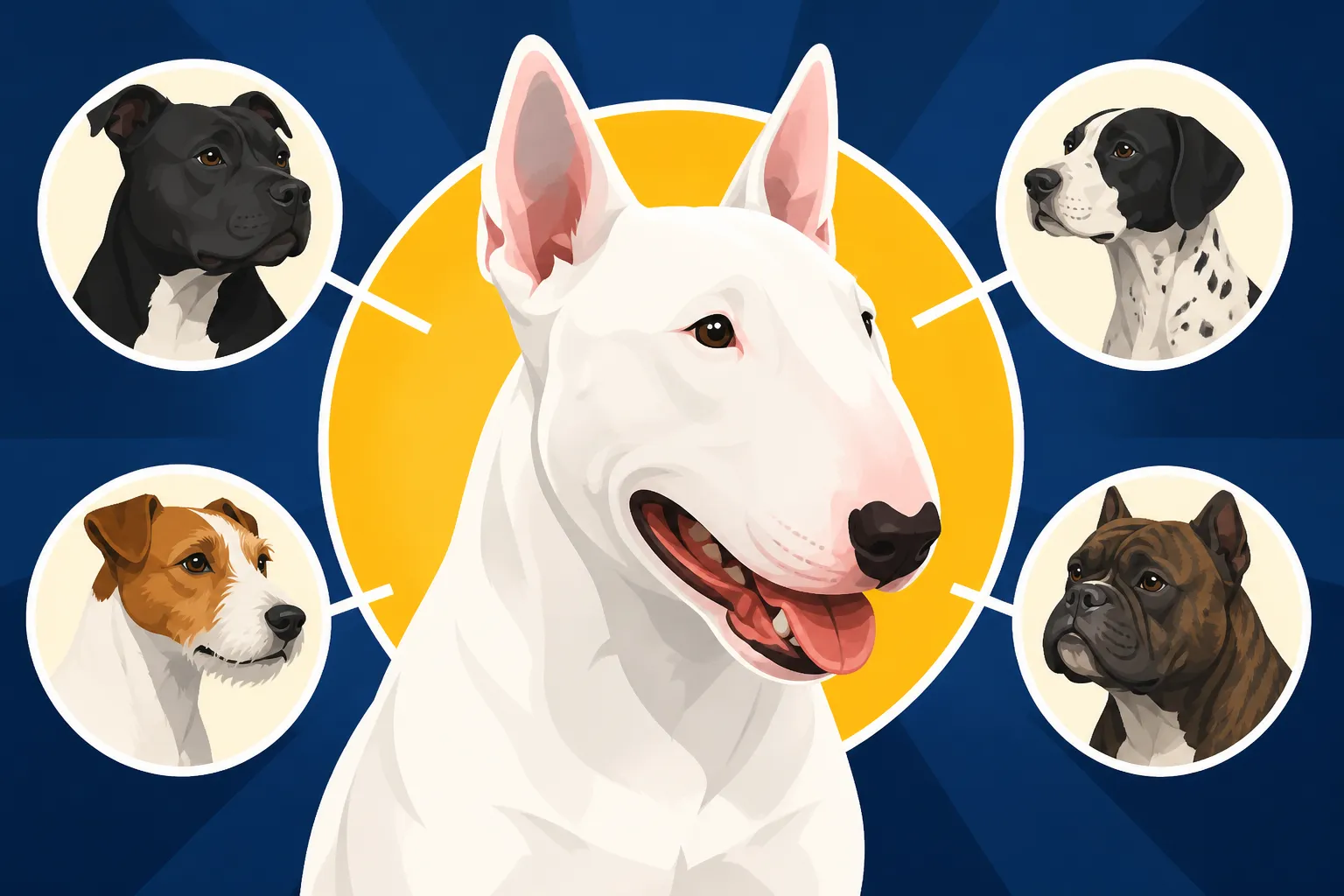
The combination of the Old English Bulldog's strength, the various terriers' gameness, the English White Terrier's refinement and pure white coat, and the possible infusions of Dalmatian elegance and Greyhound grace resulted in a truly one-of-a-kind breed. It's a testament to Hinks' vision and the complex tapestry of genetic contributions that shaped the Bull Terrier into the dog we adore. When you see a Bull Terrier gracefully navigate a dog park or elegantly sprawl on your Which Bed Survives a Bull Terrier, remember the diverse influences that converged to create such a magnificent animal.
The Evolution of the Colored Bull Terrier
For many years, the pure white Bull Terrier, Hinks' "White Cavalier," reigned supreme. It was the epitome of the breed standard, and colored Bull Terriers were often considered inferior or undesirable. However, genetic realities and the desire for greater genetic diversity eventually led to the reintroduction and acceptance of colored Bull Terriers, marking another significant chapter in the breed's history. This shift was not without its battles, but ultimately it broadened the breed's genetic base and enriched its variety.
The initial prejudice against color was deeply rooted in Hinks' original vision for the White Cavalier. Breeders striving for perfection often focused exclusively on white dogs. Yet, the recessive genes for color never truly disappeared from the breed's lineage, even in the purest white lines. Eventually, pragmatic breeders recognized the need to incorporate color back into the breeding pool, not just for aesthetics, but for genetic health and robustness.
The Reintroduction of Color
The resurgence of colored Bull Terriers can be attributed to several factors, including the recognition of health issues associated with intense line breeding for white coats, particularly deafness. While the exact timeline varies depending on who you ask, it was in the late 19th and early 20th centuries that dedicated breeders began to actively campaign for the acceptance of colored varieties. These breeders understood that a wider genetic pool was essential for the long-term health and vitality of the breed.
The most common colors introduced were brindle, red, black, and tricolor (black, white, and tan). These colors were likely present in the various "Bull and Terrier" ancestors before Hinks began his white breeding program. By reintroducing these colors, breeders were essentially tapping back into the original genetic diversity that had been set aside for aesthetic purity. This decision helped to fortify the breed, allowing for healthier genetic combinations and reducing the prevalence of certain issues.
Key Figures in Colored Bull Terrier Development
While James Hinks is the undisputed father of the white Bull Terrier, other breeders played pivotal roles in establishing and championing the colored varieties. Figures like Ted Lyon were instrumental in demonstrating the quality and beauty of colored Bull Terriers, challenging the prevailing notion that only white dogs were truly representative of the breed. These dedicated individuals often faced resistance from those who held onto the "White Cavalier" ideal, but their perseverance ultimately paid off.
They meticulously bred and exhibited colored Bull Terriers, proving that these dogs possessed all the desirable traits—courage, temperament, and conformation—that were prized in their white counterparts. Their efforts eventually led to the official recognition of colored Bull Terriers by various kennel clubs, allowing them to compete in dog shows and be integrated fully into the breed standard. This was a slow process, but a crucial one for the breed's future.
Modern Bull Terrier Standards
Today, both white and colored Bull Terriers are equally recognized and celebrated. The breed standard makes allowances for various colors, including white, brindle, red, fawn, and tricolor, with specific guidelines on markings and pigment. The distinct egg-shaped head and muscular build remain paramount, regardless of coat color. This acceptance has allowed breeders to focus on overall health, temperament, and conformation, rather than being confined to a single coat color.
When you're looking for a Bull Terrier, whether you prefer a striking white or a vibrant brindle, you're embracing the rich tapestry of its history. From the gritty strength of the Old English Bulldog to the agile fire of early terriers, the elegant refinement of the English White Terrier, and the possible grace of Dalmatians and Greyhounds, the Bull Terrier is a composite of powerful and purposeful ancestors. This complex heritage is what makes them such fascinating, resilient, and utterly unique companions. For everything from food to toys, you'll find a wide range of products for all Bull Terrier colors and sizes on sites like Chewy.
Here's a quick overview of the main ancestral influences:
| Ancestral Breed | Primary Contribution | Key Physical Traits (Passed Down) | Behavioral Traits (Passed Down) |
|---|---|---|---|
| Old English Bulldog | Strength, power, tenacity, tenacious grip | Muscular build, powerful jaws, deep chest | Courage, determination, stoicism |
| Various Terriers (Early) | Agility, speed, gameness, "fire" | Quick, athletic build, keen expression | Intelligence, independent, energetic, feisty |
| English White Terrier | Refinement, pure white coat | Sleek lines, elegant head, all-white coloration | (Introduced genetic predisposition to deafness) |
| Dalmatian (Speculative) | Refinement of head shape, clean body lines | Smooth "Roman finish" head, athletic physique | Grace, endurance |
| Greyhound (Speculative) | Elegance, athleticism, speed | Longer legs, refined silhouette, graceful movement | Agility, speed, sometimes a chase drive |
This diverse genetic background is what makes your Bull Terrier truly special. It's a living piece of history, carrying the traits of courageous bulldogs, spirited terriers, and elegant sighthounds, all wrapped up in that famously unique, egg-shaped package. And for their unique dietary needs, especially if they have sensitivities, you might find specific food options or supplements available at online retailers like Chewy.
Understanding the Bull Terrier's Genetic Makeup
The journey to understand Which Breeds Went Into the Bull Terrier is more than just a historical exercise; it's crucial for any Bull Terrier owner to grasp the fundamental genetic makeup of their beloved pet. The combination of these diverse ancestors has given the Bull Terrier not only its distinctive look but also its specific health predispositions and behavioral tendencies. Knowing this heritage helps owners anticipate potential issues and provide the best possible care, fostering a deeper bond rooted in understanding.
Think about it: a dog bred from powerful, tenacious bulldogs and quick, feisty terriers isn't going to be a docile couch potato. They're going to have energy, a strong will, and a playful, sometimes boisterous, nature. Similarly, the drive for a pure white coat, while aesthetically pleasing, left a legacy of health concerns that responsible owners must be aware of. Embracing this full picture allows us to appreciate the Bull Terrier for what it truly is—a complex, resilient, and utterly charming creature shaped by centuries of selective breeding.
The Impact on Health and Temperament
The genetic cocktail that formed the Bull Terrier has a direct bearing on its health and temperament. From the Old English Bulldog, they inherited a robust constitution and immense physical strength, but perhaps also a predisposition to certain joint issues in later life or specific cardiac conditions like What Aortic Stenosis Does to a Bull Terrier. From the terriers, they gained intelligence and gameness, but also a strong prey drive and an independent streak that can sometimes lead to stubbornness in training. The push for the white coat, as we discussed, brought with it the risk of deafness, making How Many White Bull Terriers Are Born Deaf a significant concern for the breed.
Understanding these inherited traits is the first step in responsible Bull Terrier ownership. It means being proactive about health screenings, recognizing the signs of potential issues, and tailoring training methods to suit their intelligent, often strong-willed, personality. For example, if you know your Bull Terrier has a strong prey drive from its terrier ancestors, you'll be extra vigilant on walks and perhaps choose a secure, escape-proof harness. Recognizing their origins helps you work with their innate nature, rather than against it.
The Role of Selective Breeding in Shaping Traits
The Bull Terrier breed as we know it today is a prime example of how intensive selective breeding can shape and refine specific traits over generations. James Hinks wasn't just randomly crossing dogs; he had a clear vision and meticulously selected individuals that moved him closer to that goal. He consciously bred for the egg-shaped head, the triangular eye, and a specific temperament, amplifying desirable characteristics and attempting to minimize undesirable ones. This intentional design transformed a functional type into a recognized breed with a distinct identity.
However, selective breeding is a double-edged sword. While it can fix desirable traits, it can also inadvertently concentrate genes for health problems, or narrow the gene pool to a point where the breed becomes less robust. The Bull Terrier's history, particularly the focus on pure white, demonstrates this vividly. Modern breeders strive for a balance, working to maintain the iconic Bull Terrier type while also prioritizing genetic health and diversity. This is why you'll often see breeders proudly sharing test results for things like kidney function and heart health.
Why Breed History Matters for Owners
Knowing the history of the Bull Terrier and the breeds that contributed to it isn't just for dog enthusiasts or historians; it's genuinely helpful for everyday owners. It provides context for your dog's quirks, its energy levels, its sometimes-strong opinions, and its incredible resilience. If your Bull Terrier is obsessed with chasing squirrels, it makes sense when you remember its terrier and sighthound ancestry. If it's incredibly loyal but also fiercely protective, you can trace that back to its bulldog guardians.
This historical understanding helps you connect with your dog on a deeper level, appreciating the centuries of development that led to the unique individual sharing your home. It also informs your decisions about training, socialization, and health care, making you a more informed and empathetic owner. When you choose a Bull Terrier, you're not just getting a pet; you're inviting a living piece of canine history, a "White Cavalier" with the heart of a bulldog and the spirit of a terrier, shaped by a fascinating and complex past. This background also helps you select appropriate food, such as a high-quality protein diet found on sites like Chewy, to fuel their active lifestyle.
Disclaimer
This article is for general informational purposes only and does not constitute professional advice. Laws, prices and regulations vary by location and change over time. Consult a qualified professional for guidance on your specific situation.