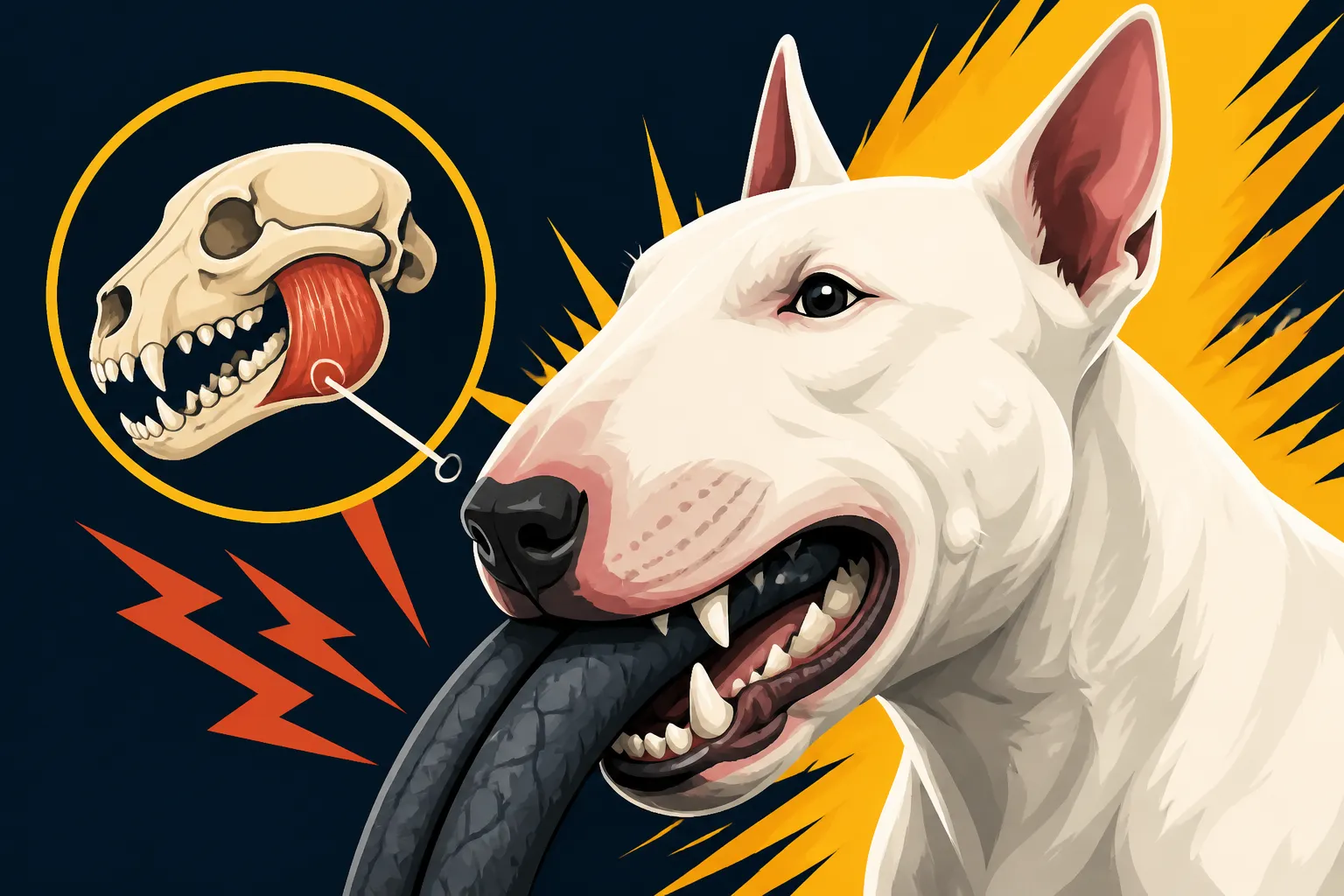
Why a Bull Terrier’s Jaw Is So Powerful
If you've ever owned a Bull Terrier, you know the struggle: a new "indestructible" toy bought yesterday is often in pieces by morning. This isn't just bad luck; it's a testament to the incredible power packed into that distinctive egg-shaped head. It can be frustrating and even expensive to manage, but understanding why their jaws are so powerful can help us better equip ourselves and our beloved companions. This guide will delve into the unique anatomy and history that gave the Bull Terrier its formidable bite and offer practical advice for living with such a strong chewer.
The Anatomy Behind the Bull Terrier's Formidable Bite
When you look at a Bull Terrier, the first thing that often catches your eye is that unmistakable head. It's a hallmark of the breed, a beautiful and powerful feature that sets them apart. But this isn't just for show; it's a masterpiece of engineering designed for incredible jaw strength. Every curve and angle of that head contributes to the remarkable power behind their bite, allowing them to exert immense pressure. It's truly a marvel of canine evolution and selective breeding.
Skull Shape and Muscle Attachment
The Bull Terrier's egg-shaped head, often described as having a "Roman finish" or "downface," isn't just aesthetically unique; it's a functional design. Unlike many other breeds that have a distinct "stop" (the indentation between the eyes where the muzzle meets the forehead), the Bull Terrier's skull flows smoothly from the top of the head to the tip of the nose. This continuous, arched profile isn't just for good looks; it's structurally superior for housing powerful musculature.
Think of it like a perfectly designed leverage system. The broad, deep skull provides an expansive surface area for the attachment of the temporalis and masseter muscles – the primary muscles responsible for jaw closure and chewing. Because there's no abrupt stop, these muscles can extend further and attach more robustly, creating a more efficient and powerful contraction. This means more force can be generated with less effort. When you consider How a Bull Terrier's Skull Is Filled Out, it becomes clear that every bit of that unique cranial structure is geared towards strength. This dense bone structure and ample muscle attachment give the Bull Terrier a mechanical advantage, allowing them to crush and grip with surprising force. It’s why even casual play can feel like a feat of strength against their powerful bite.
Tooth Structure and Jaw Alignment
Beyond the muscles and skull, the Bull Terrier's teeth themselves are perfectly suited for their powerful jaws. They boast a full complement of 42 teeth, which is standard for dogs, but it's their placement and strength that truly stand out. Their teeth are large, strong, and deeply rooted, designed for grasping, tearing, and grinding. They typically have a "scissor bite," where the upper incisors slightly overlap the lower incisors, providing a clean, efficient cutting action. This alignment isn't just for aesthetics; it ensures that the teeth meet perfectly, distributing pressure evenly across the chewing surface and maximizing the force applied.
This robust dental arrangement, combined with the immense muscle power, means a Bull Terrier can exert incredible pressure when they clamp down. It's not just a matter of size; it's about the synergistic interaction of skull, muscle, and tooth. When a Bull Terrier chews, they're not just nibbling; they're engaging a finely tuned machine built for serious work. This is why even a casual chew can leave its mark on furniture or an unsuspecting toy. Their teeth are designed to withstand significant stress, meaning they can tackle tough chews that other breeds wouldn't even consider.
The Heritage of Strength: Breeding for a Purpose
To truly understand why the Bull Terrier possesses such a powerful jaw, we need to take a step back in time and explore its origins. Breeds aren't created in a vacuum; they are meticulously developed to fulfill specific roles, and the Bull Terrier's role certainly called for exceptional strength and tenacity. Their entire physical makeup, including that mighty jaw, is a direct result of the intentions of their early breeders.
From Bull and Terrier to White Cavalier
The Bull Terrier descends from the "bull and terrier" types of the 19th century, which were bred for sports like bull-baiting and dog fighting. These early dogs were a cross between Old English Bulldogs and various terriers, combining the bulldog's strength, tenacity, and powerful bite with the terrier's agility and gameness. While these "sports" are thankfully long gone, the physical traits that made these dogs excel at them were deeply ingrained. The ability to hold on tightly, to grip and shake, was paramount, and a powerful jaw was absolutely essential for survival in such brutal contests.
James Hinks, the father of the modern Bull Terrier, refined these early types into the elegant "White Cavalier" we know today. His vision was to create a gentleman's companion – a dog with courage, athleticism, and a striking appearance, but without the aggressive tendencies towards other dogs that were prevalent in its ancestors. However, while Hinks softened the temperament and refined the appearance, he didn't breed out the underlying physical strength. The powerful jaw remained a testament to its heritage, an intrinsic part of its robust constitution, even if the purpose for that power had shifted from fighting to companionship and sport. The physical attributes that enabled those early dogs to survive demanding tasks were simply too effective to be discarded entirely.
The Evolution of the Jaw for Purpose
Even as the Bull Terrier transitioned from fighting pits to show rings and family homes, the powerful jaw remained a key characteristic. Breeders continued to select for individuals with strong, well-muscled jaws and that distinctive head shape. It wasn't just about preserving the look; it was about maintaining the breed's overall robustness and capacity for work, even if that work became more about retrieving balls or excelling in canine sports.
The jaw's strength is a legacy, a living reminder of the breed's origins. While modern Bull Terriers are loving, comical, and devoted family members, they still carry the physical traits that once made them formidable. This means that a Bull Terrier's jaw isn't just strong by accident; it's strong by design, reinforced over generations of selective breeding. It's a fascinating example of how physical traits, once bred for a specific (and now outdated) purpose, can persist and become defining features of a beloved breed. This deep-seated strength is why new owners often find themselves surprised by the sheer chewing power their Bull Terrier possesses.
Living with a Power Chewer: Practical Implications for Owners
Understanding the "why" behind your Bull Terrier's powerful jaw is the first step; the next is learning how to live with it. This strength, while impressive, can pose challenges, especially when it comes to keeping your home intact and your dog safe and entertained. It's a daily management task, but one that is absolutely essential for a happy household.
Choosing Durable Toys and Chews
This is where the rubber meets the road for Bull Terrier owners. That "indestructible" claim on a toy often stands no chance against a determined Bull Terrier. They don't just chew; they dissect, deconstruct, and devour. This means you need to be incredibly selective with what you offer them. Fragile toys are not just a waste of money; they can be a serious choking hazard or cause internal obstructions if pieces are swallowed.
Look for toys specifically marketed for "power chewers" or "extreme chewers." Materials like natural rubber (not cheap plastic), densely woven rope, or hardened nylon are often your best bet. Some brands, like KONG, offer ultra-durable options, and many online retailers like Chewy or Amazon have entire sections dedicated to these types of products. Even with these, supervision is key, especially when a toy is new. Over time, you'll learn what your individual Bull Terrier can and cannot destroy safely. For example, solid rubber balls tend to fare better than hollow ones, and extra-thick rope toys last longer than standard ones.
Here's a quick comparison of toy types and their typical lifespan with a Bull Terrier:
| Toy Type | Durability Level | Common Lifespan (approx.) | Potential Hazards |
|---|---|---|---|
| Standard Plush Toy | Low | Minutes to hours | Ingestion of stuffing/fabric |
| Thin Rubber Chew Toy | Low-Medium | Hours to a day | Swallowing small pieces |
| Rope Toy (standard weave) | Medium | Days to a week | Ingestion of strands/frayed pieces |
| Hard Nylon Chew (e.g., Nylabone) | High | Weeks to months | Sharp edges when worn down; tooth wear |
| Natural Rubber (e.g., KONG Extreme) | High-Extreme | Months to years | None, if appropriately sized |
| Solid Hard Plastic (e.g., benebone) | High | Weeks to months | Tooth fractures |
You’ll want to have a good rotation of toys, and always inspect them regularly for wear and tear. If a toy starts to break apart, it's time to replace it. For more specific guidance, check out articles like Which Chews Are Safe for a Bull Terrier and How Many Chews a Bull Terrier Needs a Week. Remember, a busy mouth is a happy Bull Terrier, and providing appropriate outlets for chewing is crucial for their mental and physical well-being.
Training and Management Strategies
While you can't reduce the physical power of their jaw, you can manage how and what your Bull Terrier chews. This comes down to consistent training and smart environmental management. Puppyhood is the ideal time to start teaching appropriate chewing habits. Provide plenty of suitable chew toys and redirect them immediately if they try to chew on furniture, shoes, or your hands. Teaching a Bull Terrier puppy to stop nipping is a critical early lesson.
Crate training is an invaluable tool, especially for younger Bull Terriers or when you can't directly supervise them. A sturdy, escape-proof crate can prevent them from destroying your home, as discussed in What a Bull Terrier Does to Drywall or Which Crate Holds a Bull Terrier. Consider a heavy-duty model, as standard wire crates often aren't enough to contain a determined Bull Terrier.
Mental stimulation is just as important as physical exercise. A bored Bull Terrier is often a destructive Bull Terrier. Puzzle toys, interactive feeders, and training sessions can help channel their energy and intelligence, reducing the likelihood of destructive chewing. Even short, engaging training sessions where they have to think can tire them out more effectively than a long, mindless walk. Remember, a Bull Terrier often "trains when it sees the point," so make those mental exercises rewarding and engaging.
Dental Health Considerations
The flip side of a powerful jaw is the potential for dental problems. While their teeth are robust, they aren't invincible. Aggressive chewing on overly hard objects can lead to fractured teeth, especially molars. This is a common issue for many power chewers. Bones, antlers, and very hard nylon chews, while popular, can pose a risk. If you hear a loud crunching sound as your dog chews, the object might be too hard.
Regular dental check-ups with your veterinarian are crucial. They can assess the health of your Bull Terrier's teeth and recommend appropriate dental care. Brushing your Bull Terrier's teeth at home is also beneficial for preventing plaque and tartar buildup, which can lead to more serious issues down the line. It's often easier said than done, but it's important! For more on this, check out Whether a Bull Terrier Needs Its Teeth Brushed.
Pay attention to any changes in your Bull Terrier's chewing habits, excessive drooling, or reluctance to eat. These could be signs of a dental issue. Addressing dental problems promptly is important not only for your dog's comfort but also for preventing more serious health complications. While their powerful jaws are a marvel, they require diligent care to ensure they remain healthy and pain-free throughout their lives. Despite their strength, Bull Terriers can still experience issues like any other dog, and sometimes, those powerful jaws are actually prone to chipping or breaking teeth on things like rocks or too-hard chews. Knowing How Often a Bull Terrier Breaks a Tooth can help owners choose safer options.
Disclaimer
This article is for general informational purposes only and does not constitute professional advice. Laws, prices and regulations vary by location and change over time. Consult a qualified professional for guidance on your specific situation.