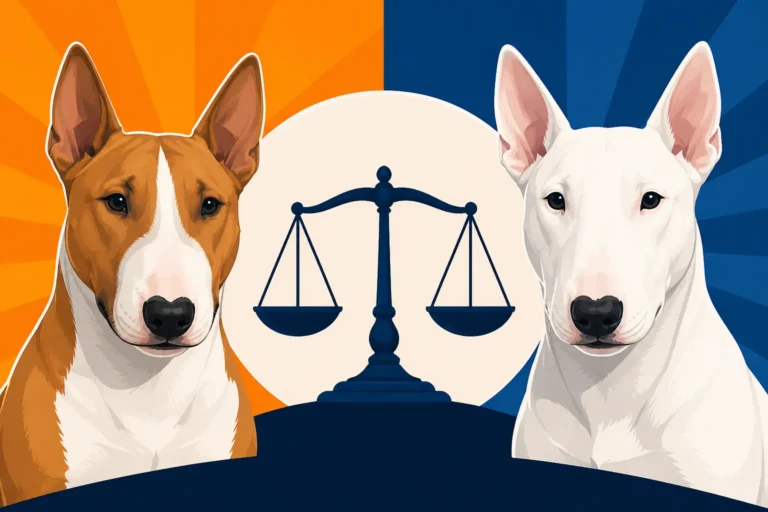
Whether a Blue Eyed Bull Terrier Can Be Shown
A Bull Terrier with blue eyes may be striking, but appearance and show eligibility are not the same thing. If you are hoping to enter a conformation show, the answer depends on the registry and its written breed standard. This guide explains the AKC rule, how other standards may differ, what to check before entering, and when an unusual eye color deserves a veterinary look.
Can a blue-eyed Bull Terrier enter a conformation show
The rule depends on the registry
For American Kennel Club conformation shows, the answer is no: the Bull Terrier breed standard lists blue or partly blue eyes as a disqualification. That means a dog with one blue eye, two blue eyes, or an eye with only part of the iris blue is not eligible to compete in AKC conformation, even if the rest of the dog closely matches the standard.
Rules are not necessarily identical across registries or countries. Another organization might treat blue eyes as a serious fault rather than an automatic disqualification, or it may use different wording in its standard. A fault and a disqualification are not interchangeable: a fault can lower a dog’s placement, while a disqualification generally removes the dog from competition under that organization’s rules.
If you plan to show outside the AKC, check the current standard and show regulations issued by the specific registry hosting the event. Do not rely on a general claim that “blue eyes are allowed” or “blue eyes are banned everywhere.” The written standard, event rules, and judge’s interpretation for that organization are what matter.
What “shown” means in this question
Conformation showing is the activity most directly affected by eye-color rules. In the ring, a judge evaluates how closely a dog fits the breed standard, including structure, movement, and features such as the Bull Terrier’s distinctive eye shape and color. You can read more about the breed feature itself in Why a Bull Terrier's Eye Is the Smallest of Any Breed.
A conformation disqualification does not automatically prevent a dog from taking part in every other dog activity. Obedience, scent work, agility, and other sports have their own eligibility rules, which may be different from conformation requirements. Check the rules for the particular event rather than assuming the eye-color clause applies to all activities.
It is also worth distinguishing show eligibility from registration. A dog may be registered with a kennel club and still be ineligible for a particular conformation class because of a disqualification. Registration records a dog in a registry; it does not guarantee that the dog meets every requirement for every competition.
How blue eyes are evaluated
Blue, partly blue, and unusual-looking eyes
When a standard names blue or partly blue eyes, the wording matters. A clearly blue iris is the most straightforward case. A patch or sector of blue within an otherwise dark iris may also fall under “partly blue,” depending on the registry’s rule. If the color is subtle, uneven, or difficult to judge in ordinary light, ask the show secretary or the relevant registry for guidance before entering.
Lighting can make dark eyes look lighter in photographs, and reflections can create a pale flash that is not the dog’s actual iris color. Check the eye in natural, indirect light rather than relying on a phone photo taken with flash. If you are uncertain whether the iris is blue, gray, or simply reflecting light, a veterinarian can help assess the eye’s appearance, while the show authority can clarify how it applies its standard.
Puppies’ eyes can look different as they develop, so avoid making a show decision from a very early photograph or a brief change in appearance. If your puppy’s eye color seems to be changing, ask your veterinarian whether the appearance is part of normal development or needs examination. The registry’s rules still determine show eligibility once the color can be assessed.
A quick comparison of show considerations
| Situation | What it may mean for conformation | What to do next |
|---|---|---|
| Clearly blue iris at an AKC conformation event | AKC standard lists blue eyes as a disqualification | Do not enter the dog in AKC conformation; check other activity rules separately |
| One eye is blue or an iris is partly blue | May fall under the standard’s blue or partly blue wording | Ask the registry or show secretary how the rule applies |
| Eyes look pale only in flash photographs | The image may not show the true iris color | Check in natural light and avoid judging from photos alone |
| Eye color changes suddenly or appears cloudy | This is a health concern, not just a show question | Contact a veterinarian promptly |
| Dog is excluded from conformation | Other activities may have separate requirements | Review the rules for the specific sport or event |
The table is a starting point, not a substitute for the written standard. If you have a dog on the edge of a rule, get a clear answer before paying entry fees or traveling to a show.
Eye color is not the same as eye health or hearing
When to ask a veterinarian about the eye
Blue coloring by itself does not tell you whether a Bull Terrier has an eye disease. But a sudden change in an adult dog’s eye appearance should not be treated as a breed-standard issue alone. Cloudiness, redness, swelling, squinting, excessive tearing, discharge, rubbing at the face, or apparent difficulty seeing are reasons to contact a veterinarian.
Some eye problems are painful or can worsen without timely attention. If the eye becomes cloudy quickly, the dog is holding it shut, or there has been an injury, seek veterinary advice promptly rather than waiting for a show appointment. A judge can assess show-standard features; a veterinarian is the right person to investigate discomfort or a change in vision.
For routine handling, keep the area around the eyes clean and avoid putting human eye drops or leftover prescription medication into the dog’s eye unless a veterinarian specifically directs you to do so. If you need to gather ordinary grooming supplies, a retailer such as Chewy may carry basic items, but products marketed for cleaning should not be used to treat redness, pain, or a sudden color change.
Blue eyes do not establish hearing status
Eye color and hearing are separate questions. A blue eye is not a hearing test, and you should not assume that a Bull Terrier with blue eyes is deaf—or that a dark-eyed dog can hear normally. Hearing can only be assessed appropriately through a veterinary evaluation and, when indicated, a BAER test.
This distinction is particularly useful for owners of white Bull Terriers, because coat pigmentation and hereditary deafness are relevant health topics in the breed. Learn what the test measures in What a BAER Test Tells a Bull Terrier Owner and why screening may be important in Why a White Bull Terrier Should Be BAER Tested. The articles Whether Blue Eyes Occur in Bull Terriers and Whether a Colored Bull Terrier Is Safer From Deafness explore how eye color, coat color, and hearing should—and should not—be interpreted.
If a breeder tells you that eye color proves a puppy’s hearing status, ask for documented test results instead. A puppy that responds to household noises may still have hearing loss in one ear, and everyday observation is not a substitute for a proper test. For background on coat patterns and accepted colors, see Which Colors a Bull Terrier Comes In.
What to check before entering a Bull Terrier
Confirm the rule and the dog’s appearance
Start by identifying the registry and event you want to enter. Read the current Bull Terrier standard and the event’s eligibility rules, paying close attention to whether blue or partly blue eyes are listed as a disqualification, a fault, or an undesirable feature. If the wording is unclear, contact the show secretary or registry with a concise description of the dog’s eye color.
Take clear, unfiltered photographs in even daylight if you need to explain the appearance, but do not treat a photograph as a formal ruling. A phone camera can distort color, especially around dark irises. If you have a puppy or an eye that looks different from one day to the next, arrange a veterinary check before drawing conclusions about color or show eligibility.
Then confirm that the dog meets the event’s other requirements. Eye color is only one part of conformation eligibility, and a dog’s registration, class, age, and other qualifications may also matter. If the dog is not eligible for conformation, ask whether another event at the same venue has rules that would allow participation.
Ask breeders for records, not assurances
If you are choosing a puppy and hope to show, discuss eye color and overall show prospects with the breeder before making a commitment. A responsible breeder should be willing to explain the written standard, describe what they can and cannot predict in a growing puppy, and provide relevant health records. For a wider checklist, see Whether a Bull Terrier Breeder Shows Both Parents and Whether a Bull Terrier Breeder Shows BAER Results.
Ask specifically what the breeder means by “show quality.” That phrase can refer to a breeder’s opinion about the puppy’s structure, temperament, or potential—not a guarantee that the dog will qualify under every show rule. If eye color is important to your plans, ask whether the puppy’s eyes have been assessed in natural light and whether there is any uncertainty as the dog matures.
A breeder’s honest answer may be that a puppy is promising but too young for a firm prediction. That is more useful than a promise of future show success. If your priority is companionship rather than conformation, a blue-eyed Bull Terrier can still be a much-loved family dog; the disqualification concerns a particular form of competition, not the dog’s worth or ability to bond with people.
For prospective owners comparing puppies, Which Health Tests a Bull Terrier Breeder Should Run offers a broader look at health screening. If you already have a dog and are preparing for an event, keep the registry’s written response, your dog’s registration documents, and any veterinary records together so you are not trying to sort everything out at the show entrance.
Disclaimer
This article is for general informational purposes only and does not constitute professional advice. Laws, prices and regulations vary by location and change over time. Consult a qualified professional for guidance on your specific situation.