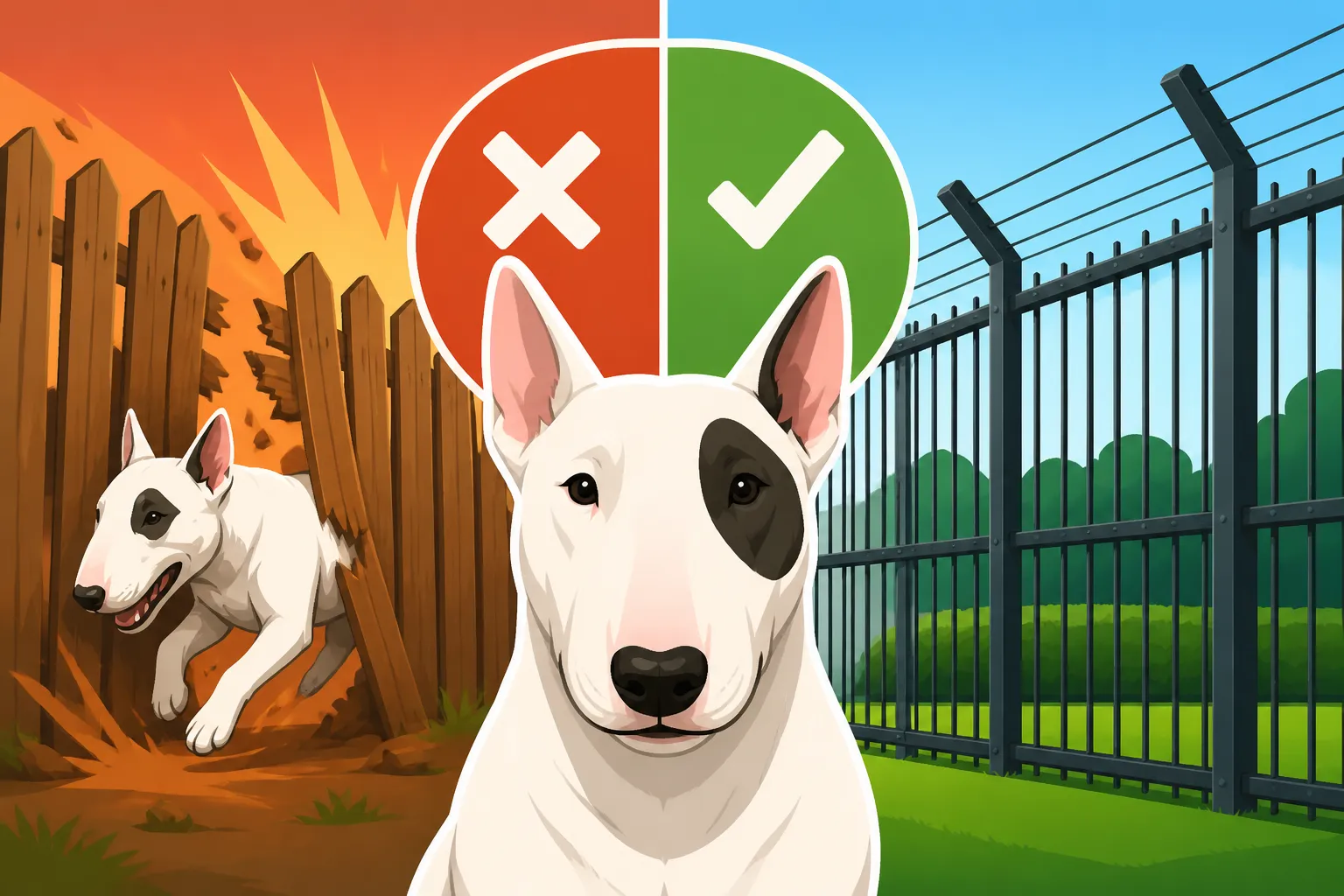
Whether a Bull Terrier Needs a Reinforced Fence
Oh, the age-old question that keeps many Bull Terrier owners up at night: "Is my fence really enough?" You've heard the stories, perhaps even lived a few yourself, of these determined, intelligent, and incredibly strong dogs finding every single weak point in what seemed like a perfectly secure perimeter. The truth is, a standard fence, the kind that might hold a Golden Retriever or a fluffy Maltese, is often just an invitation to adventure for a Bull Terrier. This guide is here to walk you through exactly why your Bull Terrier might be eyeing the horizon, and what you can do to build a truly escape-proof fortress that offers you peace of mind.
The Bull Terrier's Ingenuity and Drive: Why Standard Fences Don't Cut It
Let's be honest, Bull Terriers are not your average dog. They're a unique blend of clownish charm, unwavering loyalty, and an almost superhuman level of tenacity. This combination, while endearing in many ways, means they approach a fence not as a barrier, but as a puzzle or a challenge. It's a fundamental difference in mindset that owners often underestimate until their beloved bully is halfway down the street with a triumphant gleam in their eye.
The Master Diggers and Climbers
You might think a six-foot fence is tall enough, or that a few inches of buried chicken wire will deter even the most dedicated excavation artist. And then you get a Bull Terrier. These dogs possess incredible physical capabilities. Their powerful, muscular bodies are built for strength and agility, and they don't shy away from using every ounce of it to achieve their goals.
When it comes to digging, they are relentless. A Bull Terrier can excavate a surprising amount of earth in a very short time, especially if motivated by something on the other side. They're not just idly scratching; they are purposeful, determined diggers who understand leverage and how to shift dirt efficiently. I've seen Bull Terriers dig tunnels that look like they belong in a cartoon, disappearing completely beneath the fence line in minutes. It's not just the depth; it's the speed and persistence. As for climbing, while they might not scale a chain-link fence like a cat, they can often find footholds on wooden fences, climb over lower sections, or simply jump surprisingly high from a standing start if they have enough motivation. Any slightly unstable board, any gap they can exploit, becomes a ladder or a launching pad.
Boredom and the Call of Adventure
A truly secure fence isn't just about physical barriers; it's about understanding the psychological drivers behind an escape attempt. For a Bull Terrier, boredom is a profound motivator. These are intelligent dogs with a zest for life and an insatiable curiosity. If they are left alone in a yard with nothing to do, no stimulating toys, no human interaction, and no job, they will create their own entertainment. And often, that entertainment involves exploring what' lies beyond the familiar confines of their yard.
It's not malice; it's simply a Bull Terrier's way of saying, "I'm bored! There must be something more exciting out there!" A perfectly secure fence for a bored Bull Terrier is still just a puzzle waiting to be solved. They might start by sniffing, then pawing, then gently testing a weak spot, and before you know it, they've figured out the exact angle to push a board loose or the ideal spot to dig under. This is why addressing their mental stimulation is just as critical as the physical barrier. Ignoring this aspect often leads to frustrating and repeated escapes, no matter how robust your fence seems. If you've ever wondered What a Bull Terrier Does When It Is Bored, you'll quickly learn that inventing an escape route is high on their list.
Prey Drive and the Great Escape
Beyond boredom, there's another primal instinct that can send your Bull Terrier over, under, or through a fence: prey drive. Bull Terriers, like many terrier breeds, possess a strong instinct to chase and capture. A squirrel scampering across the neighbor's yard, a rabbit darting through the bushes, or even a leaf blowing just right can trigger that hard-wired response. In that moment, the fence becomes irrelevant. The urge to pursue is overwhelming, and they will throw every ounce of their considerable strength and determination into overcoming the barrier between them and their quarry.
This isn't a conscious decision to be "bad"; it's an instinctual response that bypasses rational thought. Even if your Bull Terrier is usually well-behaved and never attempts an escape, a strong enough stimulus can change everything. Imagine a Bull Terrier locked onto the scent of a critter, digging furiously at the base of your fence. They're not thinking about coming home later; they're thinking about the chase. This powerful drive is a critical factor to consider when designing your fence, as it means the barrier needs to be strong enough to withstand an animal utterly committed to breaching it. Their focus can be so intense that they ignore pain or discomfort if it means getting to the other side. You can explore How Strong a Bull Terrier's Prey Drive Is to understand just how powerful this instinct can be.
What a Reinforced Fence Actually Looks Like for a Bull Terrier
So, given their unique talents for escape, what does a truly reinforced fence look like for a Bull Terrier? It's more than just height; it's a multi-faceted approach that considers their digging, climbing, and pushing capabilities, leaving no stone unturned (or un-dug!).
The Digging Deterrent
This is often the first line of defense that fails with a Bull Terrier. A fence that simply ends at ground level is an open invitation. To truly deter a determined digger, you need to go deep.
- Burying the Fence Line: One of the most effective methods is to bury the fence material itself. This means extending the fence panels or mesh at least 12-18 inches below the surface. This can be achieved by digging a trench along the entire perimeter and setting the fence posts and panels into it before backfilling with concrete or tightly packed soil.
- L-Footer or Concrete Skirt: An "L-footer" is a fantastic solution. This involves burying mesh (heavy gauge wire or chain link) horizontally, extending inward from the bottom of the fence for about 18-24 inches. When your Bull Terrier starts to dig at the fence line, they quickly encounter this buried mesh, which discourages further digging. For an even more permanent solution, a concrete skirt poured along the inside base of the fence acts as an impenetrable barrier. This not only stops digging but can also add stability to the fence itself. It’s an upfront investment, but the peace of mind is priceless.
- Rock or Stone Borders: If a full concrete skirt isn't feasible, creating a deep trench filled with large, immovable rocks or stones directly along the fence line can also be effective. The uneven, heavy nature of the rocks makes digging uncomfortable and difficult for their paws and noses. The goal is to make any attempt to dig a frustrating and ultimately futile endeavor for your Bull Terrier.
Height and Anti-Climb Measures
Don't underestimate a Bull Terrier's vertical aspirations. While they might not be traditional "jumpers" like some agility breeds, they can certainly clear a surprising height, especially with momentum or a foothold.
- Minimum Height: For a Bull Terrier, a minimum fence height of six feet is generally recommended. Even better, consider eight feet if you have a particularly athletic or determined individual. Remember, they are often nicknamed "three-year-olds in a dog suits" for a reason – they have boundless energy and a clever mind that sees opportunities.
- Smooth Surfaces: Wooden privacy fences or solid vinyl fences are generally harder to climb than chain link because they offer fewer footholds. If you have chain link, consider adding smooth, vertical panels of wood or metal to the top section to eliminate climbing points.
- Leaning Inwards: For some extremely determined climbers, a fence extender that angles inward at the top can be very effective. This creates an overhang that makes it physically impossible for them to get a grip to pull themselves over. Think of it like a cat fence, but scaled for Bull Terrier strength. This might sound extreme, but for a known escape artist, it's a game-changer.
- Reinforced Weak Points: Pay close attention to corners, where they might get a better purchase for climbing, and any areas where shrubs or landscaping might provide a boost. Clear these areas to remove any natural stepping stones.
Secure Gates and Latches
A fence is only as strong as its weakest point, and often, that point is the gate. Bull Terriers are incredibly clever with latches and handles. I've known more than one Bull Terrier who learned to operate a standard gate latch by watching their humans.
- Double Latching System: Install a double-latching system. This means two separate latches that require different actions to open, making it much harder for a clever paw or nose to manipulate.
- Padlocks or Carabiners: For extra security, especially if your Bull Terrier is a known escape artist, consider using a padlock or heavy-duty carabiner on the gate when you're not actively using it. It's a small extra step that can make a huge difference.
- Gate Material and Gaps: Ensure the gate material is as robust as the rest of the fence, and that there are no gaps where the gate meets the posts or the ground. A Bull Terrier will test every small opening. Just a few inches of clearance under the gate can become a prime digging spot, so ensure any gaps are sealed, either by extending the gate lower or by adding a solid barrier at the base. Remember, you might think a small gap is fine, but your Bull Terrier sees it as an opportunity.
Here’s a quick overview of common escape methods and their reinforced solutions:
| Escape Method | Bull Terrier's Tactic | Reinforced Solution |
|---|---|---|
| Digging Under | Persistent excavation, tunneling, pushing dirt aside | Buried L-footer, concrete skirt, deep rock trench |
| Jumping Over | Vertical leap, using objects as boosts | Minimum 6-8 ft height, clear perimeter of boosting objects |
| Climbing Over | Finding footholds on chain link, pushing on loose boards | Smooth fence surfaces, inward-angling fence extenders |
| Opening Gates | Nudging latches, learning lever mechanisms | Double-latching systems, padlocks, no ground gaps |
| Pushing Through | Wedging body into gaps, exploiting weak panels | Strong, solid materials, reinforced posts, no loose boards |
Beyond the Fence: Layered Security and Management
Building an impenetrable fence is a fantastic start, but it's only one piece of the puzzle. For a Bull Terrier, true security and contentment come from a holistic approach that includes training, mental stimulation, and thoughtful supervision.
Training and Supervision: The Human Element
Even the most robust fence can be compromised by human error or a Bull Terrier's cunning. This is where consistent training and diligent supervision become paramount.
- Recall Training: A solid recall isn't just for off-leash parks; it's a lifesaver if your Bull Terrier does manage to get out. Practice it frequently in various environments, making coming back to you the most rewarding thing ever. Use high-value treats and enthusiastic praise. A Bull Terrier is smart enough to understand "what's in it for me," so make recall irresistible.
- Boundary Training: While not a substitute for a physical fence, teaching your Bull Terrier to respect invisible boundaries within the yard can be helpful. This involves positive reinforcement for staying within certain areas, especially near the fence line. It helps them understand that the fence itself isn't a plaything or a challenge.
- Active Supervision: Never leave your Bull Terrier unsupervised in the yard for extended periods, even with the best fence. Things can happen quickly. A new scent, a passing animal, or even a sudden noise could trigger an escape attempt you weren't there to prevent. Think of supervision as your last, best line of defense. When you're out there with them, you can interrupt any digging attempts, redirect their attention, and reinforce good behavior. Whether a Bull Terrier Can Be Left in a Yard at All is a question many owners ponder, and the answer is usually "with extreme caution and constant vigilance."
Enrichment and Exercise: Preventing the Desire to Escape
A tired Bull Terrier is generally a well-behaved Bull Terrier, and a mentally stimulated Bull Terrier is far less likely to be plotting its next great escape. Addressing their physical and mental needs is crucial in reducing the drive to breach your perimeter.
- Adequate Exercise: Bull Terriers need a surprising amount of exercise, both physical and mental. A long walk, a strenuous game of fetch, or a trip to a secure dog park can burn off that boundless energy that might otherwise be directed at your fence. Remember, a quick romp in the yard isn't always enough for these muscular athletes. Consider exploring How Much Exercise a Bull Terrier Actually Needs to tailor a routine that truly tires them out.
- Mental Stimulation: Puzzle toys, chew toys, and training sessions are vital. A Bull Terrier thrives on having a "job" or a challenge. Filling a Chewy Kong with peanut butter and freezing it can keep them occupied for a good while, distracting them from their fence-testing ambitions. Regular training sessions, even short ones, engage their minds and strengthen your bond, making them less likely to seek excitement elsewhere.
- Indoor Management: When you can't supervise them outside, ensure they are securely contained indoors. A heavy-duty crate, strong enough to hold a Bull Terrier, can be a lifesaver for those times you need to leave them alone. Learning Which Crate Holds a Bull Terrier is essential, as many standard crates won't withstand a determined bully. A high-quality food, like that offered by Ollie, can also contribute to overall health and contentment, indirectly influencing behavior by supporting a balanced system.
Technology and Other Aids: Extra Layers of Protection
While a physical fence and good management are primary, modern technology offers some excellent supplementary tools to enhance security.
- GPS Trackers: In the unfortunate event that your Bull Terrier does manage an escape, a GPS tracker attached to their collar can be invaluable for locating them quickly. These devices can give you real-time tracking, often with alerts if your dog leaves a designated "safe zone." This technology offers immense peace of mind, knowing that if the worst happens, you have a much better chance of a swift reunion.
- Outdoor Cameras: Installing outdoor security cameras, especially pointed at gates and known weak spots, allows you to monitor your Bull Terrier's behavior in the yard even when you're not physically present. You can catch digging attempts early, identify areas they are targeting, and quickly intervene if necessary. Some systems even offer two-way audio, allowing you to give a verbal correction from inside your home.
- Proper Identification: This seems basic, but it's critical. Ensure your Bull Terrier always wears a collar with up-to-date ID tags, and that they are microchipped with current registration information. If they do get out and are found by a kind stranger, proper identification is the quickest way for them to get home safely. Don't rely solely on a microchip; a collar tag is often the first thing people check.
The Cost of Security vs. The Cost of an Escape
When you start pricing out reinforced fencing, it can feel like a significant investment. But it’s crucial to view it not as an expense, but as an insurance policy against potentially far greater costs – both financial and emotional – if your Bull Terrier escapes.
Investing in Peace of Mind
The cost of a truly Bull Terrier-proof fence will vary widely based on materials, labor, and the size of your yard. Opting for features like buried L-footers, higher panels, and robust gate hardware certainly adds to the initial outlay. You might be looking at materials like heavy-gauge welded wire mesh, sturdy wood, or even specialty dog-proof fencing materials. Installation by a professional, especially for digging deterrents like concrete skirts, will also be a factor.
However, consider this: this is a one-time (or infrequent) investment that secures your property and, more importantly, keeps your beloved Bull Terrier safe. It mitigates the constant worry, the frantic searches, and the potential heart-wrenching scenarios that can arise from a successful escape. It's an investment in your peace of mind and your Bull Terrier's safety for years to come. Think about it in terms of their What a Bull Terrier Costs Over Its Lifetime—the fence is a critical part of ensuring that long, healthy life.
The Hidden Costs of a Lost or Injured Bull Terrier
The financial and emotional toll of a Bull Terrier escape can be staggering, making the cost of a reinforced fence seem quite reasonable in comparison.
- Veterinary Bills: If your Bull Terrier escapes, they could be hit by a car, get into a fight with another animal, ingest something toxic, or become injured from jumping or digging. Emergency vet visits can run into thousands of dollars, easily eclipsing the cost of preventive fencing. Having pet insurance from providers like Healthy Paws can certainly help with these unexpected costs, but even with insurance, there's often an deductible and the emotional strain of a critically injured pet.
- Fines and Legal Fees: Depending on local ordinances, you could face fines for having an at-large dog, especially if your Bull Terrier causes property damage or is involved in an incident with another animal or person. Repeated offenses can lead to higher fines, mandatory training, or even legal action.
- Impoundment Fees: If your Bull Terrier is picked up by animal control, you'll incur impoundment fees, daily boarding charges, and possibly additional fines before you can retrieve them.
- Search and Rescue Costs: While not always financial, the time and effort spent searching for a lost dog can be immense. Missing work, printing flyers, posting online, and the sheer emotional exhaustion are very real costs.
- Heartbreak: Above all, the emotional cost of a lost or injured Bull Terrier is immeasurable. The fear, guilt, and sadness of not knowing where your dog is, or seeing them hurt, is a burden no owner wants to bear. It’s a pain that can last a lifetime.
Ultimately, investing in a reinforced fence is a proactive step that protects your Bull Terrier, your community, and your wallet from the significant risks associated with an escape. It’s a testament to responsible Bull Terrier ownership and a commitment to their safety and well-being.
Disclaimer
This article is for general informational purposes only and does not constitute professional advice. Laws, prices and regulations vary by location and change over time. Consult a qualified professional for guidance on your specific situation.