The Age a Bull Terrier Puppy Can Be BAER Tested
Bringing home a Bull Terrier puppy is an absolute joy, but it also comes with a big responsibility: ensuring they're healthy and set up for the best possible life. One of the most heartbreaking issues a new owner can face is discovering their beloved puppy has a significant health problem that could have been detected earlier. For Bull Terriers, especially those stunning white ones, congenital deafness is a real concern. This comprehensive guide will walk you through everything you need to know about BAER testing, focusing on the crucial question of when your Bull Terrier puppy should be tested to identify any hearing issues early on.
Understanding the BAER Test for Bull Terriers
The world of dog health can be a minefield of acronyms and medical jargon, but understanding the BAER test is pretty straightforward once you break it down. It’s a vital tool for any responsible Bull Terrier owner or breeder.
What is BAER Testing and Why is it Crucial?
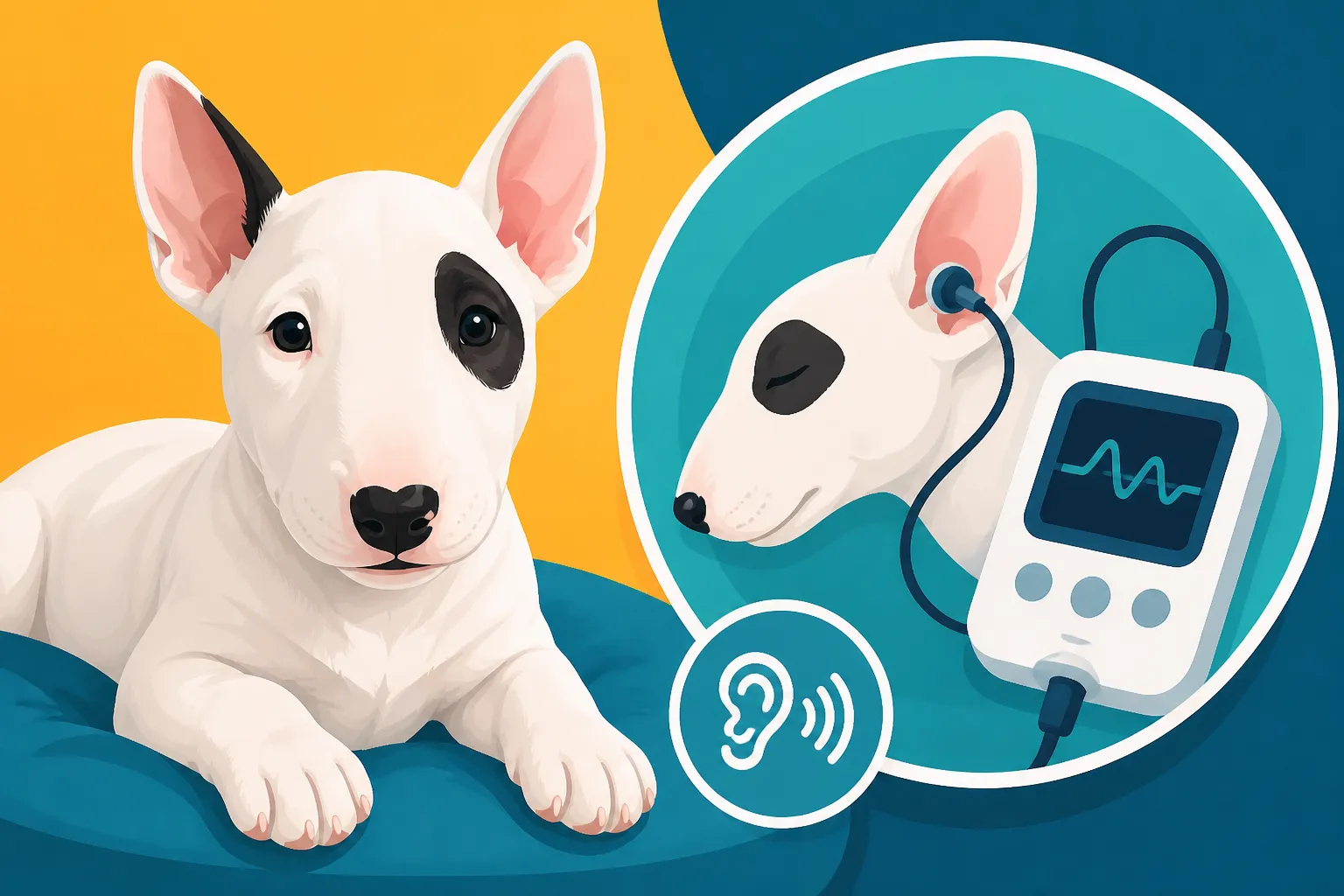
BAER stands for Brainstem Auditory Evoked Response. Essentially, it's an electrodiagnostic test that measures the electrical activity in the cochlea (inner ear) and auditory pathways in the brain in response to auditory stimuli. In simpler terms, it's an objective way to tell if your dog can hear. Tiny electrodes are placed on the puppy's head, and click sounds are played into each ear via headphones. A computer then records the brain's response. If there's no response from one side, that ear is deaf. If there's no response from either side, the puppy is bilaterally deaf.
For Bull Terriers, this test is particularly crucial because the breed has a genetically linked predisposition to deafness, especially in its white varieties. This isn't just about whether they'll respond to their name; deafness can significantly impact a dog's safety, training, and overall quality of life if not properly managed. Identifying it early means you can adjust your approach to training and ensure their environment is safe, preventing potential accidents or behavioral issues down the line. It's a proactive step that speaks volumes about responsible pet ownership. Many responsible breeders understand that Why a White Bull Terrier Should Be BAER Tested is not just a suggestion, but a necessity, especially when you consider How Many White Bull Terriers Are Born Deaf.
The Ideal Window for BAER Testing Puppies
So, when should your little egghead go in for this important check? The consensus among veterinary neurologists and breed health clubs is that Bull Terrier puppies should be BAER tested between six and eight weeks of age. This timeframe is absolutely critical for a few key reasons relating to their development.
Before six weeks, a puppy's ear canals might not be fully open, and their auditory pathways are still maturing. Testing too early could yield inaccurate results, indicating deafness where none exists simply because the system isn't yet ready to process sound effectively. Imagine trying to listen to a concert through a closed door – you wouldn't hear much!
On the other hand, waiting too long past eight weeks also has its drawbacks. By this point, puppies are often already going to their new homes. Discovering deafness after they've settled in can be an added stress for both the puppy and the new family. More importantly, early detection allows for early intervention. If a puppy is identified as deaf, the breeder and new owner can immediately begin implementing specialized training and socialization techniques tailored to their unique needs. It also helps with appropriate placement; a deaf puppy needs a specific kind of home environment, and knowing this upfront allows for a more careful selection process. It's truly what a BAER test tells a Bull Terrier owner (see What a BAER Test Tells a Bull Terrier Owner) when they consider bringing a new puppy into their home.
Preparing Your Bull Terrier Puppy for a BAER Test
Getting your puppy ready for any vet visit can feel like a mini-adventure, but preparing for a BAER test is usually quite straightforward. Knowing what to expect can ease your mind, and make the experience smoother for your furry friend.
What to Expect at the Vet or Specialist's Office
When you arrive for the BAER test, the veterinary staff, often a specialist in neurology or a veterinarian with specific training in BAER testing, will typically take your puppy into a quiet room. The goal is to minimize external noise and distractions to ensure the most accurate results possible.
First, a mild sedative is usually administered. This isn't to knock them out completely, but rather to keep them calm and still during the procedure. Puppies are naturally wiggly, and any movement can interfere with the delicate readings from the electrodes. The sedation is generally light and short-acting, meaning your puppy will be awake and alert again fairly quickly after the test.
Once sedated, small, needle-like electrodes (don't worry, they're tiny and cause minimal discomfort, similar to acupuncture needles) are placed just under the skin at specific points on the puppy's head – usually near each ear and on the top of the head. A small speaker or headphone device is then placed over or near each ear. Series of soft clicks are emitted, and the electrodes pick up the brain's response to these sounds. The whole process is usually quite quick, often lasting only 15-30 minutes, depending on how cooperative the puppy is. After the test, the electrodes are removed, and your puppy is allowed to wake up fully from the sedation under observation. It's a precise procedure, and understanding Where to Get a Bull Terrier BAER Tested usually means finding a facility equipped with specialized neurological equipment.
Interpreting the BAER Test Results
Once the test is complete, the veterinarian will analyze the waveforms generated by the equipment. This is where the crucial information comes to light.
There are generally three outcomes:
- Bilaterally Hearing: This is the best-case scenario. The waveforms show clear responses from both ears, indicating your Bull Terrier puppy has normal hearing in both ears. You'll get a certificate confirming this, often with the specific brainwave patterns documented.
- Unilaterally Deaf: In this case, one ear shows a clear response, while the other shows none. This means your puppy can hear out of one ear but is deaf in the other. This isn't always obvious to owners without testing, as the puppy often compensates remarkably well with their good ear. Many owners of unilaterally deaf dogs don't even realize their dog has a hearing deficit until much later in life, if ever. However, knowing this allows you to be mindful of which side to approach them from and how they might respond to sounds. It's good to know that Whether a Unilaterally Deaf Bull Terrier Lives Normally is a common question, and the answer is usually a resounding yes, with proper awareness.
- Bilaterally Deaf: This means neither ear produces a response, indicating the puppy is completely deaf. While this can sound daunting, it's not a death sentence for a Bull Terrier. It simply means a different approach to training and communication will be needed from day one.
The results are typically discussed with you immediately, and a formal certificate is provided. This certificate is incredibly valuable, especially if you're a breeder or if you plan to share your puppy's health status with future owners. It’s part of the comprehensive health picture, alongside other important screens like The Heart Murmur a Bull Terrier Puppy Should Be Checked For.
Living with a Deaf or Unilaterally Deaf Bull Terrier
Discovering your Bull Terrier puppy is deaf can be an emotional moment. It's natural to feel a mix of worry, sadness, and determination. But let me assure you, deaf Bull Terriers can lead incredibly rich, fulfilling lives, brimming with joy and typical Bull Terrier mischief! It simply requires a slightly different approach and a little extra patience and understanding from their human family.
Adapting Training and Communication for Hearing-Impaired Pups
The biggest adjustment for a deaf Bull Terrier, and for you as their owner, will be communication. Verbal cues are out, so you'll need to rely entirely on visual cues and physical sensations.
- Hand Signals are Your New Language: Start immediately. Teach all basic commands – sit, stay, come, down, wait – using clear, consistent hand signals. There are many resources online for common dog hand signals, or you can create your own. The key is consistency. Everyone in the household needs to use the same signals. Think of it like teaching a child sign language.
- Vibrating Collars: These can be invaluable for recall and getting your dog's attention, especially outdoors. They don't deliver a shock, just a gentle vibration. Pair the vibration with a "come" hand signal and a high-value treat from the very beginning. Your dog will learn that the vibration means to check in with you for good things. Brands like SportDOG and Dogtra offer reliable vibrating collar options that are highly effective when used correctly.
- Stomping for Attention: A gentle stomp on the floor can create vibrations that a deaf dog can feel, letting them know you're trying to get their attention if they're in the same room.
- Light Signals: A flashlight can be useful for getting their attention from a distance, particularly in low-light conditions. Again, pair the light flash with a positive reinforcement for checking in with you.
- Safety First, Always: A deaf dog cannot hear an approaching car, a shouted warning, or the doorbell. They should always be on a leash when outside a securely fenced area. Consider having them wear a collar or harness that clearly indicates "DEAF DOG" with embroidery or a tag. This alerts others to their special needs. You'll find that once they learn to communicate with you through visual cues, their focus on you can be even stronger than a hearing dog's. This is why Whether a Deaf Bull Terrier Should Be Placed in a Home is less about their disability and more about the owner's commitment to adapting.
The Emotional and Practical Considerations for Owners
It's completely normal to feel a range of emotions, from concern to frustration, especially during those early training days. But remember, your Bull Terrier doesn't see their deafness as a disability; it's simply their reality.
- Patience is a Virtue: Training a deaf dog requires extra patience and a keen eye for subtle body language. Celebrate every small victory! Your bond will deepen through this unique communication journey.
- Socialization is Still Key: Just like any Bull Terrier, a deaf one needs proper socialization. Introduce them to new sights, smells, people, and other well-mannered dogs in a controlled, safe manner. Because they can't hear, they might startle more easily, so always approach them gently and make your presence known visually before touching them.
- Advocacy: You might encounter people who are unfamiliar with deaf dogs. Be ready to politely educate them about your dog's needs and capabilities. Your Bull Terrier can be a wonderful ambassador for deaf dogs everywhere.
- Consider a Second Dog (Carefully): Some owners find that a hearing companion dog can act as an "ear" for their deaf Bull Terrier, alerting them to things like the doorbell or someone at the door. However, this decision should be made carefully, ensuring both dogs are well-matched in temperament and that the second dog doesn't become a crutch, but rather an enhancement to the deaf dog's life. Understanding Whether a Deaf Bull Terrier Should Be Bred is also an important ethical consideration for breeders.
Beyond the BAER Test: Ongoing Care and Support
The BAER test is a snapshot in time, a crucial early screening. But caring for a Bull Terrier, whether hearing or deaf, is a lifelong commitment that involves ongoing health monitoring, responsible breeding practices, and financial planning.
The Breeder's Role and Responsible Practices
A truly responsible Bull Terrier breeder goes above and beyond. They don't just breed for looks or temperament; they prioritize health. This means routinely performing all recommended health screenings on their breeding stock and puppies, including BAER testing.
- Transparency is Key: A reputable breeder will openly share the BAER test results for the entire litter, not just the puppy you're interested in. They should be able to provide paperwork from the veterinary specialist who performed the test. They understand that Which Health Tests a Bull Terrier Breeder Should Run extends far beyond just deafness.
- Education and Support: Good breeders are also educators. They will explain the implications of a deaf diagnosis and offer guidance and support to families adopting deaf puppies. They see it as their responsibility to ensure their puppies, regardless of hearing status, find loving, appropriate homes.
- Avoiding "Backyard Breeders": Be wary of breeders who claim their puppies "don't need" BAER testing, or who refuse to provide results. This is a massive red flag. Such breeders often prioritize profit over health and may be perpetuating genetic health issues in the breed. Always insist on seeing proof of BAER testing for your potential puppy. You can often tell a lot about a breeder by Whether a Bull Terrier Breeder Will Show BAER Results.
Financial Considerations and Insurance
While the BAER test itself is a relatively minor expense in the grand scheme of dog ownership, the long-term costs of caring for any dog, especially a purebred prone to certain health issues, can add up quickly.
- Cost of the Test: The cost of a BAER test can vary depending on your location and the veterinary clinic, but it typically ranges from $100 to $250 per puppy. This often includes the mild sedation required.
- Ongoing Veterinary Care: Bull Terriers, like all breeds, require regular veterinary check-ups, vaccinations, and parasite prevention. Beyond routine care, they can also be prone to other issues such as kidney disease (like Hereditary Nephritis Takes Bull Terriers in Their Prime) or skin problems (A Bull Terrier's Skin Is Its Weakest Point), which can incur significant costs.
- Pet Insurance: This is where a good pet insurance policy can be a lifesaver. Companies like Healthy Paws offer comprehensive coverage that can help offset unexpected veterinary bills, including those for congenital conditions (as long as they are not pre-existing conditions before you enroll). While BAER testing itself might not always be covered, identifying deafness early allows you to plan and ensure any related health issues down the line are covered. It’s always wise to research policies thoroughly to understand what they cover and what exclusions apply. An unexpected illness or injury can lead to bills reaching into the thousands, making insurance a valuable investment for peace of mind.
Being prepared, both emotionally and financially, is part and parcel of being a responsible Bull Terrier owner. The BAER test is an important first step in that journey, providing you with vital information to give your unique companion the very best life.
| Feature | Description | Ideal Age Range | Results | Importance for Bull Terriers |
|---|---|---|---|---|
| Test Name | Brainstem Auditory Evoked Response (BAER) | 6-8 weeks of age | Bilaterally Hearing, Unilaterally Deaf, Bilaterally Deaf | High, due to genetic predisposition to deafness |
| Purpose | Objectively measures electrical activity in auditory pathways to confirm hearing ability in each ear. | Before puppy placement | Provides definitive diagnosis for hearing loss in one or both ears. | Guides early training, management, and placement. |
| Procedure | Non-invasive (with mild sedation), uses electrodes and click sounds. | Ear canals fully open, neurological development sufficient. | Essential for responsible breeding and ownership decisions. | Reduces stress for new owners, ensures safe environment. |
| Cost | Typically $100-$250 (varies by clinic and location). | Critical for accurate and reliable results. | Allows for early adaptation of communication methods and safety protocols. | Promotes the health and well-being of the breed. |
Disclaimer
The information provided in this article is for general informational purposes only and is not intended as a substitute for professional veterinary advice. Always consult with a qualified veterinarian or veterinary specialist for any health concerns or before making any decisions about your pet's medical care.