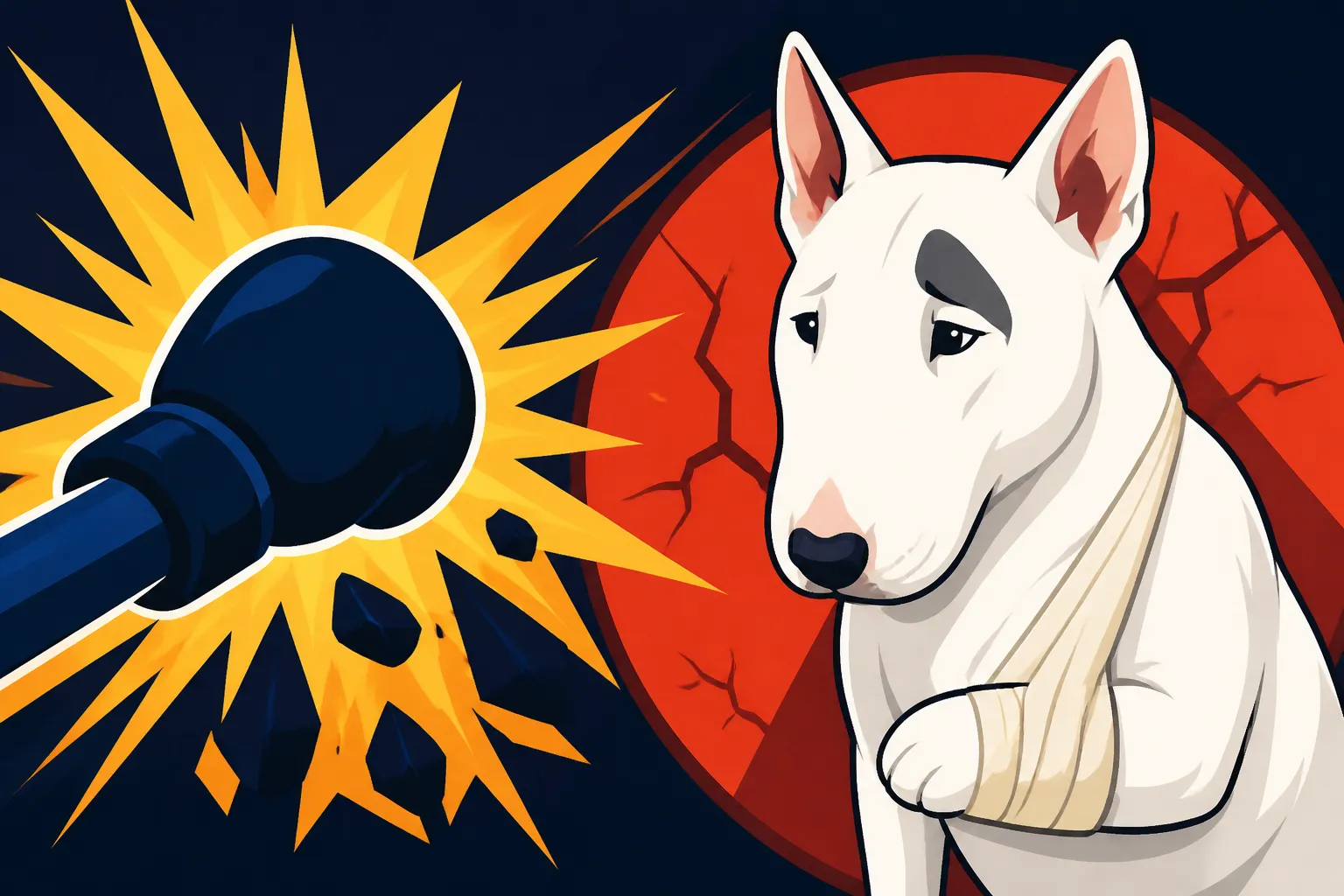
Whether the Boom Hurt the Bull Terrier
The Bull Terrier’s sudden visibility during the Spuds MacKenzie era brought attention, new admirers, and more demand for the breed. But popularity can be a rough bargain: when people buy a dog for its image without understanding its needs, dogs and owners can both pay for it. This guide looks at what the boom changed, what it didn’t, and how to separate lasting harm from myth.
What the Bull Terrier boom was
How Spuds MacKenzie put the breed in the spotlight
For many people, the Bull Terrier became instantly recognizable through Spuds MacKenzie, the energetic dog featured in Bud Light advertising. The campaign gave the breed a place in popular culture and made its distinctive head and confident expression familiar to people who might otherwise never have encountered one.
That kind of visibility can create a fast-moving wave of interest. Some viewers start wondering whether the dog they see on television would make a good companion at home. Others simply remember the breed as funny, bold, and attractive. When a breed becomes a cultural symbol, the image can travel much faster than accurate information about daily care, training, or temperament.
The phrase “Bull Terrier boom” is often used for this period of increased attention. It does not mean that every Bull Terrier was suddenly bred carelessly, or that all new owners were unprepared. It means that popularity rose around a memorable public image, creating pressure for more puppies and increasing the chance that some people would choose the breed for the wrong reasons. For more background on the advertising connection, see Whether Spuds MacKenzie Caused a Bull Terrier Boom.
Why a celebrity dog can change demand
A widely seen mascot can make a breed seem like a ready-made personality: fun, fearless, mischievous, and always entertaining. Those traits may be part of how people imagine Bull Terriers, but an advertising character is not a complete guide to living with an individual dog. A real Bull Terrier still needs daily exercise, patient training, boundaries, and close attention to its behavior.
This gap between image and reality matters. A person charmed by a dog’s comic antics may not anticipate the strength behind those antics, the need to prevent rough greetings, or the time involved in teaching good household manners. A family may picture a permanently amusing companion, then feel overwhelmed by a high-energy adolescent that needs structure and supervision.
Popularity is not automatically harmful. It can also bring more public interest in the breed and help responsible breeders find suitable homes. The trouble begins when demand rises faster than careful breeding and thoughtful ownership can support. A boom is best understood as a pressure test: it reveals what happens when a breed’s fame grows faster than public understanding.
How popularity can hurt a breed
More demand can reward careless breeding
When people want more puppies quickly, some sellers may prioritize volume or appearance over health, temperament, and careful placement. That risk is not unique to Bull Terriers. It can affect any breed that becomes fashionable, especially when buyers are drawn by a famous dog, a striking look, or the hope of getting a puppy immediately.
A responsible breeder should be willing to talk about health screening, the parents’ temperaments, the puppies’ early experiences, and what kind of home is a good fit. A buyer should have time to ask questions and consider the answers. If a seller focuses on urgency, guarantees an ideal personality, or has little interest in the buyer’s experience and plans, pause before committing. The basics in Whether Bull Terrier Breeders Are Hard to Find can help explain why finding the right breeder may take patience.
Careless breeding can leave puppies and their future families with difficult problems. Health concerns may be missed, and a puppy’s early environment may not prepare it well for ordinary life. These outcomes cannot be blamed on popularity alone, but rapid demand can make it easier for poor practices to succeed if buyers do not know what to look for.
A famous image can attract the wrong homes
The Bull Terrier’s clownish reputation can be appealing, but it may cause people to underestimate the work of raising one. A strong, exuberant dog can knock someone off balance, chew household items when under-stimulated, or struggle to settle if its needs are not being met. Those behaviors are not proof that the dog is “bad”; they are signs that the match, the training plan, or the daily routine may need attention.
There is also a difference between liking a breed and being ready for its needs. An owner who has time to train, provide enrichment, and manage interactions may enjoy the breed’s lively character. Someone who expects an easygoing dog that can entertain itself for long stretches may find the reality frustrating. A realistic look at What a Bull Terrier's Temperament Is Really Like can help potential owners think beyond the breed’s public image.
When a mismatch becomes too difficult, a dog may be rehomed. That can happen for many reasons, including changes in housing or family circumstances, not just poor preparation. Still, impulse purchases and unrealistic expectations can add to the number of dogs whose homes do not work out. This is why the question is less “Did popularity ruin the breed?” and more “Did popularity encourage people to choose without understanding?”
| What popularity can change | What it does not prove | What helps reduce the risk |
|---|---|---|
| Public awareness and demand for puppies | That every breeder became irresponsible | Research breeders and ask for clear health information |
| The number of people drawn to the breed’s appearance | That every new owner was unprepared | Learn about exercise, training, and management before choosing |
| The chance of impulse buying | That a dog’s behavior is caused by fame | Match the individual dog to the household |
| The pressure on rescue and rehoming networks | That every rehomed dog is difficult | Seek support early when challenges appear |
What changed and what stayed the same
Popularity did not create every breed challenge
Bull Terriers have needs and traits that existed before any advertising campaign made the breed famous. Their strength, energy, and individual differences still matter whether the dog comes from a famous bloodline, a careful breeder, or a rescue. It would be too simple to say the boom caused every later difficulty a Bull Terrier owner might encounter.
Likewise, a breed’s reputation can flatten a wide range of individual dogs into one stereotype. Some Bull Terriers are exceptionally outgoing; others are more reserved. Some are comfortable around other dogs, while others need careful management and distance. Owners should assess the dog in front of them rather than assuming that a shared breed name guarantees a shared personality.
The public image can also feed misunderstandings about the breed. People may confuse appearance with behavior or assume that a Bull Terrier is automatically dangerous, easy to handle, or suitable for any household. Learning about What People Get Wrong About the Bull Terrier helps put those assumptions in perspective. The dog’s actual upbringing, health, temperament, and environment matter.
Breed popularity does not explain restrictions or stigma by itself
A recognizable breed can draw more attention, both positive and negative. That visibility may make people more likely to notice a Bull Terrier in a news story or hear a strong opinion about “bully breeds.” But public attention alone does not explain local laws, housing rules, or how individual dogs are treated.
If you are considering a Bull Terrier, check the rules that apply where you live before bringing one home. Rental agreements, insurance policies, and local regulations may differ, and a dog’s breed or appearance can affect how a policy or rule is applied. For a starting point, read Whether a Bull Terrier Is Banned Anywhere, then confirm requirements with the relevant local authority or housing provider.
This practical check is not a judgment about the dog. It is a way to avoid a painful surprise after you have already formed a bond. A household that understands the dog’s needs and the rules around ownership is better positioned to provide a stable home.
How to make a better choice today
Look for preparation, not a fashionable pedigree
If you are buying a puppy, take time to examine the breeder’s process. Ask what health checks have been completed, what results are available, how the puppies are raised, and what support the breeder offers after the puppy goes home. Ask to learn about the parents’ behavior, too. A responsible breeder should welcome thoughtful questions rather than treating them as an inconvenience.
Do not make the decision based only on a puppy’s face, coat, or resemblance to a famous Bull Terrier. The right choice depends on whether the dog’s needs fit your home and whether you can provide steady training and care. If a litter is unavailable, waiting may be wiser than accepting a rushed alternative. You can also compare breeder and rescue options through Adopting a Bull Terrier From Rescue.
For a rescue dog, ask what is known about its background, health, behavior, and comfort around people and other animals. A rescue organization may not have every answer, especially if the dog was found as a stray or surrendered without a full history. That uncertainty is not a reason to dismiss the dog, but it is a reason to plan for a gradual transition and ask what support is available.
Plan for the ordinary work of ownership
Before bringing a Bull Terrier home, think through the regular, unglamorous parts of care: feeding, exercise, training, veterinary visits, enrichment, and supervision. A dependable routine can help a dog settle, while boredom and inconsistency can make household challenges harder to manage. For example, a young dog left with little to do may find its own entertainment in chewing, jumping, or pestering people.
A move to a new home can be stressful, so ask what food the dog has been eating and try to keep the transition predictable. If you need to obtain familiar food or routine supplies, a retailer such as Chewy is one option to consider; the important part is maintaining a suitable plan and checking any diet changes with your veterinarian. Buying supplies is not a substitute for time, training, or veterinary care.
If you adopt, make the first days quieter than you think they need to be. Let the dog rest, establish a simple routine, and introduce new people and places gradually. For ordinary supplies, including food and enrichment items, owners may compare local stores with retailers such as Chewy, while choosing products that suit the individual dog. If a transition raises questions about food, behavior, or health, ask the rescue organization or your veterinarian rather than guessing.
The boom may have increased pressure on the breed, especially where demand encouraged rushed decisions. But a wave of popularity does not determine every Bull Terrier’s future. Careful breeding, realistic expectations, responsible ownership, and supportive rescue work all matter more than the dog’s moment in the spotlight. If you are drawn to the breed, learn about the real dog—not just the famous one—and choose with enough patience to give that dog a stable home.
Disclaimer
This article is for general informational purposes only and does not constitute professional advice. Laws, prices and regulations vary by location and change over time. Consult a qualified professional for guidance on your specific situation.